“Cats” at Regent’s Park Open Air Theatre
Franco Milazzo in North London
★★★☆☆
9 August 2026
Regent’s Park Open Air Theatre is boldly billing this Cats as “London’s most anticipated musical”. That’s sheer chutzpah, given that artistic director Drew McOnie’s predecessor is drawing nightly ovations for another Andrew Lloyd Webber show just three miles down the road. Tim Sheader’s resurrected Jesus Christ Superstar is attracting mid-show standing ovations and marquee Herods at the Palladium nightly, before it walks – on tarmac now, not water – over to Drury Lane.

Photo credit: Mark Senior.
There’s a case, looking at recent history, that Webber’s back catalogue only thrives lately when someone takes a hatchet to it. Jamie Lloyd’s Sunset Boulevard cut songs, stripped the set and the glamorous costumes, and walked away with seven Oliviers and three Tonys. Its follow-up, Evita, shocked paying punters by sending Rachel Zegler out to sing “Don’t Cry for Me, Argentina” to the street rather than the stalls. On Broadway, Cats itself has already been reconceived as a queer ballroom event called The Jellicle Ball, voguing felines and all, while elsewhere in New York The Phantom of the Opera has closed and been succeeded by the Lloyd Webber-approved immersive experience Masquerade. McOnie knows this musical inside out, having acted in it before taking the helm, yet his Cats takes no such liberties. It is, book and score, pretty much the show that opened in 1981.
That fidelity is likely a contractual reality as much as an artistic one (one senses that Lloyd Webber and his lawyers would likely have conniptions if a note or lyric – from T.S. Eliot’s Old Possum’s Book of Practical Cats – moved in an unapproved manner). But it leaves McOnie only choreography and visual design to make his own; he delivers more on the first count than the second.
As both director and choreographer (and the first Regent’s Park AD to combine the two roles), he keeps the company in perpetual motion, the first half in particular danced-through as thoroughly as it’s sung-through. McOnie embellishes throughout with his signature styles – all street-inflected pops and sudden unison snaps – a prime example being Mr Mistoffelees breaking into full breakdance. It is the evening’s high-water mark for sheer physical audacity and, if there is something to be said for prioritizing magical motion over monotone monologues, McOnie says it well.
The one moment the score can’t survive on movement alone is Grizabella’s, and here the temporary absence of Rachael Wooding hands us a silver lining. With the credited Grizabella out, understudy Taziva-Faye Katsande takes “Memory” and doesn’t so much rise to the occasion as annex it, testing the venue’s PA with top notes that earn every second of the standing ovation the number always fishes for.
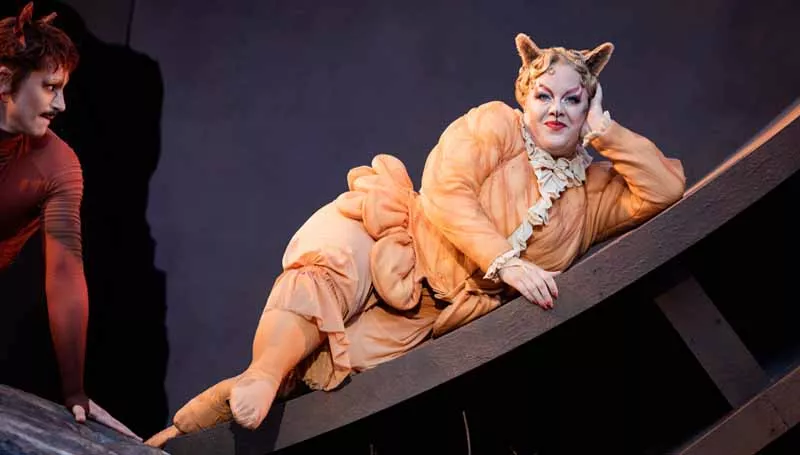
Design is where the goodwill runs out. Sami Fendall ditches the traditional oversized junkyard – its bins, boots, and abandoned shoes scaled up so the cats read as genuinely small – swapping it for a set of immense, bare crescents presumably meant to evoke the Jellicle moon. With that moon hanging directly behind everything else, though, the effect is less lunar and more like squinting down a telescope. Jessica Hung Han Yun’s lighting does the heavy lifting the set and writing won’t, shifting hue, timbre, and tone as the sky darkens and Gary Wilmot’s lovely, weathered Gus recounts Growltiger’s last stand in cinematic style; a steam engine on rollers and flames edging the set arrive late to remind us that, somewhere, someone allocated a design budget.
Frankly, it’s not enough for something flaunting itself as “London’s most anticipated musical”. This is the same artistic director who saw an altogether more elaborate and engaging production from an even older premise earlier this season. Sean Holmes’ Sherlock Holmes spun Joel Horwood’s script around a revolving stage and sent a hot-air balloon aloft above it for the finale, using the full height of the theatre in a way this production never attempts; his own Cats, for all the constant motion downstage, barely troubles the rest of the venue he runs.
There is a good production of Cats somewhere inside this one – you can hear it in Katsande’s top notes and see it in Hung Han Yun’s lighting rig – but McOnie’s choreographic gifts only underline how little he’s risked anywhere else: fidelity, not the hatchet, was always the safer bet. There’s a further sting to swallow: the choreography drawing those nightly ovations at the Palladium is also McOnie’s, credited to his 2016 self and now on loan to a rival production while his own goes begging for a fresh source of ideas. Sheader’s Messiah has better legs and, it turns out, better choreography too.