“Sherlock Holmes” at Regent’s Park Open Air Theatre
Franco Milazzo in North London
★★★★☆
18 May 2026
New approaches to the Holmes mythos have broadened and increased considerably in the 21st century since the fusty portrayals by the likes of Basil Rathbone and Jeremy Brett. On the small screen, Benedict Cumberbatch was iconic, Jonny Lee Miller broke a record for the most appearances as the detective, and Japan has both puppet and anime versions. Nancy Springer’s Enola Holmes books added a feminist slant while Robert Downey Jr was more action hero than amateur sleuth.

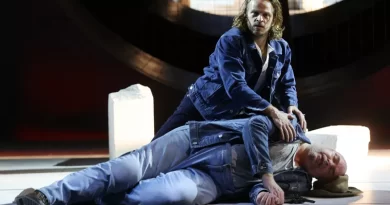
Jyuddah Jaymes as Dr Watson.
Photo credit: Tristram Kenton.
The character has survived all of it, which is either a tribute to Conan Doyle’s architecture or a testament to the world’s inexhaustible appetite for a man who is cleverer than everyone else in the room. Joel Horwood’s new play at Regent’s Park Open Air Theatre—a loose adaptation of The Sign of Four, performed half a mile from the fictional 221B Baker Street—tests what remains to say about the most over-adapted figure in popular fiction, and finds intriguing new avenues to explore in both Sherlock himself and our understanding of his world.
Horwood’s Holmes is more neurodivergent than eccentric, trailing unpaid bills and a suicidal air. Mrs Hudson dishes out orders rather than taking them and hints at her lodger’s queerness by comparing him to Oscar Wilde. More substantially, Watson is here a Black man back from the wars with a psychosomatic limp pointing to PTSD. As he explains, he earned his medical degree through scholarships and describes himself, with pointed matter-of-factness, as “all of Britain”. An unashamedly unreliable narrator, he documents their cases carefully, always aware that a happy ending sells better than the grimmer truth he encounters.
The bones of the plot—a mysterious woman, a box of stolen Indian treasure, a dead man in a locked room, a conspiracy with international ramifications—are drawn from The Sign of Four, a novel that was always saturated with imperial anxiety even when Doyle wasn’t looking directly at it. Horwood looks directly at it. That stolen treasure is not free wealth, as Holmes points out; it is stolen history. If you worried this would descend into agit-prop lecture, it mostly doesn’t. The politics are embedded rather than stencilled on.
That said, the production takes some time to find its footing. There is early exposition to chew through, multiple MacGuffins to log and a sense, through the first portion of the evening, of a play that is assembling its machinery rather than running it. The game takes a while to become properly afoot. Once it does, though, director Sean Holmes drives the whole enterprise with real confidence, blending action-adventure, character comedy, and plot twists without letting any one register tip into farce. Familiar faces from the canon (Moriarty, Mycroft, Lestrade, Mary Morstan) are teased and deployed expertly.
Joshua James gives a tour de force performance in the title role, digging deep into the physical, cerebral, and depressive dimensions of a character who has been played into the ground and somehow still surprises. He inhabits Holmes’s nervous energy rather than performing it, and his crazed emphasis and comic timing are immaculate. Alongside him, Jyuddah Jaymes is an earnest and intelligent Watson, never more than a step behind his companion’s thinking and never reduced to foil status. Nadi Kemp-Sayfi’s Mary begins as the damsel in distress and Watson’s love interest but earns considerably more than that by the end of the evening.
Grace Smart’s design never stops delivering. A revolving central platform transforms, scene to scene, from a cosy Baker Street study to a rushing river to a Victorian big top; the highest levels of the theatre are pressed into service for an exciting Reichenbach Fall-style climax; actors in animal costumes roam the peripheral darkness like the silhouettes of empire lurking just beyond the gaslight.
Ryan Day’s lighting draws the night in around the brightness, with the darkness of Regent’s Park becoming part of the production’s argument: the great show of Victorian life sustained by tricks, illusion, and whatever the audience is willing not to look at. Elena Peña’s 360-degree sound design and Jherek Bischoff’s compositions add an immersive tension throughout; the evening sounds as good as it looks.
The Sign of Four has always been a tale of empire coming home to roost: treasure extracted from India by British soldiers at the cost of others’ lives, conspiracies built on betrayal, a detective who restores order without examining what that order was built on. Horwood’s considerable achievement is to stage the same story and let it mean something different, using the Holmesian brand’s own momentum to carry an audience into territory Conan Doyle was careful to avoid. Not every element works—the early scenes creak, some of the thematic underlining is heavier than it needs to be—but this is a genuinely interesting addition to the many versions of Holmes the 21st century has already produced, executed with theatrical flair and anchored by a lead performance that more than justifies the commission.