“Love’s Labour’s Lost”/“Much Ado About Nothing” at Thomas’s College, Richmond
David Wootton in West London
★★★★☆
12 August 2026
Though Shakespeare’s comedies Love’s Labour’s Lost and Much Ado About Nothing have been paired before, Tom Littler’s delightful productions of them, in a collaboration between Orange Tree Theatre and Guildford Shakespeare Company, are certainly innovative. For Littler has adapted the plays to strengthen the links between them and so create a single story. This experiment provides many insights along the way and, ultimately, a satisfying whole.

James Sheldon and Phoebe Pryce in Much Ado About Nothing.
Photo credit: Harry Elletson.
Littler’s approach is prompted by the possible existence of a lost play by Shakespeare entitled Love’s Labour’s Won, which was first mentioned by Francis Meres in his commonplace book Palladis Tamia published in 1598. Scholarly views differ as to whether this refers to a lost work, and probably the sequel to Love’s Labour’s Lost, or to an alternative title for a known one. In Littler’s treatment, it becomes both, with Much Ado tweaked to act as the conclusion to a play that is open ended and often leaves the audience wanting to know what happens next.
The two plays are highly patterned, and have several parallels in structure, theme, and character. Of course, as comedies by Shakespeare, they focus on love, but they do so by exploring the differences between love in theory and love in practice, with, at their centres, pairs of lovers who employ astonishing verbal dexterity to express cynicism at romance and marriage, while failing to resist desire for each other.
Littler sets his narrative on either side of the Second World War, with the action of Love’s Labour’s Lost placed in the summer of 1939 and that of Much Ado About Nothing after VE Day in 1945. Though the programme states that the location is Messina (the actual setting of Much Ado), and that its visitors include aristocrats from France and Navarre, it is clearly a very English village. And the Englishness is emphasized in both the outdoor venues for the productions and elements of the set. Initially presented in the gardens of Braboeuf Manor, Guildford, they are now performed in the grounds of Thomas’s College, Richmond, against Andrew Trimen’s magnificent collegiate Tudor-Gothic façade (of what was once a Wesleyan Theological Institution).
Neil Irish’s charming design depicts a riverside walk, with a jetty and a rowing boat, and, stage left, “Costard’s Café and Bar”. The space bristles with signs – as well as bunting and lights – several in the first play indicating the self-imposed restrictions of some budding ascetics (such as “No Cake”), and several in the second indicating the privations of war (including “Closed Until Further Notice”).

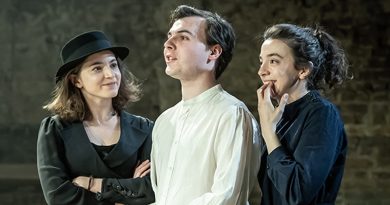
Joelle Brabban, Phoebe Pryce and Sally Cheng in Much Ado About Nothing.
Photo credit: Harry Elletson.
Into this world step the Prince of Navarre, John Longaville (Navarre’s illegitimate half-brother), and two friends, Benedick Berowne and Claudio Dumain (who have names that cleverly conflate the characters of the two plays). Though they are lively men of the world, dressed in three-piece suits and trilbies, and also carrying suitcases, Navarre persuades them to resist the company of women for three years, and instead devote themselves to study and fasting.
Even Benedick eventually accepts, though he points out that special arrangements will need to be made for the Princess of France, who is arriving on a diplomatic mission with her young relatives: her daughter Hero and her nieces Margaret and Beatrice (all the original names of characters in Much Ado). When they appear, in elegant dresses and picture hats (with Beatrice in palazzo pants), the banter begins, and the men and women prove to be well matched and well distinguished.
Both Owen Oakeshott’s Prince and Sarah Gobran’s Princess strike a successful balance between the dignity of their positions and the impishness of their inclinations. While they must set an example to their young companions, they are as ready as any to flirt and tease. As the youngest lovers Hero and Claudio, Jöelle Brabban and Chirag Benedict Lobo exhibit ardent enthusiasm, which in Claudio becomes at times a wide-eyed naivety. Sally Cheng’s Margaret and Matt Pinches’ Longaville are slightly more circumspect, while James Sheldon’s Benedick and Phoebe Pryce’s Beatrice relish every opportunity to spar. Each of these relationships alter and deepen, sometimes to damaging effect, through the narrative that is extended and developed in Much Ado.
These actors are eight of a company of only ten, and there is impressive doubling by cast members within and across the plays. Together they bring to life the large and lively population of Messina, so that, while some characters are cut, they are hardly missed.

Matthew Pinches, Phoebe Pryce and Chirag Benedict in Love’s Labour’s Lost.
Photo credit: Harry Elletson.
Concerning those outside the aristocratic circle, the subplot of Love’s Labour’s Lost creates context and broadens the humour. The dandyish, duplicitous Spanish refugee Don Adriano de Armado outs the cook and publican Costard as engaging in an illicit relationship with the barmaid Jacquenetta, while having his own wicked way with her. Robin Simpson is exquisitely extravagant as Adriano and Jeremy Lloyd sweetly sympathetic as the illiterate Costard, who causes confusion by unintentionally swapping love letters that he has been sent to deliver – Adriano’s going to Beatrice and Benedick’s to Jacquenetta (played by Cheng).
The broader humour affects the aristocrats, and there is much brilliant comic business, as when the men try to hide the letters that they are drafting to their loves while surreptitiously indulging in prohibited sweet treats, so that Benedick’s letter ends up in Claudio’s cake. This vein climaxes in their decision to woo the ladies in the guise of “Muscovites”, and in the ladies getting the better of them by disguising themselves as each other.
Love’s Labour’s Lost is a good-humoured play with much verbal wit and little real villainy, though it has a melancholy tinge, and ends movingly, even profoundly. By contrast, Much Ado About Nothing, though more popular and more often performed, can feel awkward in its combination of a somewhat ponderous plot, founded on a false accusation of infidelity, and the quickfire humorous dialogue that abounds in the subplot. This awkwardness is both mitigated and justified by Littler’s pairing and handling.
The characters of Much Ado arrive with rich back stories, both those seen in Love’s Labour’s Lost and those suggested by their latest appearance. Following a radio announcement that war is at an end, the four women enter. Only the Princess – now identified as Leonata – is dressed in civvies, for Hero and Margaret are nurses, while Beatrice is in the Women’s Auxiliary Air Force. They are soon joined by the men, who are Royal Air Force officers.
All seem older and affected by their experiences, so that Beatrice and Benedict spar more harshly than in the past, and Longaville is nervy, withdrawn, and probably suffering from post-traumatic stress disorder. The atmosphere is not unlike that of Terence Rattigan’s wartime play Flare Path, where the bar-room banter of pilots attempts to deflect from thoughts of danger and death. It certainly helps to explain Longaville’s spiteful decision to spoil Claudio’s plans to marry Hero by accusing her of being unfaithful. He is encouraged in this by his RAF colleague Borachio (played by Lloyd, in great contrast to his portrayal of Costard).
In his adaptation and direction, Littler mediates masterfully between the play’s light and shade, and so emphasizes the struggles towards true love, whether provoked by exterior forces (as for Claudio and Hero) or prompted by personality (as with Benedick and Beatrice). This has great benefits when the two overlap, as when Beatrice urges Benedick to “kill Claudio”. At such moments, multiple emotions come into play, and both friendship and love are tested.
Nevertheless, the comedy remains strong, and the famous set pieces are achieved with style, even when verging on slapstick. The scenes in which, first, Benedick and, then, Beatrice overhear the news that they are loved by the other are a joy to behold. Similarly, the scenes involving Constable “Dull” Dogberry (Pinches), Holofernes (Oakeshott), and Nathaniel (Lobo) as members of the Home Guard are a delight.
Music and dance contribute significantly to the complex pattern of courtship that develops across the two plays. Original music in the spirit of the forties is provided by composer and music director Matthew Floyd Jones, and dance steps by movement director and choreographer Asha Jennings-Grant. Also to be credited are sound designer Matt Eaton (extending the aural landscape to include church bells, cars, and planes) and fight director Philip d’Orléans.
With so many wonderful performances from so small and tight a troupe, it seems almost invidious to single anyone out. However, Sheldon as Benedick Berowne and Pryce as Beatrice carry much of the responsibility for the success of the show as the alluring (anti-)romantic leads. And Pinches is especially impressive in doubling the damaged Longaville and the well-intentioned, if bumbling, “Dull” Dogberry.
Pinches co-founded the Guildford Shakespeare Company with Gobran, and this year they are celebrating its 20th anniversary. Orange Tree artistic director Littler has worked with them before on productions of Much Ado About Nothing (2016) and Love’s Labour’s Lost (2018), and their current collaboration feels like a culmination of all they have achieved. Seen separately, the plays will provide much pleasure, while seen together they are likely to inform reflections and revivals for many years to come.