“The Winter’s Tale” at the Delacorte Outdoor Theatre, Central Park
Glenda Frank in New York
★★★★☆
20 August 2026
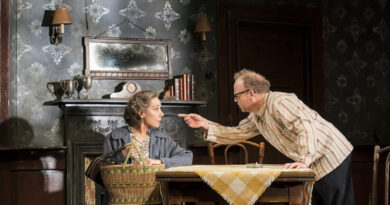
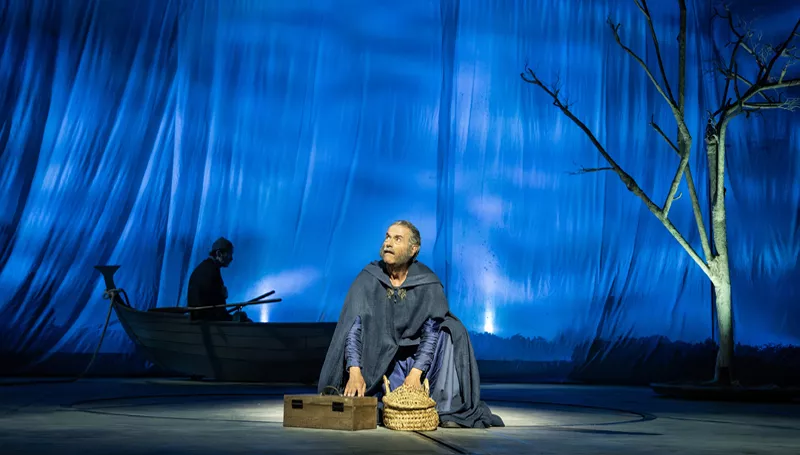
I’ve a fondness for Shakespeare’s later comedies with their complexity and moral ambiguity — that is, all except for The Winters Tale (1609-11), until now. The incomparable Daniel Sullivan has directed a lively, very funny, and poignant staging at the Delacorte that has almost made me a fan. He has transformed Leontes, King of Sicilia, one of drama’s most reprehensible husbands, into an almost tragicomic figure, and a young prince into a hero of love. In the hands of his mostly remarkable cast, even the stock characters are close to believable. And when they’re not, there is always that bear!

Photo credit: Joan Marcus.
The play tells a nasty story about King Leontes (Raúl Esparza), who is so full of himself that he will listen to no one, condemning his beautiful, faithful and pregnant wife to jail on the false charge of adultery, and his newborn daughter to death. When the play opens, he is hosting an old friend, Polixenes, King of Bohemia (Gilbert Owuor), and has entreated Hermione (Lily Rabe) to befriend their guest. She implores him to stay longer. But out of nowhere, Leontes falls victim to jealousy, the green-eyed monster that Iago speaks of in Othello.
He is obsessed with the mistaken idea that his wife is carrying Polixenes’s child. He orders Camillo, his faithful advisor, (a loose-limbed, scene-stealing Teagle F. Bougere) to become a poisoner or die. A sensible man caught with horrible choices, Camillo flees. Leontes takes this as proof, and casts his bewildered wife into a dungeon, considers burning her alive, and orders Antigonus (Steven Skybell), husband to Paulina played by Marsha Stephanie Blake, to take the infant to a foreign land and expose her to the elements.
Shakespeare treasured his outspoken women – Portia in The Merchant of Venice, Beatrice in Much Ado and Paulina, the only one brave enough here to speak truth to power and to defy the mad king for 16 years. The selection of Antigonus to commit infanticide is probably a test of his loyalty, but his reward is to be eaten by a (shadow) bear. He is the subject of the most famous stage direction in all literature: “Exit, pursued by a bear.” The peasants who witness his danger debate whether they should watch the bear devour him or take the baby to safety. This is absurdity with a light touch, and we get to vote (silently).

Photo credit: Joan Marcus.
Just as a reminder: one of Shakespeare’s competitors as an attraction was the bear-baiting spectacle almost next door. Queen Elizabeth thought so highly of the practice, she would order that it be performed for foreign dignitaries, and in 1591 she prohibited play productions on Thursday because this was bear-baiting day. So the wily Bard included a bear attack.
Leontes’s rage is terrifying, but the more obsessed he gets, the more evident it is that he is a comic figure, and the audience at the Delacorte enjoy laughing at him. Even when the message arrives from the Delphi Oracle that exonerates the queen, he will not be swayed. It’s hard to feel compassion for him when he realizes what he has done, but by then Shakespeare has taken us to a new country and some goodly peasants. (Peasants in Shakespeare’s day were called clowns, not to be confused with clever jesters. The word “clown” was related to the word clod, an ignorant bumbler, the best subject for comedy according to Aristotle.)
Leontes’s rescued daughter, Perdita (the lovely Isabela Ferrer) is raised by a peasant family, and Florizel, the prince ( a very stage-worthy Daniel Kyri from Chicago Fire) has fallen in love with her. Enter an older, more rigid Polixenes, who lays down the law about royal marriages. Florizel vows to relinquish any hope of the throne rather than give her up. They flee to Sicilia, where other surprises await them, including a statue that comes to life.
You can see why the seventeenth-century French, working hard to follow the strictures of dramatic construction suggested by Aristotle and made into rules by Horace, a Roman poet, judged Shakespeare a bad playwright with little craft. Shakespeare not only ignored the unities of place and time, but had all these bits of humor tucked into tragic places. This innovating and rule- breaking make him so much fun today, especially when the actors don’t take themselves too seriously and just wink at realism. Here, when the humour lapsed, the dramedy dipped.
And that is why the closing scene, which should have made us weep, was unaffecting. How I should have loved to see Hermione drop her disguise slowly, as though waking from a dream instead of emerging full-throttle. I had also imagined more amazement from the onlookers, especially Leontes. Esparza is such a brilliant actor that I always expect him to be outstanding, but his Leontes was anyone’s Leontes. Michael Khalid Karadsheh as the Young Shepherd, Bougere and Kyri win our attention – and our hearts – by revving it up a notch or two.
But all in all, this production is a gift. I expected nothing, except a little boredom from this play. But Sullivan and his cast have transformed it. Costumes by Linda Cho add grace and clarity to the scenes as characters move across an attractive, movable set design by Maruti Evans.