“Giant”, Music Box Theatre, New York
Glenda Frank in Midtown Manhattan
★★★★☆
7 April 2026
Giant by Mark Rosenblatt, winner of three Olivier Awards, directed by Nicholas Hytner (co-founder and director of The Bridge Theatre) focuses us again on cancel culture. Roald Dahl, its flawed protagonist, has sold over 300 million books worldwide including the beloved James and the Giant Peach, Matilda, and Charlie and the Chocolate Factory. All three, (adapted into films and then musicals) were an important influence on young readers. His protagonists live in a world where adults are often cruel, life can be fantastical, and only the lucky few slip by unscathed. Dahl’s stature was enhanced by his stint as a Royal Airforce fighter pilot during World War Two. Forbes named him the top earner among dead celebrities in 2021.
He earned opprobrium in a 1982 book review about Israel’s invasion of Lebanon. Dahl labelled Israelis a race of barbarous murderers and compared their tactics to those of Hitler and Himmler. In an interview that year, he opined that there is something in the Jewish character that inspired animosity. “Even a stinker like Hitler didn’t just pick on them for no reason.”
Giant is a play of ideas. The pivotal question is whether this literary icon will recant in the face of financial and social pressure, especially from the Jewish community. It opens with Dahl (John Lithgow), his fiancée “Liccy” Crosland played by Rachael Stirling (Private Lives at the Donmar Warehouse, London), and Tom (Elliot Levey, Three Sisters) who is his British publishing house representative, awaiting the arrival of Jessie (Aya Cash) who is a Farrar, Straus and Giroux marketing executive. Jessie is also a fan. She has brought with her a copy of James and the Giant Peach, her handicapped son’s favourite book, to be signed. The ensuing heated debate is not just a matter of principle. Dahl has just completed a new novel, The Witches. Some bookstore owners in America are refusing to carry his work, and early readers are finding the novel a not-so-subtle anti-Semitic allegory.
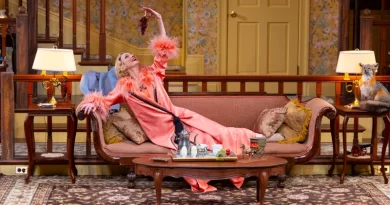
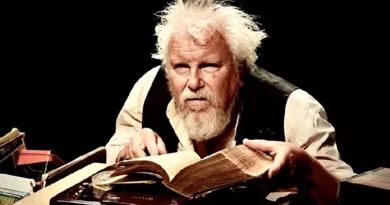
In the very capable hands of John Lithgow, Dahl is charming, petulant, fretful, angry and seemingly rational by turns. Standing, the lanky actor dominates the under-construction country house and his fellow performers. The set and the mismatched furniture may be a metaphor for the changes in Dahl’s reputation, but I found it a curious visual distraction. Just as I found Jessie bright red dress (set and costumes by Bob Crowley) in this drab world a little too in-yer-face.
The arguments are voiced by Dahl, Tom and Jessie. Dahl, a passionate defender of children, is distressed by the destruction of Beirut, “the Paris of the Middle East,” and in his rage makes no distinction between the Israeli military and the Jewish people. (The play is set in 1983.)
Tom, his British publisher, has convinced himself that antisemitism is just boyish spite. His complacency may be a survival mask in a country with a population of almost 68 million but only 290,000 Jews. He is proud to remain Dahl’s friend. It is Jessie alone who calls him out. She is eager for the author to publish an apology and a retraction, but the more she argues, the more entrenched Dahl becomes. Lithgow towers in his self-righteousness. It is a compelling performance – and a revelation.