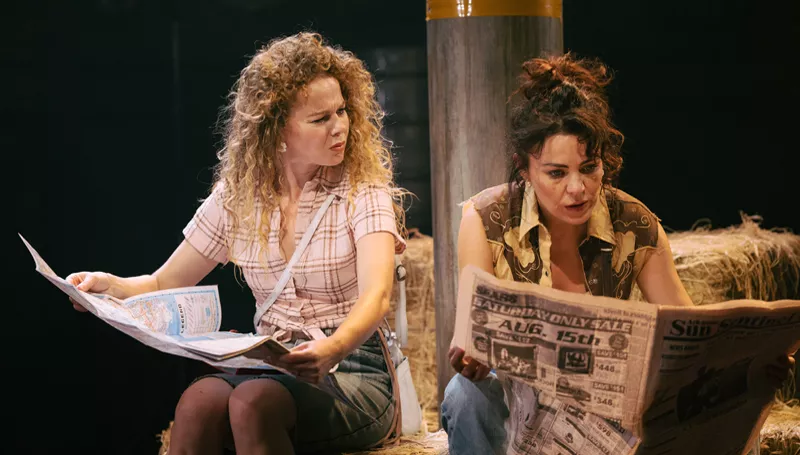
“Thelma and Louise” at the Young Vic
Franco Milazzo on the South Bank
★★☆☆☆
18 September 2026
Let’s cut to the chase. How do you even start to think about putting on a musical based on one of the most iconic road movies without having a car on stage? Or a road? Or even a chase?
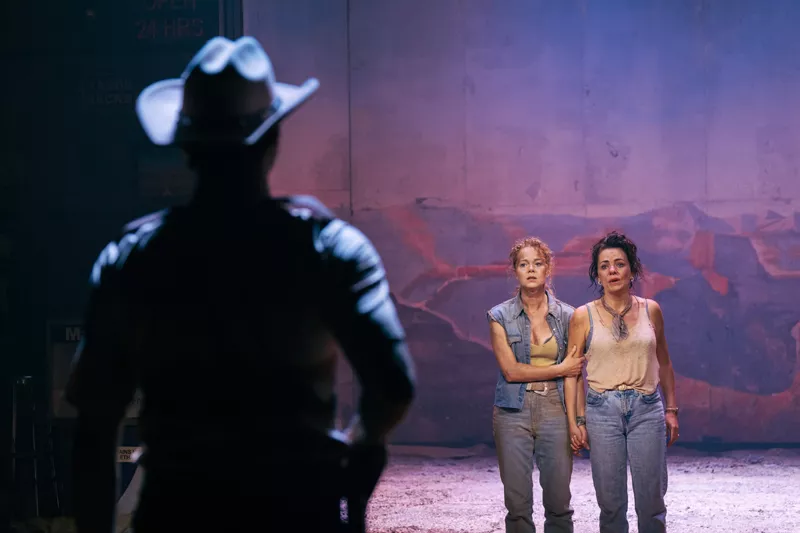
Amy Lennox and Rachel Tucker.
Photo credit: Helen Murray.
When Ridley Scott’s Thelma & Louise crashed into cinemas, few who saw it would have thought that it would be turned into a song-and-dance spectacle. And yet, some 35 years down the line, here we are. Trip Cullman directs this underpowered ride back to the early nineties at the Young Vic, in what can only be seen as an audition for a transfer to the West End or Broadway.
There are three big questions here to mull over. The first question is, “Why this film of all films?” Yes, yes, it has what one critic called at the time “a feminist manifesto” with themes that are timeless but, if it really is open season on turning Scott movies into musical theatre, can we expect a show based on Gladiator? And will we be entertained? Maybe there’s a take on Blade Runner on the way where we definitively find out whether Deckard is a replicant or not. Or how about Alien: The Musical from the point of view of a xenomorph looking for love in all the wrong places?
The second question is, “Who is this for?” The obvious answer is those who have seen and loved the film and still have that classic final shot – Susan Sarandon and Geena Davies gripping each other’s hands tight as they speed headlong into the wide blue yonder over the Grand Canyon – seared into their minds. Milking silver screen nostalgia in the form of a musical, though, is a grand idea that rarely pans out these days. Just ask the producers of the rolling disaster that is Burlesque, the overhyped Beetlejuice (which recently announced that it is closing early), or the critically panned Trainspotting (whose tour has been cancelled).
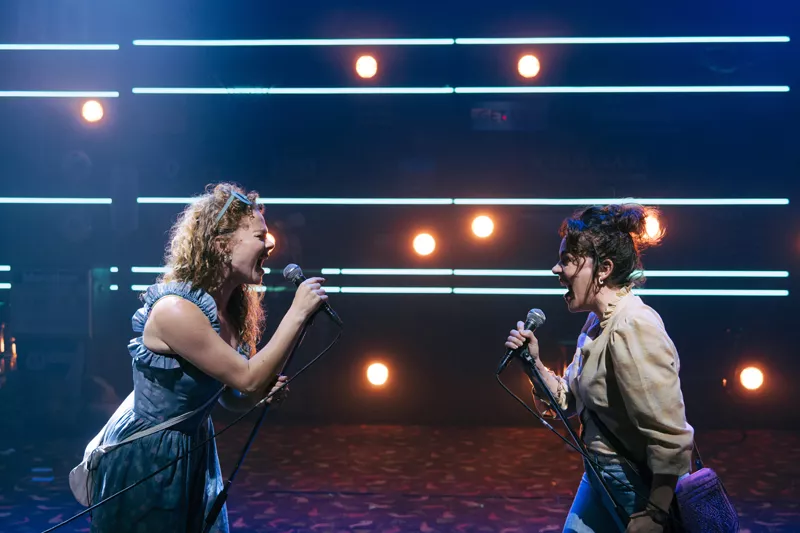
Amy Lennox and Rachel Tucker.
Photo credit: Helen Murray.
The last question is, “How did such a talented cast get suckered into signing up?” Amy Lennox, Rachel Tucker, and Jordan Luke Gage (a sheer waste of talent for the thinly written thief JD) do well with what they are given but there are notable shortfalls where the drama, emotion, connection, character definition, and thrilling set pieces in the original film are concerned. It’s not helped that Neko Case’s songbook is, by and large, underdeveloped and eminently forgettable. As with most other screen-to-stage adaptations, projection is doing the work of imagination, lending a cinematic sweep to writing that has done nothing whatsoever to earn one.
The under-par staging doesn’t do anyone many favours, despite the design coming from the Tony and Olivier Award-winning Christine Jones and Brett J. Banakis who both worked on American Idiot and Harry Potter and the Cursed Child. Most of it is given over to the set of the Silver Bullet bar with additional furniture wheeled on as necessary. A central sliding door at the back reveals more but its contents are obscured to those sitting on the far left or far right. Even though all the singers are equipped with wireless mics, Cullman has decided to have mic stands awkwardly carried on just for the musical numbers (and then just as awkwardly carried off after). Natasha Chivers’ lighting creates an intense vibe that the book struggles to match.
Given TV music-drama Nashville creator Callie Khouri has adapted her own Oscar-winning screenplay for the book, it’s not surprising that replays of the film’s dialogue are the hardest-hitting element, even if the best lines mainly come from one direction. In a key early scene, Louise interrupts the attempted rape of a drunk Thelma. The man holds up his hands and stands his ground, saying that he was “just havin’ a little fun”. Before shooting him dead, Louise replies “in the future, when a woman’s crying like that, she isn’t having any fun”. Then there’s her darkly humorous, “Look, you shoot off a guy’s head with his pants down, believe me, Texas ain’t the place you want to get caught.” It is telling that, three decades later, Khouri has decided not to revitalize the dialogue or address this imbalance but mainly to revisit her most famous work.
To be fair, there are a couple of areas that have been embellished or updated but not to any great effect. The character of the sympathetic policeman Hal is the most notable difference. Played on screen by Harvey Keitel, Trevor Dion Nicholas’s Hal digs into what it is like being a Black homicide detective inside a mostly white Arkansas police force. Meanwhile, the state trooper that catches the fugitive women is not locked up in the trunk of his car (as in the film) but ends up wearing only his underwear, boots, and shades. The first is only explored to any great extent in one scene, the second can apparently be widely seen in one form or another through adult entertainment websites. Neither makes a jot of difference to Thelma & Louise’s overall direction of travel.
In the end, despite a pair of stellar performances, this tame nostalgia trip sticks to the safety of the middle lane, has an engine that purrs when it should rev, and runs out of gas well before it attains the momentum, heart, and visceral thrill of the source material.