“Tristan & Yseult” at Theatre Royal Bath
Simon Thomas in South West England
★★★★☆
18 September 2026
Tristan and Yseult is a tale that has gone through many transformations. Even in the medieval era there were different traditions, ever since the 12th-century French versions of Thomas of Britain and Beroul and the slightly later German text of Gottfried of Strasbourg. By the 13th century, the story was being given an Arthurian twist with a completely different conclusion and in the 1850s Richard Wagner composed the most famous version of all with his music-drama Tristan und Isolde, providing his own ending and bringing it fully into the late 19th-century romantic tradition. In the 1980s Robert A. Johnson was citing it as the source of all evil in The Psychology of Romantic Love, the beginning of an infatuation with unrealistic expectations of relationships that condemns mankind to unhappiness and delusion.
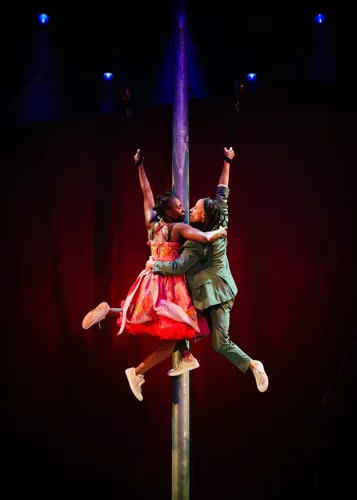
Nandi Bhebhe and John Leader.
Photo credit: Steve Tanner.
Then in 2003 a new rumbustious, irreverent manifestation happened in the fields of West England, when physical theatre company Kneehigh gave it a Kernow-infused theme, not unreasonable for proud Cornwallians as much of the story is set in their county. It was written by Carl Grose and Anna Maria Murphy, and directed by Emma Rice who made her mark with it and set the tone for the company for the next couple of decades. And the show lives on, going through various iterations including being performed on the Cornish cliffs, the National Theatre’s Cottesloe, Shakespeare’s Globe, and worldwide exposure. It’s a work that Rice returns to again and again, with this adaptation for her own company set to tour widely in the coming months.
As with other of Rice’s exuberant productions, the emphasis is on fun, energy, and flippancy with nods to more serious treatments, as the opening bars of Wagner’s opera, with their famous “Tristan chord”, blare out from an old gramophone. The comedy and pizazz work better than the weightier elements, which descend into melodrama towards the end.
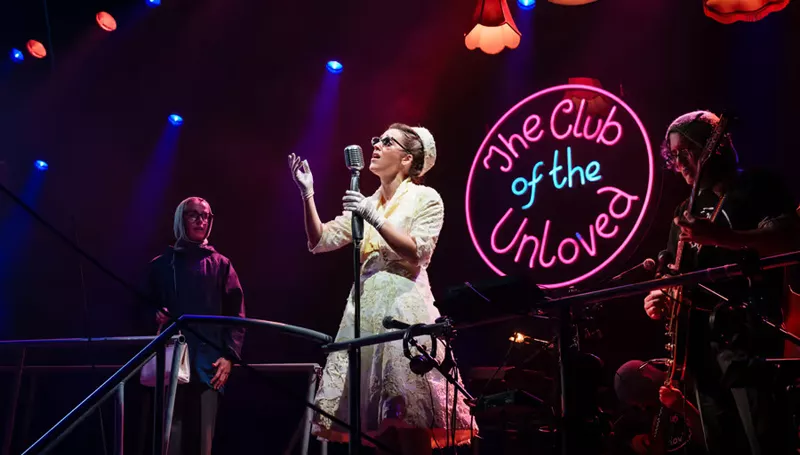
Rice adds an audacious original layer by making the show as much about being unloved as loved. While the eponymous couple wallow in uncontrolled emotion, under the powerful effects of magic potions, Rice provides a comic backdrop with a chorus of The Unloved Club, an ever-present bunch of anoraks with thick glasses, notebooks, and binoculars, known as the Love Spotters. This gang is led and spurred on by a character called Whitehands, recognizable to readers of the earliest French tradition of the tale as the second wife of Tristan, who tears the lovers apart out of jealousy and the lust for the revenge of the unrequited. There’s a poignancy in this strand of the evening and in the maid Brangian’s recounting of her experience of replacing Yseult in King Mark’s bed to disguise the Irish princess’s lost virginity.
This restaging brings together a multi-talented cast who couldn’t give more in energy and commitment as they burst into frantic dance routines, play instruments, and swing and dangle perilously from the central ship’s mast. Tom Fox is a vicious Morholt, the Irish thug who sets off the ensuing tragedy, and then goes full pantomime dame, with his bedraggled Brangian, who leaps, gurns, and flutters like a crazy person. As a secondary zanni, Matthew Churcher impresses as the treacherous Frocin (Wagner’s Melot) and Stephanie Hockley powerfully portrays the vengeful Whitehands, a role Rice herself assumed back in the early days. John Leader and Nandi Bhebhe provide a strong central core as the main couple and Edward Rowe towers as the betrayed King Mark. But this is very much an ensemble piece with the 12-strong cast all working their socks off to entertain.
The production actually does a service to Wagner lovers by filling in the background to the opera, which the composer kept sketchy despite the work’s four a half hours’ length. The back story of Morold’s defeat and Tristan’s recovery under Yseult’s care, mentioned only in passing in Wagner’s libretto, is brought vividly to life. Rice’s treatment of the story couldn’t be more different from Wagner’s but she can’t resist ending the evening by resorting to a blazing non-vocal Liebestod, the opera lover’s ultimate reward for so much patience and forbearance. There can be no better ending for any show.
The late Bill Mitchell’s original sets and costumes are “refreshed” by regular Emma Rice Company contributor Vicki Mortimer and the eclectic score is enhanced by original songs by composer Stu Barker, with pop classics thrown into the mix. After Theatre Royal Bath the show tours venues across Britain (as well as New York) through to next year, including co-producers York Theatre Royal and Nottingham Playhouse. Given the show’s longevity, Rice’s devotion to it, and the audience’s evident enthusiasm for it, Tristan & Yseult will no doubt be around for some time to come.