“NINA” at Battersea Arts Centre
Tom Bolton in South London
★★★★★
9 February 2026
Writer/co-director Caroline Williams and fellow co-director Deborah Pearson are a team who grew up on the space for experimentation provided at Battersea Arts Centre, where they both started out. Williams wrote NINA during Covid and, intriguingly, it makes arguments which have since dropped out of wider discourse. The MeToo era has given way to anti-woke posturing, and questions about the way women experience the power of men have become obscured. NINA is a timely return to issues never properly addressed. It is also a powerful and absorbing piece of writing which shakes up expectations.

Samantha Begeman as NINA 02.
Photo credit: Ali Wright.
It opens with a projected quote from the writer Trigorin who, in Chekhov’s The Seagull, proposes a short story in which a young, aspiring actress is destroyed by a man out of sheer boredom, shot like a passing seagull. This scenario plays out in The Seagull itself, as the young actress Nina is used and destroyed by Trigorin himself. And it plays out in NINA, as a series of actresses audition for the part.
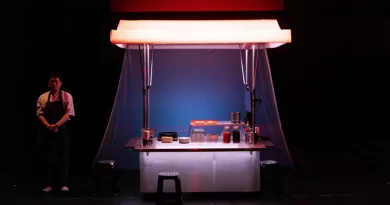
Tomás Palmer’s set is a bare rehearsal room, where four young women stand in the spotlight, while Goran (Rowan Polonski) oversees their auditions, at first as a disembodied voice through a “God-mike”. He is an autocratic, generically European director. All the audition candidates tell him how much they love his work, and he manipulates them as he pleases. Nina 01 (Maya Bartley O’Dea) is shot like the seagull after just a couple of lines. Nina 02 (Samantha Begeman) is nervous and, professionally, in no position to assert herself. Nina 03 (Nina Bowers) is too self-possessed for Goran. Nina 04 (Gemma Barnett) is told she is too old for Nina, too young for the part of Irina Arkadina.

Joseph Payne and Samantha Begeman.
Photo credit: Ali Wright.
Goran’s treatment of Nina 02 is at the centre of the play. He casts her as Nina and pushes her through an exposing masturbation scene, ignoring his pleas to let her stop. The play is a success and it makes her a star but, when the pair are interviewed on TV, the cost to her becomes clear.
NINA is based around a set of stellar performances. Begeman’s Nina 02 is remarkable in her journey from awkward inexperience to an insight she never asked for. She gives a speech about the way acting makes her feel she is able to stop time, in which she pretty much does exactly that. But the cost of putting her vulnerability on display, at the behest of a controlling male ego, is shocking. In Daniel Denton’s highly effective video design, her raw performance is projected behind her as she plucks the feathers from her costume in despair.
Bowers is equally impressive as an actor who thinks she is an equal in an artistic relationship with a director, only to discover she is being used in every way. In an intense and horrifying scene, Goran pressures her into channelling her pregnancy and abortion to enact a childbirth scene, recreating the experience of Nina in the play – and when she asks for feedback, it turns out he went to lunch halfway through.
Polonski is unnervingly convincing as the liberal, fêted, deeply misogynist Goran. Joseph Payne is excellent playing Goran’s sidekick, a nepo-baby aspiring writer who is both socially awkward and sexually rapacious, grabbing the opportunity to touch up Nina 03 the moment she tells him she’s in a relationship.
Some of the gratuitous mistreatment of the actresses would seem cartoon-like, if it weren’t for Williams’s programme note explaining that everything in the play really happened, either to her or to friends. Her writing throws the treatment of women on stage back in the face of perpetrators, but it does more than that. She also challenges the dominance of a classical canon powered by male representations of women, like Nina, suffering trauma at their hands. And she challenges the expectation that actresses will relive their own personal traumas, also experienced at the hands of men, to perform these representations. NINA shows us how much we take for granted, from actresses and the theatre, and asks whether the costs are justified.
NINA opens the autumn season at Battersea Arts Centre, an eclectic programme that reaffirms the venue’s commitment to experimental theatre. BAC takes risks to ask questions that matter, but that kind of theatre is more costly than ever and harder to sustain, especially in a glorious, rambling, impossibly expensive building like the former Battersea Town Hall. BAC is irreplaceable, but the feeling is growing that sooner or later we will have to fight for places like this. The fate of Edinburgh’s Summerhall, another shoestring arts complex now forced to compete for space with hotels and student housing, shows there are no guarantees. What better way, then, to affirm BAC’s role as one of the UK’s most innovative producing venues than with an exciting, unashamedly confrontational new play?