“Into the Woods” at Noël Coward Theatre
David Wootton in the West End
★★★★☆
10 October 2026
For long a powerful element of the German imagination, the forest was central to the fairy tales of the Brothers Grimm. For them, it was a place in which protagonists underwent trials and changes, and in psychoanalytic interpretations of their work it is the site of anxieties that children must overcome to gain maturity. Such are the themes that inspired Stephen Sondheim and James Lapine in creating their 1986 musical Into the Woods as a successor to Sunday in the Park with George.

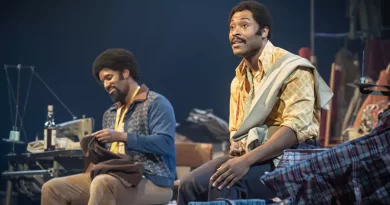
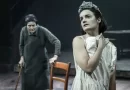
Gabrielle Lewis Dodson, Michael. S Seigel, Hana Ichijo.
Photo credit: Johan Persson.
The genius of Into the Woods lies greatly in its ability to encompass a wide range of tone. There is the innocent delight of the nursery tale suggested by the jaunty hook of the title number. There is the knowing irony of more adult entertainment. And there is the moving profundity of the deepest work of art. The challenge for a director is how to negotiate and unify these qualities, while the challenge for a designer is how to suggest them through striking imagery, and – most crucially – how to represent those woods.
In Jordan Fein’s punchy yet perceptive production, transferring to the West End after an award-winning run at the Bridge Theatre, the woods are of a full-blown, or full-grown, naturalism. This is achieved through the combined talents of the designer Tom Scutt, the scenic artist Richard Nutborne and his team, and the lighting designer Aideen Malone. The rough, ivy-covered trunks of huge trees rise out of an undergrowth of ferns and grasses, and burst into a canopy of leafy branches. Constantly changing shafts of light break through them to animate the landscape in ways worthy of Altdorfer or Friedrich.
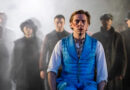
This arboreal array is something of a surprise when revealed, for the production begins in a much more minimal fashion, with a shallow space backed by a black drop stencilled with the show’s title. Onto this bare stage comes Michael S. Siegel’s Narrator who, dressed like Sondheim himself, utters the magic words, “Once upon a time”, and introduces the crucial figures of Cinderella (Simbi Akande), Jack of beanstalk fame (Keith Ramsay), and his Mother (Julie Jupp), and the Baker and his Wife (John Dalgleish and Laura Pitt-Pulford), the last of whom are joined by Little Red Ridinghood (Gracie McGonigal).

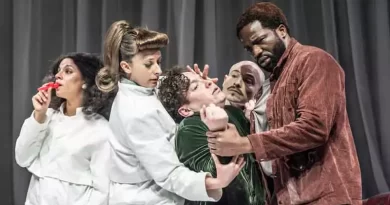
Keith Ramsay as Jack.
Photo credit: Johan Persson.
Cinderella wishes to attend a festival given by the King; Jack wishes that his cow Milky White would give milk; Little Red wishes for bread for her sick Grandmother; the Baker and his Wife wish for a child. As they share these desires with the audience, a dais rises out of the floor that enables a greater variety of choreography while acting as a kitchen for the Baker, a refuge for Jack, etcetera.
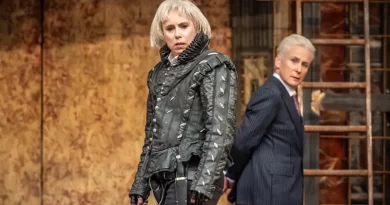
Their plaints are disturbed by the appearance of the Witch, who is the Baker’s neighbour. As played by Kate Fleetwood, she is an uncompromisingly disturbing character, who tells the Baker that she placed a curse on his family to make them barren, and stole his golden-haired sister Rapunzel when a child. The curse will be lifted only if he returns in three days with four items for her: red cloak, white cow, yellow hair, and golden slipper. So, the journey into the woods is set in motion: the Baker to find these items, Cinderella to tend her mother’s grave, Jack to sell his cow, and Little Red to visit her Grandmother.
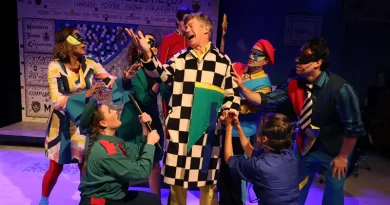
Scutt’s costumes confirm that they inhabit a fantastic version of a mythical medieval past, with extravagant headgear and flowing robes, some made of bold patchwork and others with beautifully quilted details, while all feeling of one piece. Accessories inject an element of wit, such as the handbags shaped like a carriage and horses carried by Cinderella’s Stepmother and stepsisters (Jennifer Hepburn, Hana Ichijo, and Gabrielle Lewis-Dodson). Other props are charmingly humorous, notably the puppet cow and hen (designed and made by Max Humphries, Chuck Brown, Charlie Findlay, and Rhiannonn Magill).
Even once the wood appears, much of the action takes place downstage, and some of it in the auditorium itself, so that performers ensure a strong engagement with the audience. And this allows them and us to relish both the comedy and the drama. However, some key sequences take place upstage, with a parting of the trees revealing, say, the cottage belonging to Little Red’s Grandmother (Valda Aviks) or the tower imprisoning Rapunzel (Fiona Finsbury contributing fine parodic coloratura).
The narrative strand involving Little Red is especially successful, with Matthew Seadon-Young providing an alluring Wolf, whose comeuppance is shown in animated silhouette through the cottage windows (with videos designed by Roland Horvath). Seadon-Young also plays Cinderella’s Prince and, with Lucas Koch as Rapunzel’s Prince, almost threatens to steal the show with the hilarious duet “Agony”, expressive of the pains they take to win their maidens.
“Agony” acts as a comic counterpoint to much of the real pain that is suffered by the central characters during their emotional journeys. While there is an apparent sense of reconciliation at the end of Act One, signalled by the ensemble “Happy Ever After”, events take an even darker turn in Act Two, when a Giant (again played by Aviks) seeks revenge for the death of her husband, and devastates the woodland in the process, forcing the survivors to work together.
Indeed, working together is very much what Into the Woods is about, as it relies on a great ensemble cast blending with a tight set of musicians. It certainly gets that in Fein’s production, the musical elements of which are deftly directed by Alex Beetschen. About half the members have transferred from the Bridge, including Fleetwood, who anchors the group with her commanding portrayal of the Witch. Of the many talented newcomers to the cast, Akande is especially radiant as Cinderella in such numbers as “On the Steps of the Palace”.
Having established himself as a director in the United States, Fein has been active in London since 2021. 2026 has seen both the transfer of Into the Woods to the West End and his revival of Arthur Miller’s Broken Glass at the Young Vic, which has arguably been the best production of a play in the capital this year. Together they confirm him as one of the most substantial talents in theatre today, able to get to the heart of a work and make it shine.