“An Oak Tree” at The Other Palace
Neil Dowden in West London
★★★★☆
11 October 2026
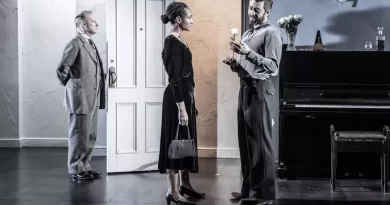
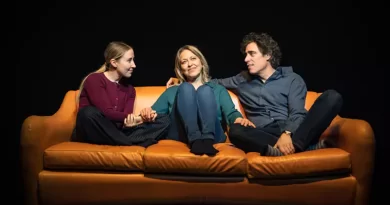
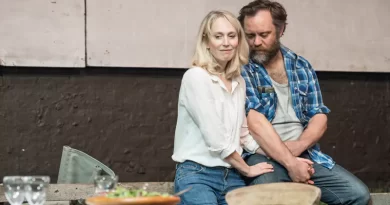
Tim Crouch has performed his ground-breaking play An Oak Tree in many different countries with hundreds of different, often high-profile actors since it premiered in 2005, most recently at the Young Vic last year. None of them have seen the script, let alone rehearsed it, before they come on stage – and indeed even then they don’t know how it will develop. The current run at The Other Palace has a strong roster of guest actors including Olivia Williams, Juliet Stevenson, Adrian Lester, Reece Shearsmith, and Suranne Jones – with Death Valley star Gwyneth Keyworth appearing on opening night.

Tim Crouch.
Photo credit: Pamela Raith.
The play is inspired by Michael Craig-Martin’s same-named 1973 conceptual work of art in which a glass of water is imagined as an oak tree. Crouch has said: “Theatre in its purest form is a conceptual artform. It doesn’t need sets, costumes and props, but exists inside an audience’s head.” And this is exactly what he delivers in the stripped-back An Oak Tree. Essentially, it is Crouch himself inviting on stage another actor whom he then prompts (via a microphone into their earphones, or quietly speaking directly to them, or giving them a script to read) with lines or movements. The text itself is not improvised but the performance will be different every time according to how the other actor responds in the moment.
The bare bones of the story are simple. The second actor plays a father called Andy whose young daughter has been accidentally killed by a car driven by a stage hypnotist (Crouch), whose act he volunteers for three months later. In the meantime he has come to believe that an oak tree near the fatal crash has been transformed into his dead daughter. Seeking answers, will Andy’s meeting with the hypnotist lead to confrontation or reconciliation?
This show may seem a bit of a voyeuristic gimmick where audiences can see how well-known actors cope with the challenges of performing live drama when they don’t know what’s going to happen next. Will they hack it, or will it just be embarrassing? But this feeling of spontaneous edginess is very much what Crouch intends as the essence of theatre-making which cannot be replicated in any other medium. And he is certainly not out to humiliate his co-stars. Although Crouch is definitely in charge while directing Keyworth on stage – and there is a parallel between their roles as hypnotist and participant which does raise questions of power and agency – this is a collaboration which will not succeed if it is too one-sided. Here, it works brilliantly.

Gwyneth Keyworth.
Photo credit: Pamela Raith.
Again, the metatheatricality may seem tricksy, but the show confronts us with not so much the dichotomy of illusion versus reality as different kinds of truth – actual/literal and emotional/imagined. We are used to suspending disbelief when going to the theatre but here we are also asked to suspend our belief, while the show plays with our expectations as the fourth wall comes up and down and the actors go in and out of character. We’re never quite sure what’s what.
At the start Crouch directly addresses the audience to explain the set-up, asking us to imagine ourselves as punters at a pub performance of the hypnotist’s act – but adding that when he invites volunteers on stage he doesn’t want us to step up. And he tells Keyworth – who’s been sitting in the front row – to imagine herself as a 40-something, six-foot-plus grieving father. Keyworth also has to voice some words of Andy’s wife who tells him he is delusional to think their daughter is now embodied in a tree when she is buried elsewhere. There is some genuine pathos in his refusal to let her go.
But this is counterpointed by the ridiculous delusions that Andy is under when hypnotised, including playing an invisible piano in the Royal Albert Hall, believing he has soiled himself, and shockingly even that he has run over a girl – all part of the exploitative show that the hypnotist puts on before realizing who Andy is. We are never quite sure what turn the play is going to take, with Crouch even leaving Keyworth alone on stage for a minute – contributing to the sense of unease that he wants us to feel.
While the nervous but intrepid Keyworth clearly alternates between herself as an actor and the character in the story, conveying an affecting vulnerability, Crouch amusingly plays the manipulative, fancy-waistcoat-wearing hypnotist with a showman’s patter. But even when he is apparently himself directing her his mannered voice and deliberately broken speech suggest this is another shifty persona. And when they seem to be deconstructing the show near the end their speech is all scripted in a Pirandellian twist.
Crouch has co-directed the show with Karl James and Andy Smith, so he too presumably is under direction. Although An Oak Tree – which runs straight through for 75 minutes – may resemble a workshop or scratch performance, it is carefully crafted. And though it has minimalist staging, it features red velvet curtains and some props – namely, four plastic chairs and a piano stool, plus a table for scripts and a device that plays the sound of road traffic as well as music, with Pete Gill’s tacky show tunes alternating with bombastic clips from Carl Orff’s O Fortuna (used for the Old Spice advert).
This is the second time we have seen Crouch on stage in London this year, following his reimagining of The Tempest at Sam Wanamaker Playhouse in the spring. That is his latest idiosyncratic spin on Shakespeare’s oeuvre, which includes Truth’s a Dog Must to Kennel (staged at Battersea Arts Centre in 2023). He has also made theatre for young people appealing directly to their imaginative instincts unsullied by realism.
Crouch may well have influenced Iranian experimental playwright Nassim Soleimanpour, with whom he has collaborated and whose 2010 play White Rabbit Red Rabbit is coincidentally currently playing on Monday nights at the Duchess Theatre. That too is performed by a different actor each time with no pre-knowledge of the script, though it is a solo performance introduced by the director and there is on-stage audience participation. It seems that An Oak Tree has spread its branches and dropped seeds on fertile ground.