“Krapp’s Last Tape”, Rotunda Theatre, Brighton Fringe
Jeremy Malies in Brighton
★★★★☆
18 May 2026
What is the collective noun for a set of productions of this play? A spool, I suppose. Gary Oldman has done it recently in York, and Stephen Rea (in the same week) did it at the Barbican. Oldman is now reprising his version at the Royal Court.
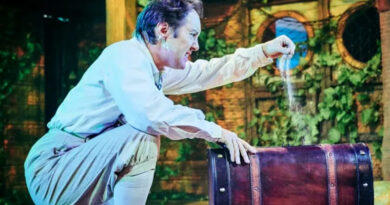
I always worry about the potassium intake for a long run, but Ross Ericson is only here for a few nights. Doing it from a wheelchair, Harold Pinter famously omitted the bananas. It’s the oldest joke in the world; a man trips on a banana skin. And stage directions ask only for a slip but Ericson in his brown lab coat (less dishevelled than most Krapps) bravely falls prone. That would hurt the actor if it were repeated too many times.
It is Krapp’s sixty-ninth birthday and the setting is “some time in the future”. The ritual on his birthday is that he records his thoughts on a reel-to-reel tape recorder. This year he is also listening to a recording that he made 30 years ago. And that recording, in its turn, has content in which he reflects on having just listened to another tape from 10 years earlier. So we are learning about this alcoholic, failed writer with a stomach complaint at three stages of his life. And Krapp knows that this may well be the last recording.
As I type, the penny has dropped as to why Beckett placed this in the future. He wrote the play in 1960 and was aware conceptually of what a recorder was but had to ask friends in the radio industry for details. If the technology is to be presented as being quite a few decades old, then the play must be futuristic – for the author at least. Beckett knew intuitively that this gadget would serve as a stage metaphor for the struggle over memory and that it was ideal for presenting a dialogue between our past and future selves.
Ericson captures the laborious tottering and vacuous stares described precisely in the stage directions. Every single gesture as required in the text is calibrated to achieve the accumulated effect that Beckett was after.
Ericson is more stoic than the slew of Krapps that I have seen over 50 years of watching the play. This is an iteration of the character who quite clearly knows that, however much he might love women, he has had his last throw of the dice with them. It is of course all in the text, right down to the number of seconds that should be used up, but Ericson has confidence in his abilities to exploit all the dead air.
And there is also a message for writers here: get a body of work behind you by the age of 39 – intellectually it is the crest of your wave. Saying that, Beckett who was a late developer having had his novels rejected multiple times, wrote this piece in his early fifties. He was already worrying intensely about the ageing process.
Ericson’s poking at the boxes (tins actually) containing the many tapes is so precise that several of them oscillate in front of us and reinforce the chaos of the character’s surroundings. The props are generally excellent though I do wonder whether the small dictionary he consults is big enough to contain the obscure word he is searching for. But you can’t fault the detail; venturing up to the set after the performance I noted that one of the books is indeed the sentimental novel Effi Briest by Theodor Fontane that Beckett asks for.
The recording of our man from 30 years ago is remarkable for the change of timbre. Unless Ericson had the foresight to do what Samuel West has done (he put down the relevant portion as a recording at the age of 39 in 2006 prior to an envisaged production in 2036) then it’s quite a feat and is a vocal equivalent of sleight of hand. West might like to note that 2036 is indeed “some time in the future”.
Despite the intensity with which Ericson manages to summon up the character’s memories of time spent with lovers, he leaves us in no doubt that this is a failed author who has always seen time spent with others as time when he is not writing. He is also, as he reflects on the 30-year-old tape, consumed by self-hatred for having been over-confident about future achievements. His sacrifices have produced nothing and while he is articulate about self-discipline, he has allowed excessive drinking to leave him hamstrung as a creator. Beckett’s skill is illustrated in the fact that the final words from the 39-year-old Krapp on the tape are speculation that his best years may have gone already. We leave him in the present at the end of that recording with blank tape running on. It’s up to us to speculate on the further agonies of the present-day Krapp.
A production by David Westhead (under the direction of Stockard Channing no less) has been reviewed here and will continue to tour globally in 2026. So long as writers have a crushing sense of having underachieved, people judge themselves in any sphere by the hubris of youth, and men remember (even if the view is jaundiced) their girlfriends at railway stations then this play is not going to go out of fashion.