“Krapp’s Last Tape” at Royal Court Theatre Downstairs
Simon Thomas in West London
★★★★☆
12 May 2026
The Royal Court has a long relationship with the works of Samuel Beckett, stretching back to the premiere of Krapp’s Last Tape in 1958 and beyond. Since then, it’s seen the UK premieres of Happy Days and Not I, Beckett’s own production of Footfalls, and, more recently, his fellow playwright Harold Pinter’s poignant tribute as Krapp, just two years before his own death. It seems entirely fitting that the venue should turn to the same play as a contribution to its 70th anniversary celebrations.

Gary Oldman as Krapp.
Photo credit: Jack English.
Fortunately for them, an able and willing Gary Oldman is the latest in a long line of star turns in the part, following his York Theatre Royal run last year. The two theatres are beacons of good feeling for the actor, as both featured prominently in his early career. He made his professional debut in York in 1979 and he cherishes memories of the Royal Court from the following years. Since then he’s been busy becoming one of his generation’s most successful and respected film actors and only with this project makes a much-anticipated return to the boards.
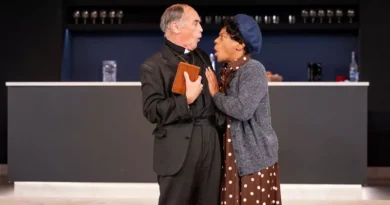
For that first outing for the play, which gave Patrick Magee such a unique opportunity to exercise his weirdness, Krapp’s Last Tape served as a curtain-raiser to the English-language version of Endgame (played in French as Fin de Partie at the Royal Court the previous year). Now, established as a classic in its own right, the play deserves its own curtain-raiser, which comes in the form of Leo Simpe-Asante’s 20-minute piece Godot’s To-Do List.
Written when Simpe-Asante was 19 years old, the play was a winner of the Royal Court Young Playwrights Award, a clear case of handing over the baton to a new generation. It’s a bravura piece, suggesting the reason for Godot failing to turn up, although not in any literal sense, and playing with various ideas that are entirely compatible with Beckett’s work. There’s an offstage voice manipulating the onstage Godot, with resonances of Beckett’s Eh Joe and What Where, and also nods towards a much more modern neurosis about the controlling potential of technology.
Krapp’s Last Tape also has a strong reliance on new technology. So recent was the invention of the recording tape at the time, that Beckett had to reach out to find out how it actually worked. The ominous implications of Godot’s To-Do List are all around us today, as a possibly mechanical consciousness puts its all-too-human Godot through his paces. There are plenty of laughs in the witty script, and in Shakeel Haakim’s performance as the hapless figure, but a creeping sense of unease in the absurd orders issued by Flora Ashton’s disembodied voice.

Shakeel Haakim.
Photo credit: Camilla Greenwell.
The main act follows after a brief break, when Oldman takes to the stage as the shabbiest of Krapps. It’s a performance of studied crankiness, as he makes the sight of an old man silently and slowly eating bananas a riveting experience. Oldman directs himself and even designs the set. His assertion in the programme that all the play needs is “one man, one tape machine, a few props and a bunch of bananas” is belied by a huge pile of detritus filling the stage and getting added to each night.
He’s right, though, that the essence of the work is the man and his memories. Beckett’s text is deceptively simple, full of subtle references and allusions, as the 69-year-old Krapp relives his thoughts and feelings of 30 years earlier. Oldman fills the theatre with Krapp’s memories; he’s tortured by them. He scorns the relative optimism and aspirations of his former self but yearns for the feelings of the younger man. His obsessive replaying of the moments of fleeting pleasure and sexual hope betrays his reluctance to relinquish yearning, all the more painful as it’s now too late. The business with bananas is more than just clowning, as the tender stroking of the phallic fruit reflects the constant theme of sexual desire and frustration.
You feel for this broken-down old man at every half-recalled thought – the violated expectation of success as a writer, the loss of parents, the minutiae of living such as a ball handed to a dog – all expressed in the most pared-down of images. Pinter’s performance was short on humour and filled with pain but Oldman captures both. It’s a fine performance of a great play that will hopefully be caught on film so audiences beyond those for this brief run will get to experience its strange beauty.