“Jesus Christ Superstar” at London Palladium
Franco Milazzo in the West End
★★★★☆
8 July 2026
And. lo, after forty days (and quite a few years), Sam Ryder Eurovision Superstar returns to the limelight to augur in yet another run of this acclaimed rock musical. Timothy Sheader’s production of Jesus Christ Superstar is now on its fourth London address in a decade, following its 2016 debut at Regent’s Park Open Air Theatre, a Barbican transfer, an assortment of tours, and a stint at the Palladium this summer before it decamps to Theatre Royal Drury Lane in the autumn.
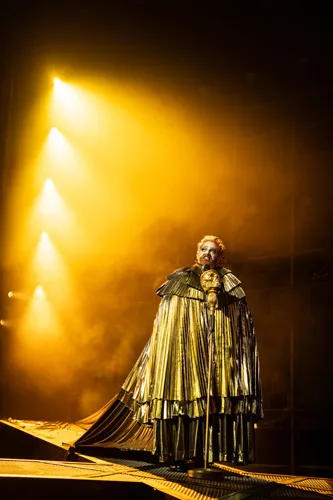
Jesse Tyler Ferguson as King Herod.
Photo credit: Johan Persson.
Tim Rice and Andrew Lloyd Webber wrote their masterwork backwards by any sane theatrical logic: a 1970 concept album first, a Broadway staging the following year, Norman Jewison’s 1973 film after that, and only slowly, over five decades, has the Passion achieved mythical status in the pantheon of musical theatre. Now 55 years from its Broadway debut, its bones remain sound enough that even a non-actor in the title role can’t fully derail it.
Sheader’s direction hasn’t changed all that much across the various iterations he has helmed, pandemic interruptions included, and there’s something to be said for a production confident enough not to fidget with a winning formula. It still carries the distinct tang of a seventies prog-rock gig, but the political undertow hits harder now than it did fifty or even ten years ago. Sheader strips out the purely divine and replaces it with something closer to a study of institutional power, populism, and the machinery of celebrity; his Jesus is less a fist-pumping revolutionary than an evasive, unreadable figure who won’t confirm his own status even under direct interrogation, which plays rather differently in an age of cancel culture, conspiracy pile-ons, and the pitiless scroll of the group chat.
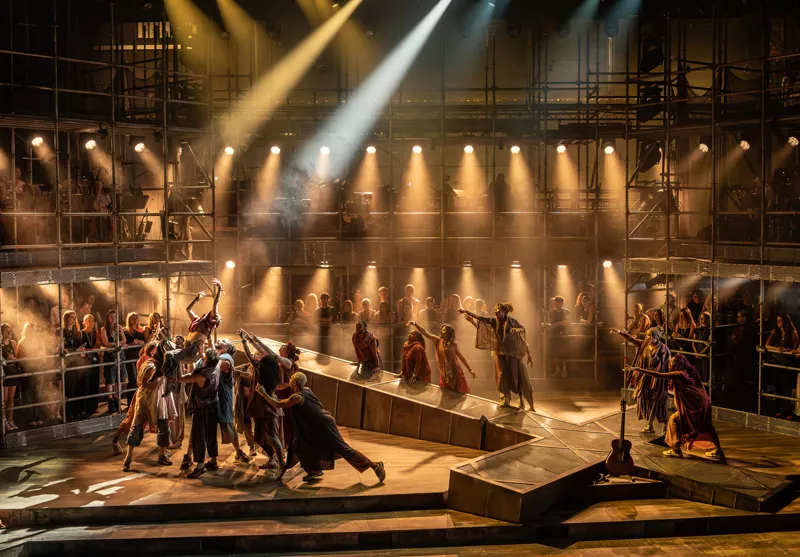
Tom Scutt’s design leans into this without ever showing its workings too plainly. The microphone stands do quiet double duty throughout – pikes for the soldiers, staffs for the accusing elders, the rope Judas eventually hangs from – and the moment the stage lifts skyward lands with considerably more force indoors than it ever did under Regent’s Park’s open sky. Lee Curran’s crepuscular lighting works overtime too, keeping the mood suitably grey while telegraphing the storm gathering over the proclaimed King of the Jews. There’s no easy resurrection resolution here, no hint that Jesus is off for a long bank-holiday weekend; just the accumulating certainty of a terrible, painful death.
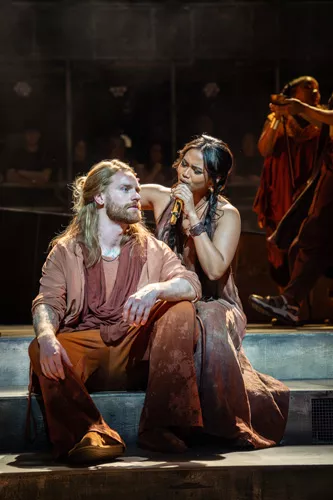
Sam Ryder and Desmonda Cathabel.
Photo credit: Johan Persson.
Where the show still creaks, though, is in the storytelling. Scenes arrive with little connective tissue with characters barely introduced and sketched rather than built. Anyone coming to this cold, without having experienced either the album or the film, will likely spend the second act working out who everyone actually is. Some will feel that they have literally lost the plot.
As for Ryder: his name is on the poster and so the cross is on his shoulders. He’ll always carry a certain folk-hero glow from that Eurovision runner-up finish in 2022. Sheader wisely keeps him out of the spotlight for long stretches, watching from the wings rather than commanding the stage. When he does step forward, three things become apparent. He can’t act. He can’t dance. But he definitely can sing, and every time he opens his mouth the song more than covers the shortfall elsewhere.
He’s surrounded by people who know exactly what they’re doing. Desmonda Cathabel’s Mary Magdalene is a subtle but phenomenal presence in her few scenes. Her creamy, country-inflected voice suits the lullaby calm of “Everything’s Alright” and the ache of “Could We Start Again Please”. The black-and-silver priesthood brings genuine menace, with Bob Harms’s Caiaphas dark and simmering, and Matty J’s Annas all petulant edges.
David Thaxton’s Pilate returns from Regent’s Park thoughtful and faintly unhinged, SPQR tattoos and all, alongside Phil King’s amiably baffled Peter. Tyrone Huntley reprises his Olivier-nominated Judas and remains the production’s beating, tortured heart with his rasping vocals curdling into real venom on a scorching “Heaven on Their Minds”. And then there’s Herod, played across the run by a rotating cast of six, which tells you everything about how this production now markets itself. Jesse Tyler Ferguson takes the honours on press night, sauntering on in gold lamé with the puffed-up, manic glee of a man who knows he’s got four minutes to steal the whole evening, a stark, glittering contrast to the bloodied king kneeling at his feet.
None of this quite solves the show’s structural gaps, and Ryder’s presence is more a vocal event than dramatic one. But Sheader’s production has earned its confidence the hard way, across a decade and several postcodes, and this latest stop is worth catching on the strength of everything around its reluctant, golden-voiced centre. Ferguson’s strut alone is reason enough to book before the Herods change again.