“Vanessa”, Festival of Two Worlds, Spoleto
Annie M Loui in Province of Perugia
★★★★☆
30 June 2026
This 1958 opera by Gian Carlo Menotti and Samuel Barber has been remounted by the Festival dei Due Mondi at Spoleto under the baton of the new artistic director, Daniele Cipriani.
“Roots” is the theme of the season; and energetically addressing the festival’s creative source and depth, Cipriani has brought about this collaborative creation of music and psychological drama.
The plot is deceptively simple; a wealthy woman trapped in the memory of her lost lover spends 20 years waiting for him to return until a stranger knocks on the door during a snowstorm. Or is he a stranger? A love triangle develops, and questions about truth and memory see family history repeating itself.
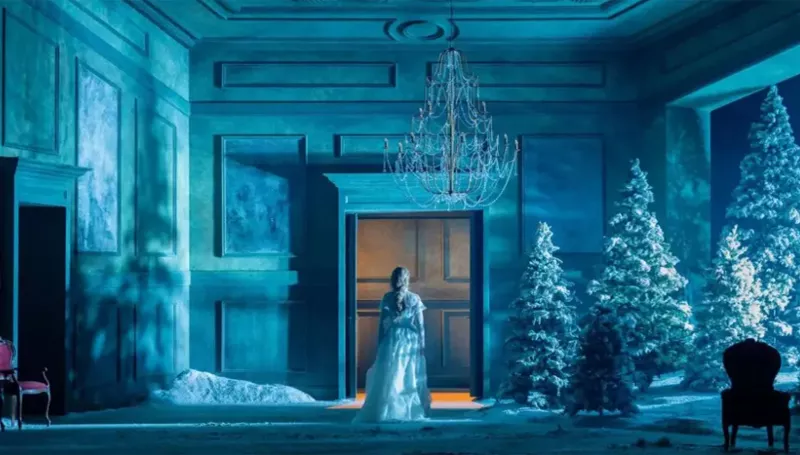
A triumph of the late 1950s, (Samuel Barber won a Pulitzer prize for the music), the libretto and book by Menotti create an atmosphere of dark introspection and the revelation of inner truths. In the Festival production, the scenery and lighting are faithful to the sense of drama, evoking Alfred Hitchock films and film noir camera techniques. Shadows are used effectively to highlight and reveal; light streams out of open doors while the falling snow that is a consistent theme throughout the opera builds up in corners of the house. Snow spills out of the fireplace where different people huddle for a non-existent warmth while snow-covered pines ominously creep into the house as the complexities of plot develop.
Characters are staged in and out of this actual/psychological world; they reach a truly effective conclusion when the five principals stand, each in their own separate circle of light and simultaneously singing their individual songs of desire and need.
The clever conceit of an off-stage church hymn sung in juxtaposition to Menotti/Barber’s counterpoint of character revealed in onstage song is another moment indicative of the simultaneous multiple realities that are presented to the audience.
This is very much a period piece of psychological drama and the production exhibits strength and integrity in embracing that aesthetic. The power of the singers varied, and I wished that the seductive and mysterious stranger Anatol could have embodied the charisma and bravura the role demands. But the emotional tension was grounded effectively in the conflict between the excellent Erika (mezzo-soprano Kayleigh Decker) and Vanessa (Lauren Fagan). An experiment of monumental size for the 1950s, Vanessa is a brave look backwards. It shows that the Festival, under its new leadership, can do ample justice to works from the past while also going forward towards a creative future.