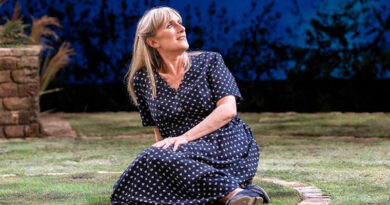
“Othello”, Bard in the Botanics, Glasgow
Mark Brown in Glasgow
★★★★☆
6 July 2026
Bard in the Botanics (BiB) – the annual mini-festival of Shakespeare and other classic texts which is held every summer in Glasgow’s Botanic Gardens – is currently celebrating its 25th anniversary. A quarter century of this moderately funded programme – which has often (and increasingly) exceeded reasonable expectations – is certainly something worth celebrating.

Photo credit: Tommy Ga-Ken Wan.
For a remarkable 22 of its 25 years the festival has been led by its dedicated, indefatigable and talented artistic director Gordon Barr. His festival (which has just announced as its new patron the Scottish actor Forbes Masson) always stages four productions, two on its outdoor stage, two inside the Botanics’ gorgeous, Victorian glasshouse, the Kibble Palace.
This year’s offerings begin with a staging of Shakespeare’s comic morality play Twelfth Night (directed outdoors by Barr’s very able deputy Jennifer Dick) and a truncation of Othello (adapted and directed by Barr, and presented in the Kibble Palace). It would take a needlessly unbending purist to quibble with Barr’s reduction of the Bard’s tragedy of skulduggery, jealousy and murderously misdirected rage.
Far from requiring an assiduous protection of every dot and comma, genuinely great classic texts are – as the rise, in the 20th and 21st centuries, of the “auteur” theatre director attests – more than robust enough to sustain any number of adaptations and interpretations. In fact – although Barr cuts Othello down to 100 minutes (without interval) and six characters – his abridgement is, arguably, most notable for its faithfulness to the essence of Shakespeare’s drama.
BiB has long been celebrated for giving a platform to fine, young acting talent. This production continues that tradition by giving the titular lead to Manasa Tagica, a recent graduate of the Royal Conservatoire of Scotland, who is making his professional Shakespeare debut here.
He is thoughtful and compelling in his playing of the North African, Muslim army captain. In this version Othello commands British armed forces in latter day Cyprus: a choice, one assumes, that Barr made – with extraordinary prescience – before the US-Israeli bombing of Iran led to the Tehran regime targeting the UK military presence on the Mediterranean island.
Tagica’s military man is, necessarily, possessed of more than his fair share of toxic masculinity, arrogance and self-importance. All the better, in this finely modulated performance, for the actor to draw out the underlying weaknesses, fears and insecurities of his character (which are played upon so deftly, and despicably, by Adam Donaldson’s marvellously wicked Iago).
We know that, as Othello’s ensign, Iago famously hates his boss. In this concentrated version of the play, a tremendous emphasis is placed on the combination, in Iago, of personal jealousy (both professional and sexual) and xenophobia (in Shakespeare’s day a person like Othello would have been despised by someone like Iago for his “otherness”, rather than on the basis of the pseudo-scientific racism that would gain a prevalence in the centuries to come).
At the play’s resounding end – during which Iago is bang to rights, but it is Othello who is broken – Donaldson communicates his character’s appalling lack of remorse with an ambiguous, smirking expression.
If Tagica and Donaldson impress, so, too, does the ever-excellent Esme Bayley, whose likeable Desdemona is played with a shuddering shock and terror in the face of Othello’s unexpected, false and violent accusation of infidelity. James Steffan’s Michael Cassio is the picture of military decency and personal honesty, while Isabelle Joss is equally engrossing as both Emilia (Iago’s naïve wife) and Brabantio (the gender-swapped mother of Desdemona, who should, surely, have been renamed “Brabantia”).
Played – as BiB’s shows in the Kibble Palace always are – in remarkable proximity to the audience, this is a pungent and intense rendering.
Until 11 July: bardinthebotanics.co.uk