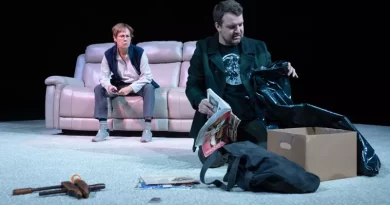
“I, Daniel Blake” at Northern Stage, Newcastle upon Tyne
Dylan Neri in Tyne and Wear
★★★☆☆
30 March 2026
This adaptation of the Ken Loach film has been produced by Northern Stage in Newcastle upon Tyne in association with Leeds Playhouse. The version for the stage is by Dave Johns, the actor who played Daniel Blake in the film.

Micky Cochrane.
Photo credit: Pamela Raith.
The play follows Daniel Blake (Dan), a carpenter, as he applies for social support following a heart attack. His doctor has told him he must not return to work; the Job Centre has declared him fit for work and expects him to look for employment if he is to receive financial support. He appeals the decision. The play is set in the time between his appeal and the eventual appeal date. Crucially, until his appeal date he must seek work. In that time, he befriends Katie and her daughter Daisy who we learn have been forced to move from London to Newcastle in search of affordable and reasonable quality state housing. Initially reluctant to accept the kindness of strangers, Katie eventually sees the decency of Dan, fatherless and a widow, and they become something of a family.
Above all else, the play is intended as a statement about the brutality of the system. The staging is minimal – two chairs, a few shelves and a table – and the cast is six actors. There is little pretence of artistic intention; the focus is the words and actions. The play is interspersed with audio clips of comments by politicians on the benefit system, displayed concurrently as Tweets above the stage along with ironic UK Government adverts for networking events, “reskilling”, etc. The implication is clear: those who rule do not care about the poor. Change is necessary.
Superficially this is a radical work. But a closer inspection shows this to be false. The play is little more than a criticism of bureaucracy in modern society. Daniel Blake has more in common with Kafka’s Joseph. K and Heller’s Yossarian than with citizen-prophets like George Fox or Gerrard Winstanley. That is, the play says nothing about the justification for the current system, only that it isn’t working. Its conclusion is this, “If only everyone was a little bit nicer and had a little more common sense, then the system would work fine.” This is not radical; it is a traditional form of conservatism; one expressed by many peasants throughout history. Those who say, ‘”Just give us enough to eat and a warm place to live and we will work hard.” A truly radical doctrine might be one which asks, “Why do the poor need to rent themselves out in the first place?”

David Nellist and Micky Cochrane.
Photo credit: Pamela Raith.
The writing is clunky and unnatural at times: characters slip into incredibly unnatural dialogue in order to convey a point that they would never make in real life. Dan’s young neighbour, China, for example, seemingly exists only to deliver occasional banal lines such as, “They had him working on a zero-hour contract …” (no young person ever said that), and to rap for about 15 seconds. Or, directly after a scene in which Dan was threatened with a sanction for using a pencil-drawn CV, a shop owner describes the CV as “one of the best I’ve ever seen” (unlikely to be said by any shop owner). When he learns that Dan isn’t really interested in the job but applied only so that he would receive state support, he calls him a “benefit scrounger” and tells him to get a job, rather than, say, listening to the reasonable yet absurd series of events that have led Dan to this point. Again, if only everyone had more common sense; if only everyone was nicer…
Occasionally the play threatens to say something profound, but it is as if the connections have not quite been made yet. The result is ambiguity. Does it argue that benefit scroungers are bad? Are only those who are willing to prostitute themselves to work worthy of help? What about those who reject society and face the consequences willingly? The homeless, the jobless, the scroungers. Are they not the true revolutionaries, the true prophets?
After Dan writes his name in graffiti on the wall, a homeless man takes centre stage and begins a diatribe about “the system”, calling Dan a prophet and a martyr. There is a literary tradition which places profundity in the mouths of the mad going back at least to Shakespeare (maybe even Thersites), but this is not it. What is prophetic about Daniel Blake? Did he stand for anything? Did he demand anything? Did he inspire popular action, change? No, he merely said, “I’ll go to work when I am fit to work, but I am not fit to work; this is absurd.” All he stood for was common sense, not radical change. And as for his martyrdom, his death was incidental. Presumably he would have died of a heart attack whether the system had worked or not; he didn’t die for his beliefs.
The fundamental problem is that the play is monotonous. Things are bad, then they are worse, then they are even worse, then Katie turns to sex work and Dan dies. As with any artistic composition, variation is required; or else absolute clarity of conviction. At least Yossarian had a sense of the irony of his situation, saying, “I’d be a fool to think anything else.” At least Kafka was a great artist. The sense of irony is almost always missing from working class art, particularly in the North East. Yet anyone who has spent more than a minute on a council estate knows that what pervades is the wish to laugh at the capriciousness of the gods. In the play, the moments of humour are artificial and, worse, parochial. After finding out about her move, Dan says to Katie, “It could be worse, pet, you could be in Sunderland!” This gets laughs. And I’d like to think that one day there will be a decent play or film with a Geordie character who isn’t a bit simple, perhaps even vaguely intellectual, and who doesn’t mock his funny accent or reference “the football”.
In the final scene before his death, Dan asks Katie to accompany him to his appeal. She seems happy now that she has money. Prostitution worked! But is the prostitution of one class by another not the logical conclusion of the capitalist system? The play never asks; and its conclusion is never clear. But for anyone who likes their radicalism stuffed within the boundaries of accepted discourse, the play is worth watching.