“The Old Ladies” at Finborough Theatre
David Wootton in West London
31 March 2026
★★★☆☆
Rodney Ackland is best remembered for Absolute Hell, his riotous, baggy tragicomedy about a Soho drinking club, which he reworked in 1987 from his much earlier play The Pink Room, receiving two strong productions at the National Theatre in 1995 and 2018. Now, the enterprising Finborough Theatre has chosen to revive Ackland’s 1935 play The Old Ladies, and give it its first London revival in more than 30 years.

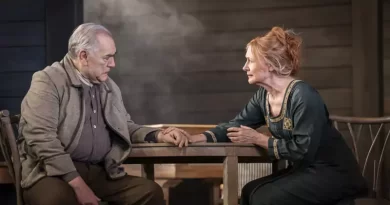
Julia Watson, Abigail Thaw, Catherine Cusack.
Photo credit: Carla Joy Evans.
A taut, tense three-hander, it couldn’t be more different from Absolute Hell. Based on Hugh Walpole’s 1924 novel of the same name, it initially establishes a naturalistic tone, familiar to readers of the works of Arnold Bennett, who, for a while, acted as Walpole’s mentor. However, as it develops, it takes on the character of a thriller, and eventually rises to a Gothic climax worthy of Edgar Allan Poe.
The action is set in a boarding house in the fictional cathedral city of Polchester, which is beautifully characterized by set designer Juliette Demoulin. On one of the smallest stages in London, she has created a claustrophobic yet fluid space that, through its furnishings, suggests the rooms of its three contrasting residents: a tea table, a rocking chair, and a single bed. These are united by curtains and the suggestion of a carpet, all decorated with a vegetal pattern in shades of grey, like the shadows of dying trees. It is Christmas Eve, close to the end of the year, and the mood suggests, perhaps, the end of the characters’ lives.
The sensible, hospitable widow and mother Lucy Amorest (seen often at the tea table) welcomes a new resident – the gentle, anxious spinster May Beringer – to the house (and to her single-bedded room). Sharing such interests as worshipping at the cathedral, they immediately become friends. Unfortunately, the dynamic of the boarding house is complicated by the third resident, also widowed, the prickly and provocative Roman Catholic Agatha Payne (who possesses the symbolically unstable rocking chair).
All three women are impoverished, and living on modest means. So, when Lucy tells the others that an invalid cousin intends to leave her £1000 a year in his will, Agatha exhibits signs of envy and avarice, and badgers Lucy for the promise of a loan. Lucy assents, though her immediate concern is to host a small celebration for her fellow lodgers. She provides refreshments, gives presents, and reveals a Christmas tree as a coup de théâtre. Agatha is astonished by the appearance of the tree and states that only she fully appreciates “beauty in colour”. However, when she is shown May’s most valued possession, a large piece of amber, her appreciation of such beauty is exposed as almost pathological covetousness.
Lucy is soon placed in the difficult position of mediator, as May complains that Agatha taps incessantly on her wall, while Agatha says that May is “frightened of everything”. Even when Agatha shows May some friendliness, and invites her into her room, she does so in an overbearing manner and, still focussed on the amber, with an ulterior motive. She tells May’s fortune, using playing cards, and warns her that she is in danger, threatening her and “gaslighting” her in equal measure. Indeed, the atmosphere of the play may be compared to the work of Patrick Hamilton, the author of the 1938 theatrical thriller Gas Light, from which the term derives.
In Brigid Larmour’s absorbing production, these three women have been perfectly cast, and are well distinguished by the actors who play them. The distinctiveness of each is also emphasized by the costumes designed by Carla Joy Evans.
Dressed in a mid-grey suit with a lace collar, Julia Watson plays Lucy warmly and sympathetically, as one who is well-balanced and resilient, despite having experienced some hardships. Thinner, taller, and wearing a paler, sparer dress, Catherine Cusack portrays May convincingly as one living sadly, even desperately, on her memories and her nerves. In striking contrast to both, Abigail Thaw as Agatha is clothed in black, with equally black jewellery and, when she goes out, elaborate hats. While her appearance succumbs to ostentatiousness, her manner is dangerously expressive. Nevertheless, Thaw is in complete control of her performance, even injecting a quality of black humour into it, and holds back the extremes of voice and action until the chilling end.
The performance is played without an interval and has a cumulative effect, with scenes being separated by the sound of haunting chamber music (Max Pappenheim is the sound designer and composer). If there were moments that occasionally felt stilted, even creaky, they are likely to lessen during the run. The play is certainly much more than a period piece, and, in its exploration of the unease and isolation that can occur in old age, it even occasionally touches the emotional depths better associated with the genius of a Maurice Maeterlinck or a Samuel Beckett.