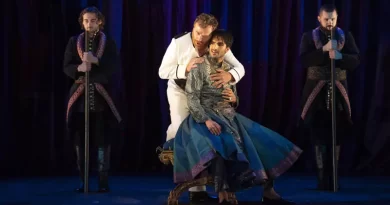
“Romeo and Juliet”, Harold Pinter Theatre
Jeremy Malies in the West End
★★★☆☆
2 April 2026
Robert Icke has his trademark digital clocks again here. They now mark time forwards across three and a half days when in Oedipus they went backwards over 24 hours. So far so good; Juliet (Sadie Sink, Stranger Things) knows that waking at a precise time from her potion-induced coma is vital to her plans. A few minutes’ error will see her entombed. But expecting the standard “two hours’ traffic of our stage”, time began to hang heavy with me as two hours had already gone when the curtain rose after the interval for Act IV. The directing style suggests that we should see all this as being frenetic, but it seldom is.

Noah Jupe and Sadie Sink.
Photo credit: Manuel Harlan.
The production is fitfully brilliant but has little context. I can cope with there being no feud between the two families since whatever dispute a director chooses can often send them off on a bizarre concept production with little investigation of central themes. But here, Tybalt (Aruna Jalloh) killing Mercutio (Kasper Hilton-Hille) struck me as unfathomable street violence.
The production is director-led theatre, and I often wished that Icke would trust the material more. A frustration when assessing this – particularly writing an unenthusiastic review – is that there is a daring insertion of new material at the end which is the main merit of the production. It’s pulled off with skill, imagination, and adept casting but to even hint at it would be a plot spoiler.
Sink’s co-star, Noah Jupe, is becoming a Shakespeare specialist having recently appeared as an actor playing Hamlet on stage within the film Hamnet. Here, he succeeds in conveying the subtleties of his character’s feelings for Juliet, darting from overwhelming attraction to a chivalrous regard for her and willingness to put himself in danger to secure their joint happiness. Jupe excels when expressing bewilderment as Romeo’s emotions build up without once losing sight of the fact that a good outcome may well prove elusive. The celestial imagery and other figurative language can easily become cloying, but Jupe conveys being overcome by a love that is proving transcendent while also being a torture in terms of desire. The hero is most assuredly in love for real rather than in love with the idea of love.
Sink is less impressive with the language. But she suggests a growing confidence that allow her to defy her parents and escape what would be an abhorrent arranged marriage to Paris. (Lewis Shepherd is suitably sullen with a hint of menace and no qualms about his intended bride being treated as a chattel.) Thirteen in the play as written, Juliet is 15 here which seems to be a standard for current productions.

Eden Epstein, Clark Gregg and Sadie Sink.
Photo credit: Manuel Harlan.
Never mind Nurse and Mercutio for the comedy. Sink has wry gag lines herself. “You kiss by the book ….” is chiding and “What satisfaction canst thou have to-night?” should be laugh out-loud. They ought to give her an element of control, but joint voice coaches Penny Dyer and Nick Trumble allow the lines to fall on rocky ground. Where Sink scores emphatically is her techniques for conveying the intoxication and exuberance of first love as she has Juliet punch pillowcases in sheer joy. She progresses from a marionette figure whose strings are being pulled to a young adult with agency.
A simple bed composed of cubes and a set of triple vertical partition shutters at the rear of the stage are the focus of Hildegard Bechtler’s set which is more than minimalist but always streamlined. (The couple are often on the bed, but we must imagine them to be in different locations.) The period is indeterminate. I thought I saw a Dictaphone being used and the weapon of choice is always a dagger. Costumes (also the work of Bechtler) do not suggest a context though fancy dress for the ball is doublet and hose.
Even the tomb of the Capulets is only hinted at with a few caskets and the slab on which Juliet comes to from the potion. It’s as though Icke wants the plot to acquire a dizzying momentum with no impediments. But there is enough in the tomb that it’s credible for Juliet’s senses to run riot as she imagines her ancestors shrieking and sees the ghost of Tybalt with the dagger still run through him.
Fittingly since both the lovers are obsessed with light and speak of it constantly, lighting design by Jon Clark is a major element. It’s often religious in tone ranging from a bank of votive candles during the marriage to illumination of leadlights (monochrome not stained glass) when Romeo visits Friar Laurence played by John Marquez. Marquez succeeds (it’s quite an ask) in being believable as an adult who is willing to side with the youngsters against the Verona powerbrokers.
Back to Mercutio who is a mainspring in this version and was a topic for discussion in the interval. Hilton-Hille has shown us his arse (yes, I know there is an obscure gag about fruit that sets this up) but I was pleased to see the back of him. He continues the visual humour and bawdiness right up until his death throes. Earlier, he has found little meaning and none of the eroticism in the Queen Mab speech. As with the similarly crude jokes and innuendo of Nurse (Clare Perkins single-geared throughout), I tired of the smut. If Icke is going to cut the decent scene in which Romeo’s pals josh him for transferring his ardour so quickly from Rosaline, surely he could trim the arcane and over-earthy smut? A little went a long way for me.
Hilton-Hille did angst well in Polly Stenham’s That Face. But I doubt if his ideal of comedy is barking like a dog while being wheeled around on a palette in a bid to disrupt the Capulets’ ball. It’s a wonder that Icke (no movement supervisor is credited) gives a young actor so little ammunition in only his second major role.
Perhaps the moral of Icke’s take on this is that life is about fine margins? As with Michael Frayn’s Copenhagen and of course Nick Payne’s Constellations, Icke will stop a scene (there is a flash of pure white light) and then have the actors rerun a few lines with changed inflection or redo physical interaction with a slight adjustment. In a play whose whole course hinges on a letter going astray this is eminently logical And yet I still don’t think that Icke’s broad sweep allows the interpretation to coalesce.