“Parsifal” at Bayerisches Statsoper
Andreas Rey in Munich
13 April 2026
★★★★☆
The Munich opera house (Bayerisches Statsoper) has revived for three dates its production of Wagner’s Parsifal in a staging by Pierre Audi with sets by German painter and sculptor Georg Baselitz. The culmination of Wagner’s reflections, both musically and in the conception of the voices and characters, Parsifal is a pinnacle of purity in the lyrical world. The blending of the sections into one another here provides a rare orchestral silkiness while the characters possess an entirely archetypal flesh in this opera.
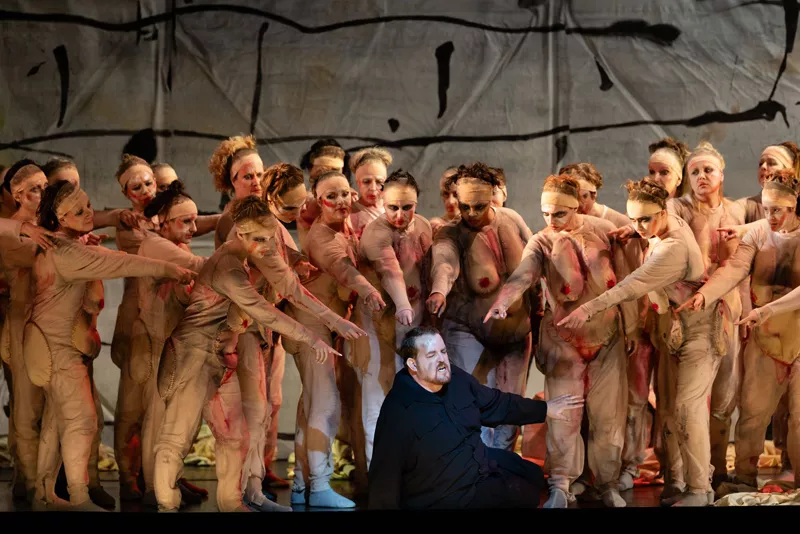
Photo credit: Geoffroy Schied.
The scene imagined by the German painter for this production conveys right from the stage curtains its end-of-the-world atmosphere where everything is raw. The stage curtains—one at the beginning of the first act, the other at the start of the second—indeed show characters lying down—when they are not upside down, this being the artist’s signature with a thinness that is reminiscent of Egon Schiele’s paintings. Nevertheless, fine lines around the feet reveal the entrance to crematoriums. Are we perhaps looking at the aftermath of a Third World War? And this barren land, this ravaged terrain watched over by black trees worthy of expressionist paintings, and in the middle of which a rough assembly of trunks stands like a church—upright in the first act and upside down in the last— is physically chilling.
The second act continues in front of a backdrop depicting a wall, in the middle of which a large tear indicates that this phase is about the women – Kundry and the flower girls – which still retains this idealization.
If Baselitz’s scenography is highly successful, the same cannot be said of the costumes by Florence von Gerkan which for the most part leave the male characters in modest t-shirts and trousers, but above all clothe the heroes around Gunrmantz and the flower girls around Kundry in repulsive nude costumes. Parsifal’s armour in the final act, though made of cardboard, still blends well with the atmosphere of the stage.
But it is above all musically that the production will be remembered.
The Munich Opera Orchestra under the direction of German conductor Sebastian Weigle manages very well to convey this silky Wagnerian flow in which all the sections correspond, and which captivates in this final opera perhaps more than its story. However, an excess of power here and there unnecessarily accentuates the sacredness of the scenes and the processional rhythm of the heroes.
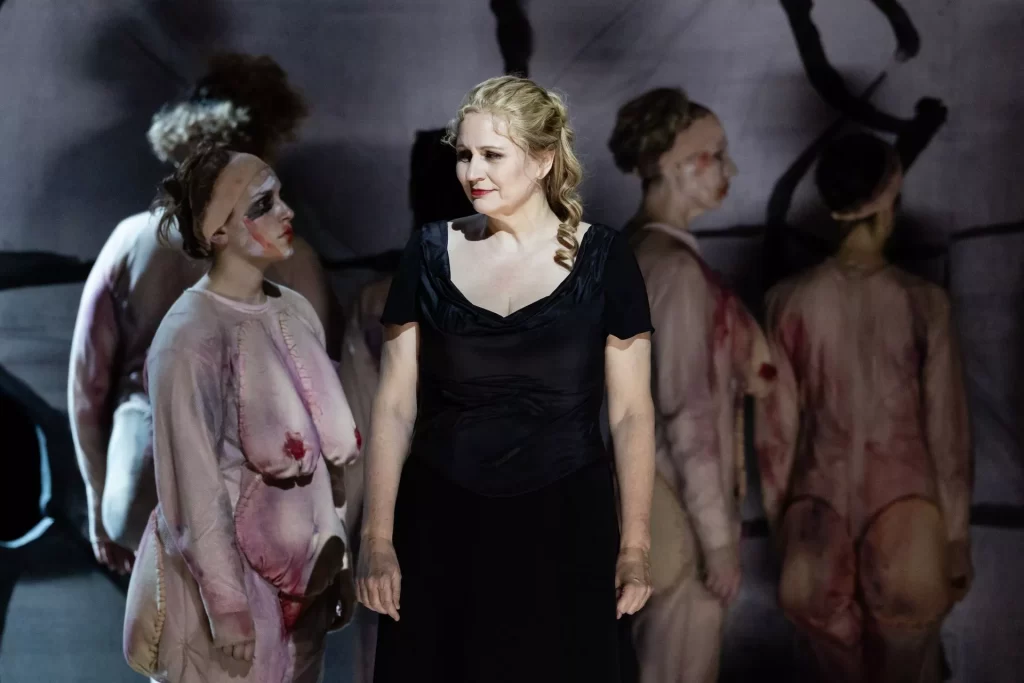
Photo credit: Geoffroy Schied.
And the interpretation by the Swedish baritone Petter Mattei as Amfortas astonishes with his embodiment, both vocally and in his acting. He presents here a sick but still rebellious king, inhabited by a religiosity as afflicted as he is. His entrance with his “Recht so! Habt Dank! – Ein wenig Rast” grips the spectator between terror and admiration, and his arias “Nein! Lasst ihn unenthüllt! – Oh!” and “Hochgesegneter der Helden!” place him at rare lyrical heights. He admirably embodies a king whose wound is not only physical, but psychological and supernatural. A great operatic moment.
And what can be said of the Gurnemanz of the German bass Christophe Fischesser whose use of the lower middle register of his timbre in his speech gives him clarity, restrained emotion, and remarkable nobility. His aria “Du siehst, das ist nicht so” brings out these qualities without breaking his composure, like a wave. A moment of grace. A picky ear might complain that his insistence on the final letters of phrases slightly undermines his naturalness.
We also appreciate the Klingsor of baritone-bass Josef Wagner despite his eclectic outfit whose dry and nasty voice, opposite to that of Amfortas, is also of a dirty incarnation.
And the choruses! If the choruses of the Bavarian opera were remarkable during yesterday’s Macbeth, they show here their expertise in coherence and restraint during their procession and in strength during the final act around Amfortas.
We also note the quality of the Kundry of the German-Italian soprano Anja Kampe who knows how to convey near madness in the first act, sometimes sweet and charming, sometimes murderous and shrill in front of Parsifal in the second, sometimes worthy of a nun in the last act. The range of this role is large, but she is equal to it and makes the ending very moving.
It is regrettable that the American tenor Clay Hilley only manages to find a place alongside the other characters and especially the orchestra during the duet with Kundry when he has to force his voice. He is undoubtedly the Achilles’ heel of this production.
The musical quality of this project, especially that of the voices of Gurnmantz and Amfortas, makes this Parsifal a high point in Munich.