“1536” at Ambassadors Theatre
Jeremy Malies in the West End
★★★★★
17 May 2026
Lucy Kirkwood does it in The Welkin with a setting that is admittedly 200 years later. Apart from pronouns and the odd common noun, Arthur Miller does it in The Crucible. Using the author’s own present-day idiom for historical dialogue has precedents and it’s an approach that works.
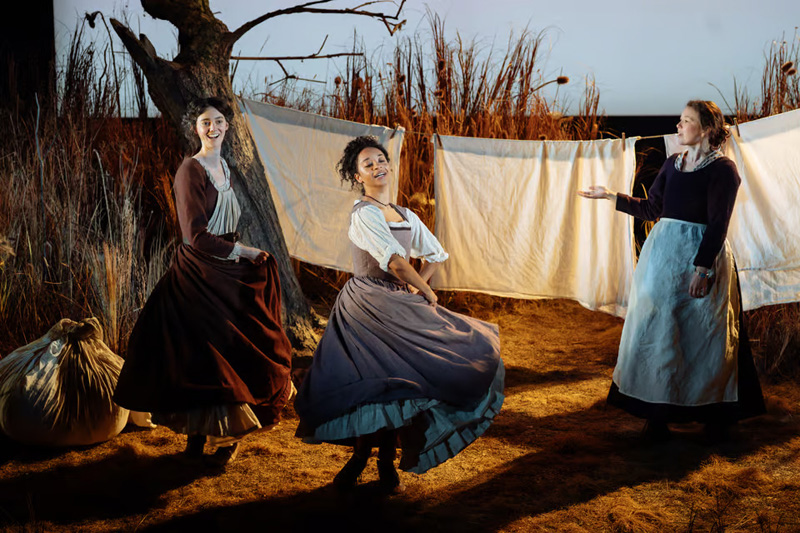
Tanya Reynolds, Siena Kelly and Liv Hill.
Photo credit: Helen Murray.
In this staggering debut play which has transferred from the Almeida, Ava Pickett has four characters from 1536 speak in accessible current Estuary English complete with glottal stops and effin’ and blinding. (My pal who earns his living as a Henry VIII historical interpreter says the Tudors swore even more than us.) No doubt there will be earnest academic papers claiming that we can intuit how the Tudors sounded from how puns work in the poetry of Thomas Wyatt. But truly we don’t, so Pickett’s approach is valid and she pulls it off through insight and technical brilliance backed here by an extraordinary cast.
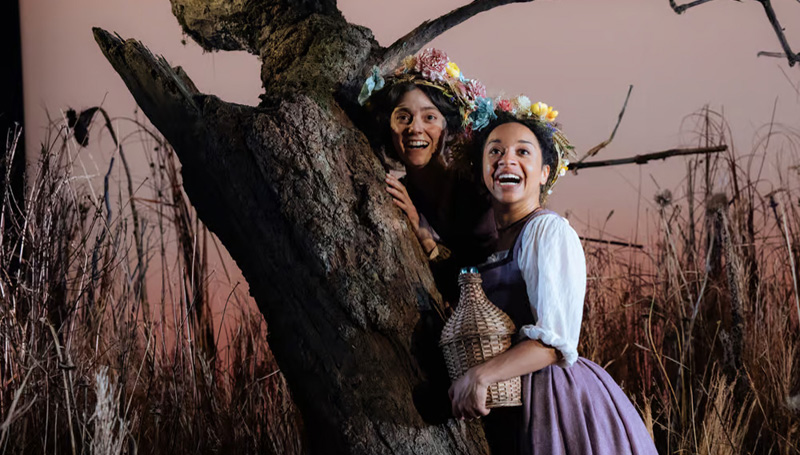
“A field in Essex, May.” is the first entry on the play text. The set by Max Jones never strays from the edge of a cornfield with beaten-down, blanched-out foliage underlining, as the characters continually tell us, that we are in a May heatwave. The first scene begins with hurried (though mutually enjoyable it seems) sex between Anna (Siena Kelly) and Richard (Oliver Johnstone) up against a tree. Helped perhaps by Pickett’s stage directions which are detailed but never prescriptive, Kelly is alluring and teasing such that you believe that Johnstone’s character is in thrall to her though we later learn that his loyalty is owed to another.
The idiom is so up to date that there are even uses of “Fuck off …!” (the statement of the other person being repeated) as a way of contradicting what they are saying. Anna is intrigued by everything that is going on at court and aware that Colchester to London is only a day’s ride on a good Roman road. But she would have to steal a horse, an act that would see her hanged if caught. She is fascinated by Henry’s arrest of Anne Boleyn. But John Pollen, an unseen baker, is more important to her than the monarch because Pollen gives her free bread and possibly a lot more. “I like free stuff and it’s boring to look at ugly men.”
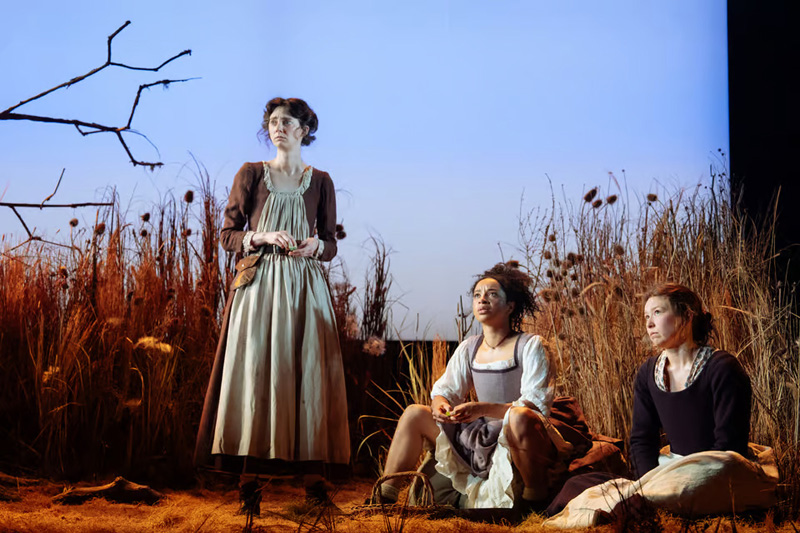
Tanya Reynolds, Siena Kelly and Liv Hill.
Photo credit: Helen Murray.
One aspect of Pickett’s craft as a playwright is to subtly build up connections between this village in Essex and goings-on at Hampton Court. The accusations of multiple instances of adultery against the Queen begin to be paralleled in the male villagers’ increasing distrust of their wives, fiancées, and even daughters.
The three women are from the same social class. Anna has her beauty, sex appeal, and wit to propel her through life. Mariella (Tanya Reynolds) has dragged herself above farm work by going into her mother’s trade of midwifery. Jane (Liv Hill) is from a family with a little land that will be her dowry, and she is engaged to a farmer. We learn that this arranged marriage will be “good for the farm”.
At the macro level, you could go as far as to note that Henry’s previous marriage to Catherine of Aragon had been engineered by his father to keep Spain as a political ally. Again, it’s for the good of the farm. Pickett plays with our historical foresight in terms of wives to come. She applies dramatic irony by the dollop yet always with skill thanks to facility with dialogue. Anna says, “Kings don’t kill their wives!” She is alarmed because she knows that men in villages take their cues from men in palaces.
Pickett excels in changing our viewpoint and showing resonance between extremes of society without ever being tricksy. She is obviously marinated in the period, but her research is not crowbarred in. The facility with dialogue means that the villagers can reflect on Henry’s marriages without seeming like a chorus. “He changed the law so he could marry her [Catherine of Aragon]. He rearranged the world so that she could be his wife.”
Arranged marriages abound at every level. It’s mentioned that one marriage in the village has “been in the works for a while”. In fact, it was decided on early in the groom’s boyhood. There are also parallels – always handled deftly – between the period we are watching and our own day. Tittle-tattle about whether Anne Boleyn might have kissed her brother could come from the pages of HELLO! magazine or a social media feed. It’s even noted that people changed their hairstyles when Anne was coronated though I’m not sure how fashion details would have spread. And there are good gags concerning the commonplace nature of our conversations about the weather.
Pickett gives us many examples of female solidarity. It can breach social chasms to the point of Anna imagining Queen Anne being taken through Traitors’ Gate and identifying with her. The writing is always cohesive, so director Lyndsey Turner has the confidence to break it up superficially by taking us in and out of total lighting blackouts as episodes flow one into another. Elsewhere, lighting designer Jack Knowles shows us lingering, diffused sunsets during which we get a sense of the way that the land has already been warmed during the day.
Costumes (also by Jones) are indeed Tudor with distinctions between the linen smocks of the poor and the velvet of lower gentry. The dialogue tells us that these women are filthy dirty to the point of one noticing that her friend has washed her neck! This contrasts with Henry who was known to be scrupulously clean. He would later be turned off by Anne of Cleves who was none too fragrant. “Sleep with garlic in your pillow and you’ll only have boys,” says Mariella. If only that advice could have travelled the 70 miles to London.
Mariella might have looked above her station socially when aspiring to William, a lower-tier aristocrat (certainly a considerable landowner) played by George Kemp. And she has lost out. I swallowed hard when realizing that she must now attend to William’s wife as she goes into labour. Anna has a Darwinian perspective on marriage and sex. “Oh, you’re always competing!” She (Anna) has the self-knowledge to understand that men do want her, but they want to have her in a field not in their bed. Voice coach Edda Sharpe (there must be some distinction even if it’s demotic language throughout) presumably helps Kemp with a slightly elevated dialect.
As with everything that I seem to see at the moment, there is a plot twist that leaves me hamstrung in describing events. One aspect is a given; the action takes place over about 20 days between Anne Boleyn’s arrest and news of her execution reaching the village.
The play has the poignancy of Brian Friel and includes his signature theme of ordinary lives carrying historical weight or mirroring larger events. Pickett is writing in a mode that spans documented history, archival reconstruction, literary experiment, and almost ventriloquism. 1536 surely heralds a notable theatrical voice across several decades of this century if (at the age of 32 she is also a successful screenwriter) this continues to be Pickett’s chosen form.