“An Ideal Husband” at Lyric Hammersmith
Jeremy Malies in West London
★★★★☆
16 May 2026
In a post-Mandelson (certainly end of his active career) world, director Nicholai La Barrie swaps Wilde’s plotline of Vienna for Washington. Aurora Perrineau as Mrs Cheveley has come from inside the Beltway to blackmail Sir Robert Chiltern who is played by Chiké Okonkwo. Chiltern, a London-based cabinet minister, has sold a state secret years ago. Cheveley who knows about this via a long-dead lover wants to force his lordship to support a scam canal construction project in Argentina.
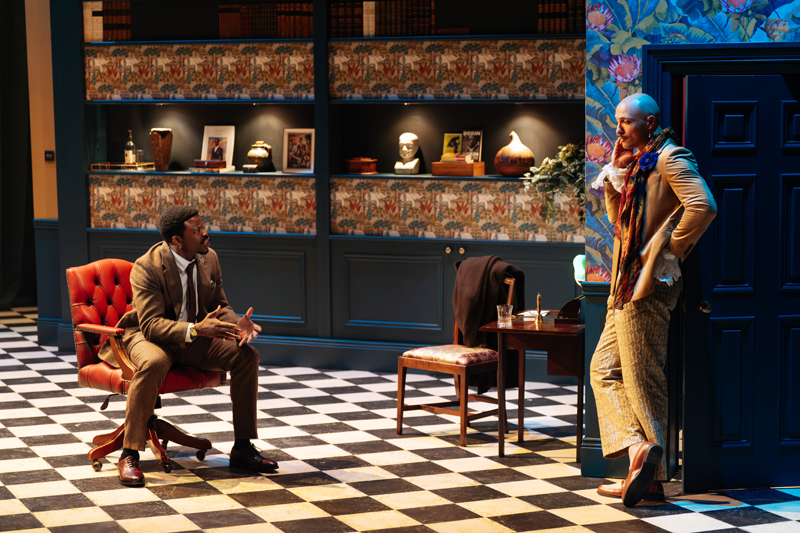
Chiké Okonkwo and Jamael Westman.
Photo credit: Helen Murray.
Beyoncé, Meghan Markle, and the Obamas are referenced. Playing two imperturbable camp manservant roles, Emmanuel Akwafo says that his employers are “the product of Soho House” which was founded in 1995. With the club and its chain associates not faring well, it’s difficult to know how to take this. But reading the text (no adapter or dramaturg credited so presumably this version is by La Barrie) I was struck by how closely he sticks to the piece as written. The few over-the-top anachronisms are witty, and the whole project won me over within minutes. It is imaginative and resourceful at turns.
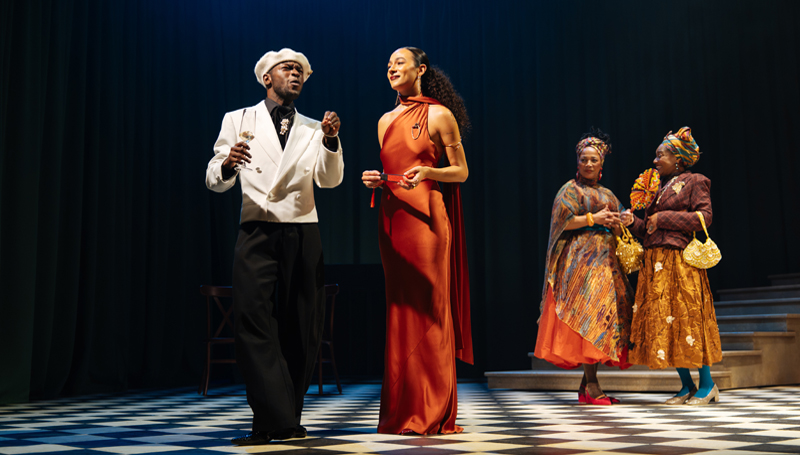
The play is kicked off by Lady Markby (Suzette Llewellyn) and the Countess of Basildon (Nimmy March) who are enjoying an evening without their husbands. Costume designer Rajha Shakiry has them sporting headwrap scarves and gaudy bead-encrusted handbags which stand out from the predominantly monochrome evening clothes worn by others in the first scene. This is perhaps to show them enjoying a night off from listening to politicians.
The countess tells us that she hates being educated. “I like looking at geniuses, and listening to beautiful people.” The epigrams and signature Wildean inversions ignite consistently, and with no voice coach listed La Barrie must have lavished attention on delivery style empowering every cast member in terms of social assertion, defence, delayed emphasis, and flirtation.
Shakiry is also responsible for the wonderful set which begins with the Chilterns’ drawing room. All the geometric forms are clean, from a vaguely Art Deco (I fancy the period has been brought forward to the thirties) staircase to a profusion of harlequin tiles front of stage. The directions specifically ask for a tapestry version of “The Triumph of Venus” but Shakiry wisely decides that it has one too many rococo cherubs or sea nymphs.
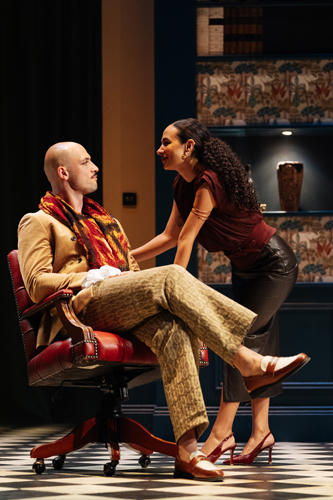
Jamael Westman and Aurora Perrineau.
Photo credit: Helen Murray.
I shouldn’t ventriloquize Wilde, but I think he might appreciate the occasional irreverence combined with innate rigour in this whole project. The Boucher painting can safely go, with its absence perhaps endorsed by the joint owner of the house. (As Lady Chiltern, Tamara Lawrence says, “I am very English in my tastes.”)
Actors don’t just inhabit the set, they seem all of a piece with it. I think particularly of Perrineau who makes her contours follow the stem of a lamp. Hers is the best acting of the night amid stellar performances elsewhere. Perrineau is space-displacing in her squabbles, and extracts much from what might have been formulaic scenes of mistaken identity.
Perhaps the most natural comedian of the night, Jamael Westman as Lord Goring is also inventive here in elements that resemble (good) farce before showing his range when flirting with fiancée Mabel played by Tiwa Lade. Seldom troubling to take his character out of second gear, Jeff Alexander is all allure and magnetism as Westman’s father, Lord Caversham. Alexander radiates just the right kind of physical attraction for the girl who is about to become his daughter-in-law
“Sooner or later in political life, one has to compromise,” says Sir Robert. Okonkwo, whose character is on the back foot from the off, shows subtlety in conveying the tension between moral idealism and political pragmatism that must bedevil all but the saintliest of statesmen.
Of course, there is compromise and there is dereliction of duty together with outrageous disloyalty to those who have championed you. And so, the wheel turns again to Peter Mandelson with Wilde (who had trouble finding a backer for this play) looking as foresighted as ever. To think that would-be producers said his view of politics was excessively cynical!
Trade and state secrets are indeed low priority for Mandelson and Andrew Mountbatten-Windsor. As Mrs Cheveley tells us, “The god of our century is wealth.” Her own sordid blackmailing mission stems from late mentor and lover Baron Arnheim, who hovers over the narrative making us think of Jeffrey Epstein. God and Mammon. La Barrie’s choice and his gentle adaptation of the plot prove outstanding.