“Julius Caesar”, Omnibus Theatre
Jeremy Malies in south west London
★★★★☆
5 November 2025
As Caesar, Roland Royal III swallows and almost abbreviates the famed line “Et tu, Brute?” In a play where the characters speak fluent Renaissance English, Shakespeare makes the strange decision to insert a single line of Latin. Royal and his director Anna Coombs choose to minimize it. What a sensible, intelligent decision in an adaptation that teems with good things.
With the United Kingdom closer to civil war than at any time since the seventeenth century, it must have been tempting for Coombs (who has already directed a regime change play in Richard II) to impose a concept production on this and discuss populist politics. But she does something far more subtle and presents us with a textually rigorous (and yet shortened – only five actors) version that is in no way prescriptive as to how we should interpret the action.
This is the very opposite of a concept production. “Indeed, they say the senators tomorrow / Mean to establish Caesar as a king;” made me think of US elections going on as I type this, and a possible (unconstitutional) run for a third term in office. Coombs emphasizes the passages in which Caesar seems to be an uber-patriot and is ignoring traditional checks and balances.
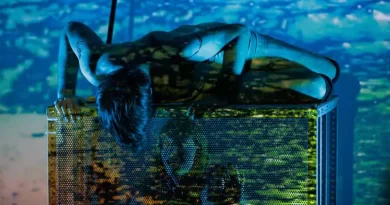
But others in the audience saw the many references to planetary disturbances (evoked wonderfully by Samya De Meo playing Cassius) as a reference to climate change. Set design by Colin Falconer features enormous concentric rings of strip lighting. Are they the planets or is the production making us think about the cyclical nature of history? The project became an enigma, and I enjoyed the way that I was being challenged but in no way cajoled.
Perhaps (and this was an outstanding aspect) the whole thing is a dreamscape by the Soothsayer played by Yaw Osafo-Kantanka? A Ghanaian poet, Osafo-Kantanka speaks mainly in Twi and is the fulcrum here. He certainly conjures up all of the characters, drums them in and out, and may well be releasing the dead into the next world. As citizens of Rome, we are encouraged by him to chant as the plot develops. Playing Brutus, Remiel Farai is all subtle inflection and gesture as he takes us through the character’s complex motives and idealism.
Samater Ahmed played Mark Antony at short notice with book in hand. After what I imagine was a prodigious act of memory, he had little recourse to it. Ahmed ensured that the perhaps over-familiar and iconic funeral oration was fresh and never hackneyed. The speech was measured and moved smoothly between introspection and rhetoric.
The verse-speaking (no voice coach credited) is first-rate across the board with actors using their resting accents. You have to suppose that the characters come from right across Italy and have different levels of education, so this was in no way a hurdle and helped the major speeches to flow naturally. There is no thumping iambic pentameter and the passages of prose from the populace gel with the verse.
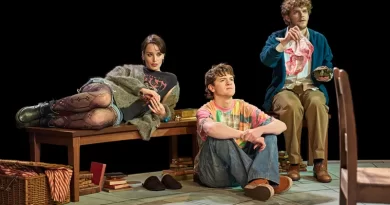
De Meo multi-tasks impressively. She plays Cassius cast as a woman (thus not gender-blind) but no great significance is attached to this – there is no sexual tension with the men around her. She also has to distinguish between her roles of Portia and Calpurnia, and the latter is given some Italian. It works, but an actor with this kind of technical armoury hardly needed it. I was amused by a few lines in which she uses her mimicry skills to imitate Caesar and gently poke fun at Royal’s Illinois-raised vowels.
The production excels across all aspects. Falconer also hints at bolts of lightning with huge sections of industrial grille fencing dotted with dozens of small bulbs – presumably done on a budget. He has worked with lighting designer Joe Hornsby. Original music by Zimbabwean composer John Pfumojena featuring glockenspiel or vibraphone has a minimalist and incantatory quality that put me in mind of Philip Glass.
Are context-free and innately pure versions of this play (as this one is) in any way a cop out? Ambition should be made of sterner stuff after all. No. It is of course great to set a production at a political convention or with the framing device of a women’s prison. But this was refreshing. Tangle Theatre Company, who are known for championing African and Caribbean work, are perhaps the antithesis of the truism quoted by Brutus to Cassius that “… the eye sees not itself”. This project has the self-awareness to let the narrative breathe and allowed me to choose my own interpretations. Impressive work.