“John Proctor Is the Villain” at the Royal Court Jerwood Theatre Downstairs
Jane Edwardes in West London
★★★★☆
29 March 2026
It is a provocative title. Especially that little word “the”. John Proctor may be a flawed character in Arthur Miller’s The Crucible, but his crimes surely don’t compare to those of the preachers and judges who are at the heart of the witch-hunt. That said, by the end of Kimberly Belflower’s rousing play one is beginning to see her point of view. Maybe Proctor isn’t such a great hero after all.

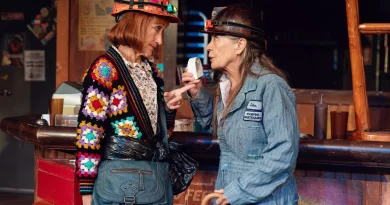
Photo credit: Camilla Greenwell.
The date is 2018 at the height of the #MeToo movement. Harvey Weinstein has just been arrested and charged with rape. Almost all the action takes place in an airy classroom adorned with motivational motifs (designed by Teresa L. Williams of AMP). They’re in a one stoplight town in Georgia. A group of sixth formers are going through the motions of a sex education class. It may be compulsory, but the town’s authorities aren’t keen, the information perfunctory, and the students have long ago picked up what they need to know elsewhere.
There’s nerdy Beth (Holly Howden Gilchrist); smart, cool Nell (Lauryn Ajufo) who has just arrived from Atlanta; pretty, rich Ivy (Clare Hughes); and Raelynn Nix (Miya James), a preacher’s daughter who is saving herself for marriage. And then there’s a couple of guys, one of them Lee, who used to be Raelynn’s boyfriend until he went off with her best friend Shelby.
At first, it feels as if we have landed in a high school comedy. The girls are too theatrically cute and funny to take seriously. But gradually their confusion starts to ring true. While they are keen to be seen as feminists, inspired by their favourite pop stars, they are also at the mercy of their hormones and enthralled by their teacher Carter Smith (Dónal Finn), who is excruciatingly keen to get down with the kids. “He’s like the teacher in an inspirational movie,” proclaims Nell. But this is not Dead Poets Society and Belflower is teasing us.
Plugging into the zeitgeist, the girls want to start a feminist society, which is not initially approved of by their somewhat reactionary school. The school counsellor, Miss Gallagher, worries that the boys will feel left out. And, in any case, this is a small town, and Gallagher doesn’t want to inflame tensions. It’s such a small world that both Smith and Gallagher went to the school themselves before going to college and returning as teachers. Any theoretical discussion about feminism, however, is undermined when a colleague accuses Ivy’s father of having an affair with her. Suddenly, it is someone they know who is being accused and they don’t know what or who to believe. “My dad’s like weirdly my favourite person,” complains Ivy.

Sadie Soverall and Miya James.
Photo credit: Camilla Greenwell.
A powder keg is lit when Shelby (Sadie Soverall) returns after spending several months in Atlanta. She is initially a nervous wreck, unable to string a sentence together as she confronts her friends for the first time for months just as they learn the news about Ivy’s father. She then shocks them further by saying she is not really surprised by the news.
Danya Taymor’s production is particularly touching as Raelynn and Shelby discover that their friendship can rise above Shelby’s betrayal. Raelynn has missed her friend, and they inch towards an understanding of each other. Shelby is bright, a bit messed up, and more worldly than her contemporaries. It would be a spoiler to say any more.
Belflower, who was given permission by Arthur Miller’s estate to use extracts from the play, shows that the hysteria of Abigail and her followers in The Crucible is not so different from the repressed feelings of a group of girls in 2018. The references to the play, as discussed in the classroom, are ingeniously interwoven with the students’ own experience as they begin to challenge one by one the idea that John Proctor is a hero. Didn’t he abuse his power when he slept with Abigail? And is he not more concerned with his honour than with taking care of his wife Elizabeth? Smith struggles to defend him in the face of this onslaught. A wild, impulsive dance is provoked by Shelby and Raelynn in which they imagine a conversation between Elizabeth Proctor and Abigail. Gradually all the girls join in. They can feel their power at last. Cue for great cheers in the audience.
Taymor, who has already directed the play in the US, has drawn strong performances from her British cast and her sympathetic production of Belflower’s play will undoubtedly press many buttons with a young female audience, just as it has done in the States. After a sold-out run at the Royal Court, this high energy, affecting play will surely move elsewhere.