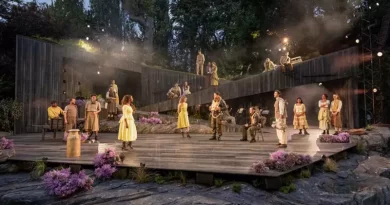
“Salomé”, Vienna Opera
Andreas Rey in Austria
★★★☆☆
6 May 2026
The Vienna Opera has revived its production of Richard Strauss’s Salome, staged by Cyril Teste, with the German conductor Sebastian Weigle at the helm.

Photo credit: Michael Poehn.
Subscribers to the Vienna Opera will have already seen this production, for example last year, with some perplexities, and it must be acknowledged that their questions about it are not likely to disappear anytime soon.
Setting the action during a high-society dinner in the Roaring Twenties—so wild, in fact, that a sensationalist press cameraman films the meal—the tetrarch is here in a tuxedo, Herodias in 1920s evening attire, and Salome blonde with bright lipstick and in a white satin dress.
Salome … or rather, the Salomes, because there are three of them. The singer is accompanied by two teenage girls, dressed like her, whose purpose is unclear. One of them even reads during the action. The other takes over during the Dance of the Seven Veils. Why is that? The Salomes are just one example among many. It would be wise to consider the usefulness of this camera, as what it films, projected onto the background of the stage, disrupts our attention by enlarging what the audience is already seeing. Why is that? This question comes up almost all the time during the production.
The Dance of the Seven Veils is far from being a performance as suggestive, even erotic, as you might wish. The one present, if we can call the gestures of the adult Salome a dance, although containing some suggestive movements, is not, alas, an exciting show; she quickly passes the stage to her young counterpart and the dance of the latter is more reminiscent of an exhortation than a dance. More than the Dance of the Seven Veils, the grand gesture with the severed head leaves one perplexed. It is not the head, but the prophet’s face, so to speak his mask, that the executioner offers to Salome. This allows her to put it on and embrace the princess.

Photo credit: Michael Poehn.
The staging even includes some moments that contradict the libretto, such as the closeness between Salomé and Jochanaan, while the prophet rejects her with all his might.
Beyond these staging issues, what this production suffers from is a serious problem with sound management and the balance between the orchestra and the voices. Up until the arrival of the prophet, it is very difficult to hear the main characters. Narraboth’s voice needs to be warmed up to be audible, and hardly anyone manages this except for the First Soldier, the bass Simonas Strazdas, thanks to his bronze tone. This acoustics issue affects Jonathan, performed by bass-baritone Tomasz Konieczny, and especially Herod, performed by tenor Gerhard Siegel, in terms of their audibility.
But it is above all the Salomé of the Russian soprano Lidia Fridman who suffers the most, as she only manages to have a sonic identity and emotion at the end of the long address to the severed head, which comes very late, because of that. The Herodias of the Austro-Slovenian Monika Bohinec, already struggling with her accent, also has difficulty making herself heard.
Vocally, it is mainly the male voices that save the day. First, the fresh, crystalline, almost childlike timbre of the German tenor Daniel Jenz, which conveys very well the soldier’s exaggerated fascination before his suicide. Then the Jocanahan of the Polish bass-baritone Tomasz Konieczny, who decreases, increases, and varies his vocal strength, making it soft and almost loving when he speaks of Christ and vehement when he speaks of the Babylonian royal family’s sin. Patrons of the Vienna Opera will have seen him as the Dutchman inhabited by death, a true colossus of depression, in The Flying Dutchman the day before. Here, he is even better, as a prophet possessed by his delirium, with acting as fluid and vivid as his voice. He saves the first part of the opera.
To save the second part, the one with the Tetrarch, is the tenor Gerhard Siegel, who holds this role with sprechgesang (speech-singing) and an acting style close to the grand theater, portraying a man with paedophilic libido, estranged from his wife, and impotent towards his stepdaughter. A very great embodiment.
The orchestra under the German conductor Sebastian Weigle is surprising here; far from merely emphasizing the edges and sharpness of the score, it also highlights the relationship between the xylophone, the harps, and the strings to accentuate the unhealthy and strange atmosphere of the palace.
No doubt, one had to turn a blind eye, or even two, and listen closely to appreciate this Salomé …