“Stand & Deliver: The Lee Jeans Sit-in”, Tron Theatre, Glasgow
Mark Brown on Clydeside
4 May 2026
★★★☆☆
Currently, across the UK, the number of trade unionists stands at 6.4 million (or 22 per cent of the workforce). This is lower, of course, than in the 1980s when Margaret Thatcher and Nicholas Ridley plotted their Conservative government’s gloves-off assault on the British labour movement.

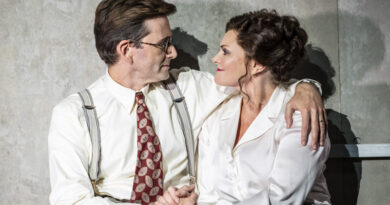
Photo credit: Mihaela Bodlovic.
However, it is considerably higher than many Thatcherites hoped and expected by the third decade of the twenty-first century. One suspects that this resilience of trade unionism (rather than mere nostalgia) is the key reason that we are seeing new stage plays about high points of working-class struggle in the UK.
Last year, for example, Townsend Theatre Productions toured their fine production We Are the Lions Mr Manager (which my colleague Jeremy Malies reviewed here). That play traces the famous 1976-78 strike by the predominantly female, South Asian workforce at Grunwick Film Processing Laboratories in North London.
Now, in a similar vein – with the prestige and resources of the National Theatre of Scotland and (its co-producer) Glasgow’s Tron Theatre behind it – we have Stand & Deliver: The Lee Jeans Sit-in by Frances Poet. The play tells the story of another overwhelmingly female workforce – the garment makers in the Lee Jeans factory in Greenock, in Inverclyde – who hit the headlines in 1981 when they took on their Reaganite American bosses.
Although the plant was profitable, the US owners were bent on closure because the local subsidies had run out and similar largesse was now available in Belfast.

Photo credit: Mihaela Bodlovic.
The workforce occupied the plant to prevent management from whisking the crucial machinery and fabric over to Northern Ireland. What followed was a seven-month occupation that concluded with the factory being bought out and the remaining workforce being kept in employment (for a time, at least).
Perhaps even more importantly, the lives of the strikers were changed utterly by an occupation that involved exhilarating highs (such as solidarity, both between themselves and from workers from around the UK and the world) and dispiriting lows (notably the lack of support from the leaders of their own union).
The play is inspired by the accounts of the women involved in the dispute (140 workers, a clear majority of the workforce, remained in occupation until the end). Writer Poet and director Jemima Levick have fashioned from this story a work of jukebox theatre.
Drawing on rock and pop music of the period (from “Duran Duran” to “The Specials”), the show intercuts dramatic scenes with live music performed by actor-musicians (even musical director Shonagh Murray is on-stage, in costume). The production boasts a really fine cast, led by the superb Joe Freer, who is compelling in the lead role of factory shop steward (and the strike’s leader) Helen Monaghan.
Pleasingly, Poet’s script doesn’t skip over important – but potentially controversial – details, such as Monaghan’s sympathy for Irish Republican hunger striker Bobby Sands and his comrades (10 of whom, including Sands, died). Crucially, Freer depicts Monaghan, not as a firebrand radical, but as a reluctant leader, driven by a working-class sense of justice she had inherited from her father.
Some of the most powerful scenes in the play are those in which she disciplines fellow strikers for breaking the all-important rules of the occupation. These carry echoes of Jimmy Reid’s famous speech to the Upper Clyde Shipbuilders sit-in of 1971-72, in which Reid told the striking workers: “there will be no hooliganism, there will be no vandalism, there will be no bevvying [drinking], because the world is watching us, and it is our responsibility to conduct ourselves with responsibility, and with dignity, and with maturity.”
The six-strong cast plays a multitude of characters, and there is a series of excellent performances in the central roles of Monaghan’s son Finlay (Aron Dochard), and the Wallace sisters Maggie (Chiara Sparkes) and Cathie (Hannah Jarrett-Scott). However, the decision to make two-dimensional caricatures of many of the secondary characters backfires.
These subsidiary roles – from the oily leader of the garment workers’ union to the factory’s drunk mechanic – may be played for laughs or pathos, but the drama demands more rounded and nuanced characterisations.
More problematic still is the use of music. “Stand & Deliver” offers (sometimes pretty thin) thematic connections between the action of the play and the songs.
The musical numbers are played perfectly well, but the musical dimension isn’t integrated into the drama in any meaningful way. Rather, the piece has a stop-start structure that kills any sense of theatrical momentum.
This play explores an important episode in Scottish working-class history with tremendous sympathy and a depth of understanding. It’s just a pity that its ill-considered structure saps dramatic energy.
Touring until June 10: nationaltheatrescotland.com