“Mass” at Donmar Warehouse
David Wootton in the West End
★★★★★
6 May 2026
There can be little in life that is worse than losing a child, and to know that your child has been murdered must be particularly painful. However, how would you feel if your child had committed murder and had then taken his own life? Might not the pain be greater, and more complex, rather than less?

Photo credit: Richard Hubert Smith.
Based on the screenplay that he himself directed in 2021, the American Fran Kranz’s devastating new stage play, Mass, handles these issues in the light of a large-scale high school shooting. At its centre are two couples, one whose son has been killed, and one whose son was the killer. Six years after the tragedy, they agree to meet, and the conversation that they have lies at its heart.
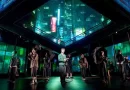
The play is set in the meeting room of a modern episcopal church, that has been offered as a safe space. It appears in every naturalistic detail on the broad but shallow Donmar stage in a breathtaking design by Anna Yates. Behind the spare interior of the meeting room itself lie a hall and kitchen, both seen through sliding glass panels. Above these is a landing glimpsed through a series of slit windows, which allow light to enter from outside.
Young Brandon (Amari Bacchus) and middle-aged Judy (Susie Trayling), two members of the church, prepare the room ahead of the arrival of the visitors. If Brandon is curious about the event, Judy is anxious to ensure that everything is ready and in place. She has bought too many groceries, in the hope of satisfying any likely need, and is careful in arranging the furniture. Nevertheless, there are moments of humour in their exchanges that belie the gravity of what is to come.
The first to arrive is Kendra (played by Rochelle Rose), a counsellor who represents the parents of the killer, Hayden, and who has facilitated the meeting. She adjusts the arrangements with the obliging Judy, and checks with Brandon that organ music from the church will not prove intrusive.
The church is close to the home of Hayden’s mother, Linda (Monica Dolan), and the others have travelled to meet her. Her husband, Richard (Paul Hilton), has flown in, suggesting early in the action that he and Linda are no longer married, while Gail and Jay Perry (Adeel Akhtar and Lyndsey Marshal) have driven. Linda and Richard are formally dressed, while Gail and Jay are more casual (costumes also by Yates).
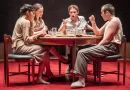
Soon, the couples are left alone and, settling at the table, they begin to talk. Any danger that the discussion between these four seated people will seem static is cleverly mitigated by placing them on an extremely slow revolve. This is the one stylized element of Carrie Cracknell’s finely tuned, hyper-real production (which achieves Kranz’s goals of “verisimilitude and intimacy”, inspired by his experience of working with his fellow playwright Richard Nelson).
However, the discussion is so absorbing and the revolve so slow that it takes a while to realize that the movement is happening. And, once one does, one appreciates the opportunity to see the facial expressions and body language of each actor in turn. Gradually, the personalities of the individuals and their relationships to the boys emerge.
Having shared news of their surviving children, the mothers show each other souvenirs of those that they have lost. Gail has chosen photographs of her son, Evan, but Linda has brought a jar of paper snails made by Hayden. It is Linda who first breaks down in tears, and Gail who offers her paper tissues.
The men try to introduce the wider implications of the shooting, but Gail is resistant to discuss politics. Instead, she is keen to learn more about Hayden than she could glean from all that she has read. So, Linda and Richard explain that, because of house moves, a lack of friends, and a period of bullying, Hayden became isolated and depressed. He reacted by spending increasing amounts of time in his room playing a fantasy computer game, and, after his elder brother left for college, he became angry and threatening, but also deceitful.
Disturbed and frightened, his parents chose delusion as a way of coping, and now blame themselves. Richard says that he regrets everything, while Linda admits that “I wished he had killed me”, which prompts Jay to respond, “he destroyed … all of our lives”. Jay, especially, wants to label Hayden as a psychopath, but his case is not straightforward and, while the conversation proceeds by way of a series of questions, accusations and rebuttals, none of its four participants find easy explanations for his violent behaviour.
The conversation allows for a release of some pent-up feeling, and does seem to bring a degree of relief. For instance, Linda and Richard are able to describe how difficult it was for them to come to terms with being the parents of a murderer, being treated almost like criminals themselves in the aftermath, both by the police and the media. And, late in the play, the women try to characterize their sons by telling two contrasting stories.
The quietly powerful intensity of the play is communicated through some extraordinarily strong and subtle performances. Only occasionally do any of the four main actors raise their voices or rise from their seats, and they are called to express much through these limitations. Akhtar, as Jay, is the quickest to move from friendliness to fury, while Marshall, as his wife, is the stillest, though signalling defeat rather than tranquillity. Dolan, as Linda, quivers nervously alongside Hilton, as her cadaverously contained husband. They are well supported by the other actors.
Kranz was partly prompted to write Mass in reflecting on the concept of “restorative justice”, which had been popularized by its use by the Truth and Reconciliation Commission in post-apartheid South Africa. The play is not the examination of the societal reasons for large-scale shootings that some commentators have seemed to have wanted, but rather an exploration of the personal experiences and feelings of those who are left behind, and, on its own humane terms, it is moving and even profound. Given the subject and its treatment, there can be no pat verbal conclusion to offer the audience. But there is a moment of aural and visual transcendence (for which lighting designer Guy Hoare, sound designer Donato Wharton, and composer Katrina Rose must all be credited).