“The Truth” at Apollo Theatre
David Wootton in the West End
★★★★☆
27 June 2026
Over the last dozen years, the plays of Florian Zeller have secured as solid a place on the London stage as on that of his native Paris. His international reputation is based on his masterly ability to apply urgent, economical dialogue to a surprising range of themes and genres, all of which chime with a wide audience – from a profound examination of dementia in The Father (his British breakthrough in 2014) to a hilarious exploration of veracity in The Truth.
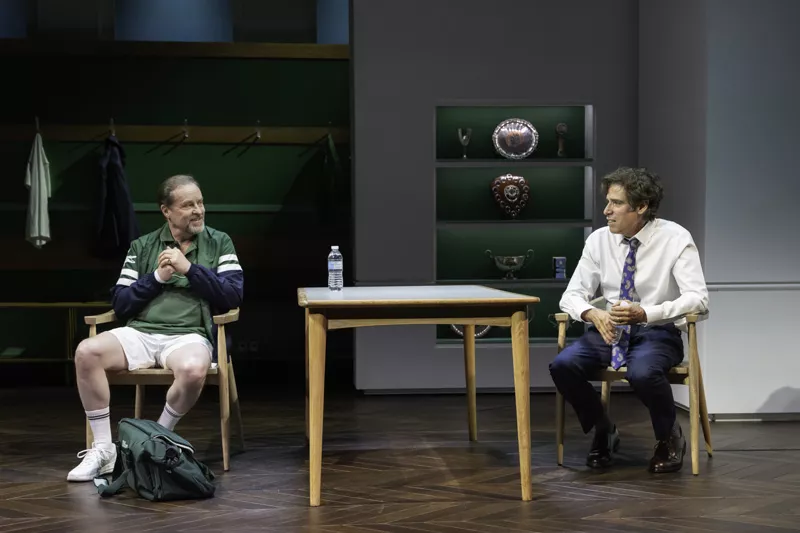
Ardal O’Hanlon and Stephen Mangan.
Photo credit: Johan Persson.
First seen in London at the Menier Chocolate Factory in 2016, The Truth is now revived at the Apollo in an accomplished new production by the same director, Lindsay Posner, and with an impressively starry cast. Superficially, at least, The Truth is a perfect boulevard comedy, building on the legacy of the likes of Georges Feydeau and Sasha Guitry. However, its wit, flair, and pace belie a more serious intent and another influence – that of the English playwright Harold Pinter. The published text of The Truth opens with a quotation from Pinter’s Betrayal, and, to a degree, it is a riff on that earlier play, in its articulation of the lies that are sparked by, and support, infidelity.
Zeller has said that, when The Truth “was first staged in Paris, people would tell me, ‘This play is so English …’ But when it premiered in London, people told me: ‘This play is so French!’” Nevertheless, it integrates well into the British repertoire, partly because of its skilful translation by Zeller’s regular collaborator, playwright Christopher Hampton. Hampton has a long track record of adapting from the French, including most notably Choderlos de Laclos’ novel Les Liaisons Dangereuses (which recently enjoyed a revival at the National Theatre) and Yasmina Reza’s plays. And, with Zeller, he has developed a relationship that is mutually sympathetic and trusting, the fruits of which are revealed in every scintillating word of The Truth.
Running for just under 90 minutes without an interval, The Truth is structured through seven dialogues, each of which presents an episode from the unravelling life of the central character, Michel (played by Stephen Mangan). As in the plays of Bertolt Brecht, these scenes are given titles that are projected above the stage and subtly direct the attention of the audience. Lizzie Clachan’s elegant and ingenious set design (lit by Richard Howell) ensures the smooth running of the action, while suggesting a box of tricks within which Michel has been trapped, or indeed has inadvertently trapped himself given his desire for control.
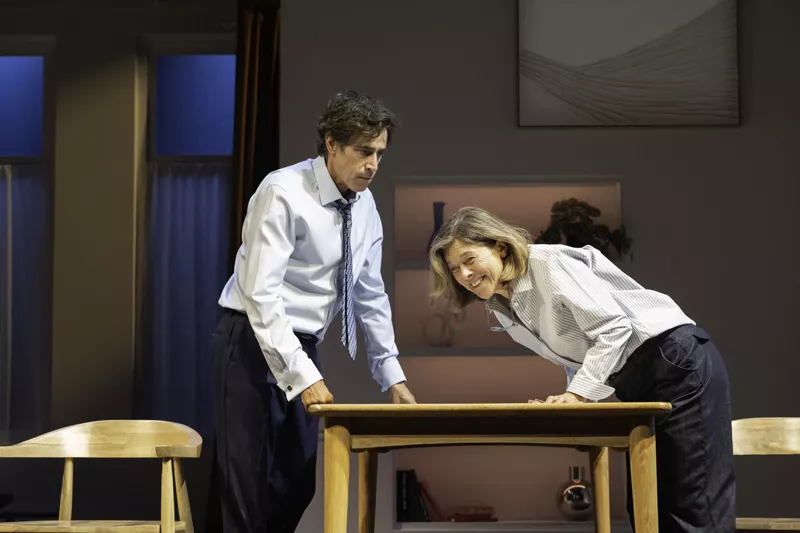
When the play opens, Michel and Alice are in the midst of an affair of several months’ duration, and are together in a hotel bed. As they rise and dress, it becomes clear that this is their latest “rendezvous” (the scene’s title), and that their relationship consists of a series of such snatched afternoons. Alice (played by Sarah Hadland) wants a greater degree of commitment, indicated by a weekend away, but Michel is initially happy with the status quo. Only when she proposes that they should break up does he agree to spend more time with her, and eventually he even phones his colleague Guillaume to cancel an appointment and so stay. He is more preoccupied with ensuring that their spouses do not find out about their meetings, and especially Alice’s husband Paul, his best friend. He convinces himself, if not Alice, that deception possesses an almost ethical quality, protecting the others from what they do not know.
On returning home, Michel finds that his deception is less watertight than he had imagined (as is signified by the second scene’s title, “Tightrope Walking”). His wife Laurence (played by Janie Dee) has met Guillaume in the street and has learned that Michel had told him that he is unwell and in bed. Michel says that he cancelled his appointment to visit Paul, who has become depressed because he is unemployed. However, Laurence explains that she has not only seen Guillaume but has also received a call from Paul asking to speak to Michel. Affecting the manner of a petulant child, Michel feels that Laurence is setting traps to test his alibi.
Michel and Alice take their weekend away, but the hotel room is so like their last one that it signals that their relations have reached a point of stagnation, even desperation. In what is surely the funniest scene of the play, they have to compound their lies to their spouses to such a degree that, in a telephone conversation with Paul, Michel is forced to impersonate the aunt with whom Alice has said she is staying. Yet, persistently self-absorbed, he still tries to persuade her that “it would be very selfish” to tell Paul the truth. In fact, Michel is so determined to keep the full truth to himself that he is the last to discover exactly what it is …
Throughout the play, Zeller entices and teases the audience in equal measure. Sometimes they are allowed to feel they know a little more than Michel, and sometimes a little less. And so absorbing is the journey that gasps and other expressions of surprise are likely to punctuate the laughter.
Mangan is riveting in the demanding central role of Michel. On stage throughout, he has to set the tempo and carry the narrative while appearing shambling and increasingly out of his depth. Though ostensibly smartly dressed in a suit and tie (the costumes also designed by Clachan), he is often in a state of dishevelment, and he frequently lets slip his obvious charm to expose his character’s inadequacies.
He is well matched by Hadland’s Alice. Hadland portrays Alice as a generally intelligent, capable woman, who has to try to manage Michel to get what she wants from him, and protect herself from being overwhelmed by his selfish demands. She has strong stage presence, and is especially good at enacting the elements of physical comedy when events get out of hand.
Dee’s Laurence presents a cool contrast to Michel (and indirectly to Alice). She is able to stay calm and speak quietly during his outbursts, though she can summon anger and reveal sentiment when necessary.
In the performance by Ardal O’Hanlon, Paul is the most subdued and enigmatic of the four characters. As with Laurence, he contrasts with Michel in being modest and unbombastic, probably because he comes from a position of greater strength. He delivers what is possibly the play’s most disarming line when he admits to Michel that “we didn’t tell you” the truth “because we love you”.