
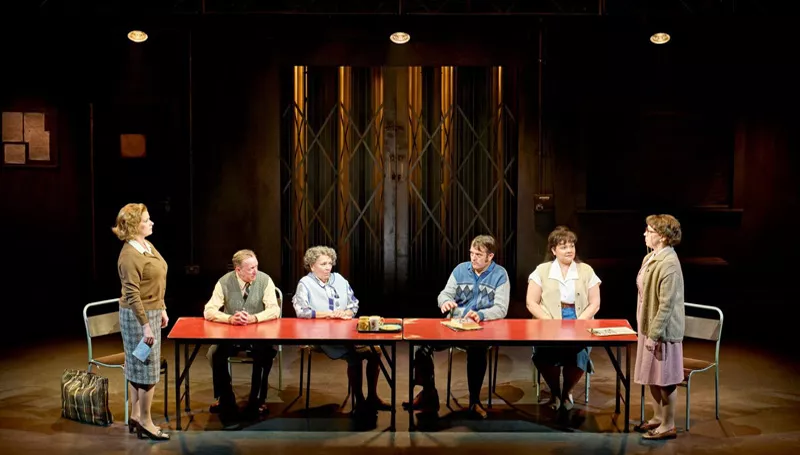
“Pride” at Dorfman, National Theatre
Louise Penn on the South Bank
★★★★★
28 June 2026
It’s 1984, and the pre-show tunes and slides remind us of cultural icons, political milestones, and industrial unrest. The new musical Pride – which premiered at the Sherman Theatre, Cardiff earlier this year before arriving at the National Theatre – is set at the time of the miners’ strike, where workers stayed on the picket lines just short of a year.
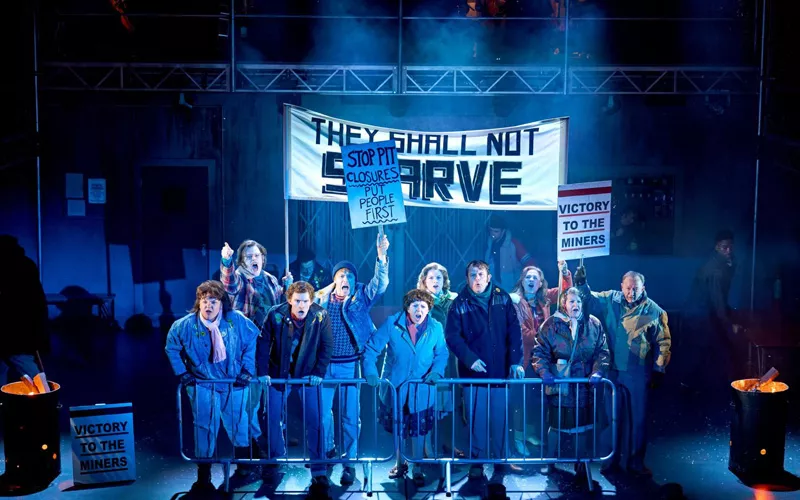
Photo credit: Manuel Harlan.
In London, young activist and socialist Mark Ashton wants to do something to help them – raising money at the Pride march, then setting up the support group Lesbians and Gays Support the Miners (LGSM). Together with Mike Jackson, Gethin Roberts, Jonathan Blake, and Stephanie Chambers, Mark tirelessly raises money and contacts the Dulais Valley miners in South Wales to hand over the money and, against the odds, form a bond with their resilient and chapel-going community.
The book and lyrics of Stephen Beresford, together with music by Christopher Nightingale, Josh Cohen, and DJ Walde, really dig deep into the social and economic realities of the 1980s, when the Thatcher government dismantled Britain’s industrial power and news outlets were intolerant of anything that threatened the straight status quo. Based on the 2014 film (like the musical written by Beresford and directed by Matthew Warchus), Pride inevitably takes some liberties with the real story. The character of Joe, referenced for most of the show as “Bromley”, just 20 years old and stumbling upon his own sexuality, is fictional.
The musical also removes or minimizes some of the more difficult scenes from the film, instead focusing on making the show a celebration and commemoration of those who went before us to help communities and build a path to attaining equal rights for gays and lesbians.
Where Pride really succeeds is in its more emotional second act, where “You Stood by Me” weaves in the Welsh choir tradition with protest anthems; solidarity and songs are the breathing heart of this joyous and heartbreaking musical. There is a moment when the action pauses to honour those the decade lost to AIDS, the creeping menace that was to take the life of Ashton, aged only 26, and leave Blake as one of the longest-living diagnosed in those early days. Then there are the declarations of personal power: Jonathan has his fantasy moment opening Act Two, and Joe has perhaps the best line of the night (“I like c**k and Ethel Merman”).
Pride is about two communities coming together against the common enemy – and yes, there is one person in the valley who hates that and tries to ruin it. But there is also understanding, friendship, fun, and empowerment.
The sequence where the women of the valley take a tour round the gay club, learning all the vernacular, is hilarious and subversive. It’s a vibrant f**k you to those who spit at gay men and call them names. It isn’t lost on us that Ashton chose to call LGSM’s fundraising concert “Pits and Perverts”.
Each performance brings something special to the show. Jhon Lumsden (Mark) is the passion; Matthew Durkan (Mike) the anchor. Samuel Barnett (Jonathan) adds flamboyance, and Chris Jenkins (Gethin) the reserve. Courtney Stapleton (Steph) is the tough lesbian who gets things done. And Jordan Shaw (Reggie) is cautious, fearful of being noticed.
In the village, Matthew Woodyatt (Dai) gives a sensitive, warm take on his role while Madeleine Morgan, Gillian Elisa, Sarah Pugh, and Mared Williams are a great quartet of sheltered but open-minded Welsh women. And Darren Lawrence (Cliff) finds his own journey just as much as Joe, offering an understated understanding of himself.
Technically, Bunny Christie’s set is suggestive of industrial Britain, and her costumes are period sharp. Lizzi Gee’s choreography is sensational and enhanced by Hugh Vanstone’s lighting and Bobby Aitken’s sound. The wigs, hair, and make-up by Campbell Young Associates are also excellent.
Pride still feels relevant now, when social media can quickly demonize a community for their economic, political standing, or their sexuality. The message that we should stand together, and that we are better for it, comes across strongly. In the audience, there were a lot of tears alongside the laughter, my own included. If you lived through the period, it still hurts and angers. If you didn’t, take this as a history lesson in how to fight and be yourself, whatever the outcome.


