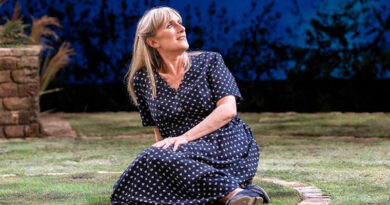
“Nayatt School Redux” at The Coronet Theatre
David Wootton in West London
★★★☆☆
19 April 2026
In devising Nayatt School Redux, the legendary American ensemble The Wooster Group poses questions about the nature and recovery of performance. It is a restoration and reworking of Nayatt School, one of the company’s earliest and most famous pieces, composed by Spalding Gray and Elizabeth LeCompte, and premiered in New York in 1978. However, Nayatt School itself involves an exploration of another work, T. S. Eliot’s 1948 verse drama The Cocktail Party, and its performance history. So, what the audience experiences is, in large part, a complex act of theatrical archaeology, be it one that is idiosyncratic, intriguing, entertaining, and ultimately explosive.

Photo credit: Gianmarco Bresadola.
At the outset, Kate Valk sits facing the audience to describe and explain the premise of the production and its staging. The flat screen television that is mounted behind her shows newly restored archival recordings of an early performance of Nayatt School. However, the sound quality is so poor that Valk narrates and, with her fellow actors, appears to read the parts of those on screen (though clearly they have learned them by heart).
The stage furniture replicates a simplified version of the original set, with long, bar-like tables and stools, along with a tent frame. While a substantial soundproof room has been jettisoned, a projection on the back wall has been added to suggest the interior of the Performing Garage, The Wooster Group’s permanent home in SoHo, Manhattan.
In her drily humorous commentary, Valk weaves together the history of her own involvement with The Wooster Group and Spalding Gray’s genesis of Nayatt School. From his childhood, Gray preferred listening to reading, so that vinyl records of performances became important to his education. These included The Cocktail Party with its original cast, headed by Alec Guinness, and Drop Dead! An Exercise in Horror, a 1962 compilation of Arch Obeler’s dramatic vignettes. Both are incorporated into Nayatt School, connected as they are by the figures of medics, the psychiatrist Sir Henry Harcourt-Reilly played by Guinness in the first and a series of demented doctors in the second. The recordings are played on turntables placed close to the audience, while Obeler’s horror-themed skits, as incorporated into Nayatt School, are seen on screen.
In 1966, Gray had appeared as Alex in an American production of The Cocktail Party, directed by the Welsh actor-manager John Wynne-Evans, who played Harcourt-Reilly. In Nayatt School, it was Gray who played Harcourt-Riley, and, as Redux develops more certainly out of lecture and into drama, Scott Shepherd takes on the role of Gray, and then the role of Gray as Harcourt-Riley. And, as Gray can be seen on screen, Shepherd needs to accomplish a degree of impersonation to achieve the desired effect, which he deftly does.

Photo credit: Gianmarco Bresadola.
Shepherd takes up the action of The Cocktail Party at the point in Act Two in which the psychiatrist Harcourt-Reilly is consulted by a patient, Celia Coplestone (played by Maura Tierney). Celia has been a factor in the breakdown in the marriage of Edward and Lavinia Chamberlayne, and Harcourt-Reilly encourages her to break away and start out on an individual path, a path that will lead to sainthood.
Books are lain, and even thrown, aside, as the eight-strong cast becomes more active and begins to perform an edited version of the remainder of Eliot’s play – which culminates in a cocktail party, hosted by Edward and Lavinia, now reconciled, and a startling revelation about Celia’s situation. However, nothing about The Wooster Group’s rendition is as one expects, or even, in other circumstances, what one would necessarily want.
Most productions of The Cocktail Party attempt a subtle shift in tone from drawing room comedy to morality play. The version in Redux, however, dispenses with naturalism in favour of a frenetic expressionism. Adding suggestions of costume to their modern dress, the actors speak artificially and move jerkily, sometimes to a soundtrack of loud funk. It is perhaps a relief that the coda to Nayatt School is not performed in Redux but is only described, by Valk, as it combined divestment with destruction, Gray, for instance, baring his backside while drilling a hole in a record.
Like the original Nayatt School, Nayatt School Redux is directed by Elizabeth LeCompte, a founder member of The Wooster Group and doyenne of theatrical innovation, and she is also its main designer (Enver Chakartash assisting with the costumes). She surely knows what she wanted to achieve, and she could hardly be bettered in gathering the disparate elements and striking a precise balance between telling and showing.
As LeCompte composed the piece in collaboration with the entire company, all were fully involved, and their commitment feels evident through all aspects of the production. However, though it seems almost to go against the spirit of the endeavour, a few individuals should be mentioned for their contributions both off and on the stage: Andrew Maillet (one of several providing the additional video), Michaela Murphy (assistant director), and Omar Zubair (responsible, with Eric Sluyter, for the sound and original music).
The Wooster Group was founded in 1975, just a decade after the death of T. S. Eliot. In creating a coalition – not to say collision – between the poet’s restrained, even austere brand of modernism and the company’s exuberant experimentalism, Nayatt School Redux provides a fascinating opportunity to reflect on the American avant-garde, both the diverse character of its history and its present energy.