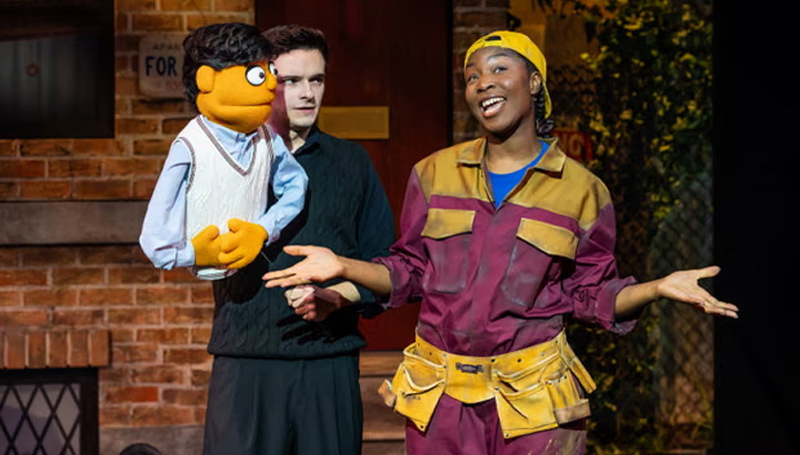
“Avenue Q” at Shaftesbury Theatre
Franco Milazzo in the West End
★★★★★
20 April 2026
The return of Avenue Q to the West End 20 years after it first landed here should be a cause for celebration. It thumbed its nose at political correctness and embraced diverse real-life topics that most musicals steer well clear of, not least pornography, racism, and student debt, There may no longer be the shock factor it enjoyed in 2006 but the quality of Robert Lopez and Jeff Marx’s songs stands in stark reprimand to its modern competition.
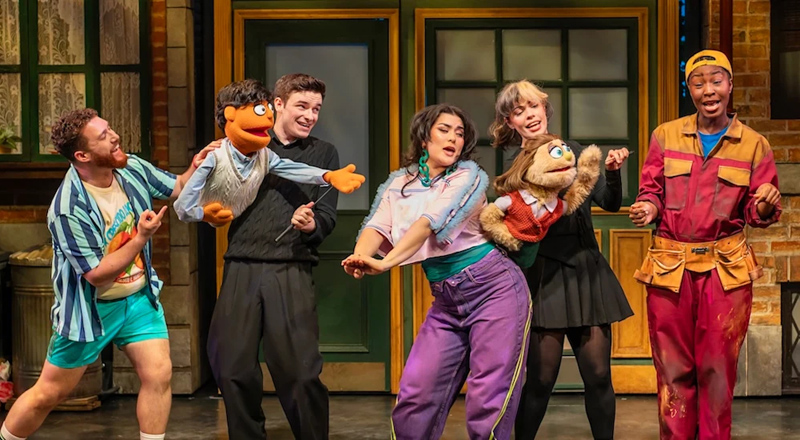
Photo credit: Matt Crockett.
Premiering in 2003, Avenue Q emerged from an unlikely collision of influences: the wholesome sensibility of children’s television and the irreverent sensibility of off-Broadway comedy. It then transferred to Broadway before arriving in London two years later. Lopez went on to co-create the inferior The Book of Mormon (a Naked Gun to Avenue Q’s Police Squad!); in many ways, Avenue Q walked so Lopez’s follow-up could run continuously in the West End for the last 13 years.
Princeton, a graduate weighed down by a useless English degree and an unhealthy amount of optimism, arrives in a rundown New York neighbourhood with his heart set on finding his purpose, employment, and an affordable place to stay. In Sesame Street-style, his neighbours are an endearing mix of humans and puppets also trying to make sense of adult life. There’s Rod, a closeted Republican investment banker, and Nicky, his slacker roommate; the pair bear more than a passing resemblance to Bert and Ernie. Next door is internet-addled misanthrope Trekkie Monster who looks like he may enjoy a cookie every now and then. Then there’s Kate Monster who dreams of opening a school for furry folk like her, Japanese-American therapist Christmas Eve with two degrees, and one wannabe comedian husband and supervisor Gary Coleman whose name and backstory tallies with the real-life child actor.
This isn’t a show renowned for its subtleties and could be considered, in parts, the most crass thing in town. Who wants nuance, though, when you’re watching something which beat Wicked to a Tony for Best Musical? In place of the acres of subtext and many long-winded conversations which underpins modern theatre, we have the relentless and merciless skewering of social hypocrisies. Numbers like “Everyone’s a Little Bit Racist” and “The Internet Is for Porn” are deployed with gleeful singalong vulgarity, while quieter moments, notably “There’s a Fine, Fine Line”, find genuine emotional weight beneath the satire.
Photo credit: Matt Crockett.
There will be those who will no doubt deride its now less-than-topical references and characters in Avenue Q. Jeff Whitty’s book has been updated in several clever ways – Princeton’s “mixtape” to Kate, for example, is now a Spotify playlist – but some would question the inclusion of Gary Coleman, most famous for his part in the eighties sitcom Diff’rent Strokes. However, topicality should not be used as a stick to beat up works that are still as entertaining as this show.
The cast, gamely straddling the dual demands of puppetry and performance, bring a kind of double-consciousness to the stage: they must be both visible and invisible, both actor and apparatus. The result is occasionally uncanny, and incredibly impressive. Standout turns come from Noah Harrison as the naive Princeton opposite Emily Benjamin as both painfully earnest (and occasionally brutally honest) Kate Monster and the rather more straightforward Lucy the Slut. As Christmas Eve, Amelia Kinu Muus brings scintillating comic skill to a role that continues to dance with controversy and come out with 10s across the board.
Jason Moore’s direction leans into nostalgia rather than reinvention which (depending perhaps on whether you grew up with dial-up screeches or Instagram stories) is either a strength or a limitation. Ebony Molina’s choreography is brisk, the pacing efficient, and there is thankfully little sense of preaching: the show is here as much to provoke thoughts as laughs.
And yet, when the ensemble gathers for the closing number, “For Now”, something curious happens. The show suddenly becomes as fresh as ever. Its central thesis, that everything is temporary, lands with unexpected force in an era more attuned than ever to cultural impermanence, the news cycle, and existential disasters on every corner, be it from climate change, AI domination, or President Trump. It is here that Avenue Q justifies its longevity, not as a relic of early-2000s irony, but as a modest, rueful meditation on the absurdity of growing up.