“Ivanov”, Grand Théâtre de la Ville de Luxembourg
Dana Rufolo in Luxembourg
21 April 2026
Ivanov as a character in the eponymous drama must be one of the original practicing existentialists and is certainly the character seed for Anton Chekhov’s future plays. The work of a young Chekhov still in his twenties, Ivanov has also the flaws of a young playwright; for instance, he hasn’t quite gotten the sense of ennui correctly positioned within the stage characters and the rhythms of the drama – build-ups to denouement – are scratchy.
There are two plays entitled Ivanov; the one shown at the Grand Théâtre de la Ville de Luxembourg is the first rather unpopular version of 1887 that was superseded by the version of 1889 which won over the cultural elite in Moscow and led to Chekhov’s enduring fame.
Myriam Muller was brave to take on Ivanov, though she was undoubtedly encouraged by the applauded translation published by Éditions Actes Sud in 2000 by André Markowicz and Françoise Morvan which modernized the script. The play was produced in French with almost the same cast Muller used six years ago; the present Ivanov is a revival.
The stage designed by Anouk Schiltz is an inner rectangular playing area, each side surrounded by raked blocks of auditorium chairs. A splattering of couches, tables and chairs indicates the setting is an interior space. This allows the actors to move in and out of the area without any restrictions, an advantage in giving them freedom to address all four audience clusters but a disadvantage when characters such as the dying Anna, Ivanov’s unloved wife, is portrayed as someone enclosed within a small and isolating room.
Anna (Sophie Mousel) is the soul of the play because she occupies a central position with regard to all the other characters. A former Jew who was deprived of her family wealth because she converted to the Orthodox Christian faith when she married, she is portrayed as a gentle tender woman who plays the piano and retires out of sight gracefully. She appreciates the attention of the spindly doctor Lvov (Mathieu Besnard) who is righteously indignant because Ivanov will not take her on a cure that might save her life. Usually calm, Anna can also become emotional. She is enraged when her husband Ivanov cruelly tells her she has tuberculosis and is dying. She cries, because she does not want to die. It is difficult to play a very ill woman who is also angry, since fragility would naturally limit the capacity to be intensely emotional, but the actress is further handicapped because Ivanov is relentlessly unwilling to empathize with her.
Ivanov, played by Jules Werner, is the physical presence in the play who is most strikingly modern. He questions the choices he made in his life, sees as mistaken his youthful conviction that he was a hero, and has sunk into lassitude because he can’t accept the reality of being penniless and without purpose now that he is 40. He is initially dressed in a bathrobe, which is, like all the other costumes, contemporary. He has no useful activity and yet retains friendships, especially with Lébédev, played by Valéry Plancke – a tall, square shouldered man with an air of the past clinging to him and who has lent Ivanov large sums of money.
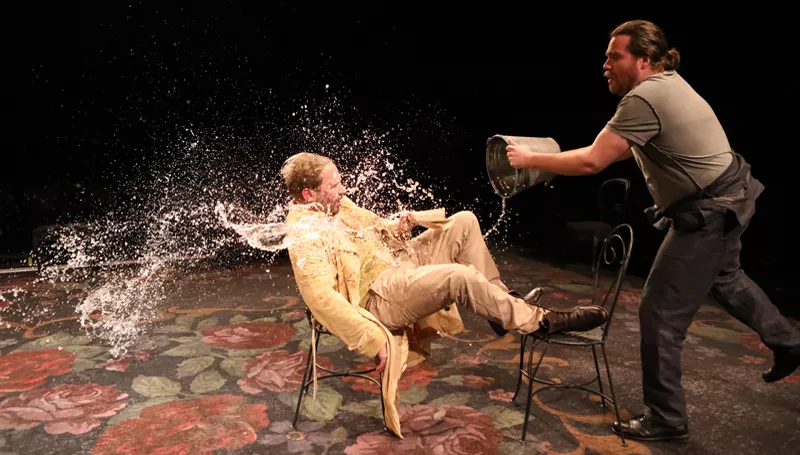
The other characters add comedy (a curious drinking contest, for instance, or a scene where Ivanov’s steward Borkine, played by Pitt Simon, throws a bucket of water on him while he sleeps and then sheepishly apologizes) and lines of interaction. But it is really the young Sacha, Lébédev’s daughter, who introduces an unpredictable element in this group of elderly, alcoholic and often crass persons. She has a crush on Ivanov and bounces into the scenes on stage at unexpected times, always ready to seduce Ivanov.
Manon Raffaelli plays Sacha, who amusingly is referred to as “la petite” though she is quite large. At the play’s conclusion, Sacha is in a bridal veil, the stage floor is covered in (artificial) white rose petals, and it seems she will become Ivanov’s new wife since Anna has meanwhile died. When Ivanov, dressed as the groom, declares he will not marry her after all, she runs to her mommy and daddy to demand their support, and they and friends all agree that Ivanov must marry Sacha even though they initially shared misgivings. But the planned future is stopped dead in its tracks because the play ends with Ivanov unable to transcend his self-loathing. He falls over alone on stage while everyone else is waiting for him in church. Chekhov instructed that he commit suicide with a pistol, but Muller preferred to keep his death symbolic, emphasizing that his is the death of the psyche.
The doctor is a comedic figure with his pompous sense of superiority to the others. “I am honest,” he declares, implying that nobody else is. A humorous scene has him advancing upon Ivanov, accusing him of cruelty. In a final gesture, he slaps Ivanov casually on the forehead. After a pause, the slap is returned, and the two men wrestle. Nothing changes, however. In the characteristic Chekhovian world view, these two men are not morally opposite but different facets of the same pretentious social system in which they have been bred.
Happening approximately midway through the two-hour show, Sacha’s birthday party is intended to switch the mood away from the boredom and aimlessness Ivanov exudes into the collective aggressivity of the later scenes, and it is therefore staged as comic relief. Despite the balloons and dancing and jolly good times, there is a sense that the whole happy event is forced; melancholy hangs around in the background. The actors hand out edible decorations from the birthday cake to a few audience members, intentionally dissipating the potential intensity of the scene and emphasizing its theatricality.
As a final add-on, Muller makes sure that references to corruption and dissipation in Chekhov’s play have contemporary parallels: singers belt out a song consisting of two words, “F**k You”, to the accompaniment of drums.