“Vincent in Brixton” at Orange Tree Theatre
Jeremy Malies in South-West London
★★★★★
23 March 2026
“It takes a while to find the knack of liking English paintings,” says Jeroen Frank Kales as the 20-year-old Vincent van Gogh. The year is 1873 and Vincent has walked from Greenwich to Brixton of a weekend and been charmed by Eugenie (played by Ayesha Ostler) who is the daughter of a school mistress. Mother and daughter are welcoming of strangers, and Eugenie has been serving tea to passersby on the street. Vincent notes that the house is advertising a room to let.

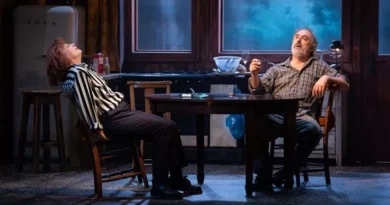
Niamh Cusack as Ursula.
Photo credit: Johan Persson.
He is interviewed as a potential lodger within a few moments of the start, this being a slick technique by which author Nicholas Wright (he won the 2003 Laurence Olivier Award for Best New Play with the piece) eases us through exposition. Goupil & Cie are now an elite online art auctioneer. At the time of the action here, their focus was on being Europe’s leading dealership and London staff included Van Gogh.
The fulcrum of the play is the relationship between Vincent and Eugenie’s mother, Ursula, played by Niamh Cusack. Ursula is a widow who has been wearing black for 15 years since the death of her French husband. In exploring how Vincent and Ursula interact in every sense, Wright springboards from documented facts in census records and the painter’s letters to the realms of sleuthing and semibiography. He does this in a bewitching way that would surely allay the objections of even the most literal-minded audience members.
Is there just a bit too much coy foreshadowing of Van Gogh’s paintings to come, and is the play’s structure in any way a lazy device by which lashings of dramatic irony accumulate for anybody who knows even the rubric of the artist’s life? Not for me. On his first evening, Ursula sets the new lodger to peeling potatoes, surely a reference to “The Potato Eaters” which Vincent would sketch, etch, and paint in North Brabant some 12 years later.
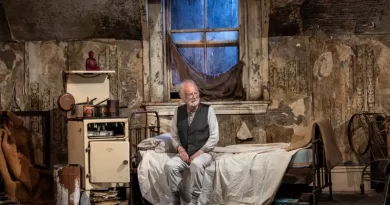
Direction by Georgia Green has the cast clustered around a broad-grained wooden table that has been lugged to London from Sussex. It’s a kitchen sink drama of another kind, with many of the characters using the plumbed-in Belfast sink. As somebody who can neither cook nor act, I marvelled at the close prop work with movement direction by Jenny Ogilvie and set by Charlotte Henery combining to allow the cooking of complex dishes in front of us with equipment that certainly smacked of the right period. It’s a high-wire act of sorts. The other major paintings are trailed such that Vincent exits to observe a starry night, while in the final scene (we move to 1875) his sodden boots are put on the table to dry and he sketches them.

Jeroen Franks Kales as Vincent van Gogh.
Photo credit: Johan Persson.
Kales (he is a recent graduate of Mountview and in his professional stage debut) develops the impulsiveness and candour called for by Wright’s text into a range of nervous tics such that he appears impulsively judgemental, in both positive and negative senses, of everything that is put in front of him. The tics sustain him through appraisal of the paintings of fellow lodger Sam (idiomatic and naturalistic if slightly anachronistic acting from Rawaed Asde) to the switching of his character’s interest from daughter to mother, and development of the relationship with Ursula.
The whole project would fail if Cusack were not so adept at showing how her character is amused, stirred, rescued from grief, and finally enraptured by the young visitor who lodges in her home as well as her head. The ending is ambiguous as she holds a flickering lamp which may begin to glow steadily or be snuffed out. There has been a battle (nominally over territory but in fact a conflict between sibling and romantic love) when Vincent’s sister Anna, played by Amber van der Brugge, arrives via the packet ferry across the North Sea to Harwich. The pair truly look like brother and sister which helps and, it hardly needs mentioning, they are both Dutch so there is no need for voice coaching.
I believed absolutely in scene and locale. Usually it’s the theatre critic’s cliché, an unthinking stale formula but here it’s accurate and a compliment to say that lighting by Lucía Sánchez Roldán is painterly. Occasional use of yellow filters is the obvious sunshine in the paintings at Arles but also I believe the mature Van Gogh’s notions of the divine. Scene and locale are always credible; it’s almost a heightened realism that runs counter to Van Gogh’s techniques.
The play has much to say about social mobility. Everybody is striving to better themselves. Even Ursula’s tiny pupils are preparing for competitive entrance to grammar school. Ursula says, “My desire is for someone near me to get out of the rut. That’s why I started the school.” Sam is a painter in the sense of being a painter and decorator, but he too wants to paint in oils and wins a scholarship which he cannot take up. Asde gives the character wonderful flourishes as he dismisses the obsessive accuracy and self-satisfied posturing of Alma-Tadema.
One of Vincent’s letters to the strict Dutch Reformed household back home (his father was a pastor) includes, “A woman does not grow old as long as she loves and is loved.” It could just as easily be a reflection on one of his customers at the art dealership and have no relevance to his landlady, but Wright bases his plot around this. The play is penetrating, restrained, and coherent in tone throughout. And it sets us thinking about who we fall for. How, why and for how long? The structure might be art about art, but the main question posed is primal and concerns the fleeting nature of happiness.
The entire run of Vincent in Brixton is sold out but the production will be screened.