“The Price” at Marylebone Theatre
David Wootton in North London
★★★★☆
28 April 2026
Though the plays of the American writer Arthur Miller have often been performed and studied in Britain since his death in 2005, there seems to have been a significant increase of interest in them during the last year. For, hard on the heels of groundbreaking productions of All My Sons (directed by Ivo van Hove at Wyndham’s Theatre) and Broken Glass (by Jordan Fein at the Young Vic) comes a pitch-perfect, understated staging of The Price from Jonathan Munby.

Photo credit: Mark Senior.
Premiered on Broadway in 1968, The Price proved to be Miller’s biggest hit after his masterly 1949 tragedy, Death of a Salesman. Both plays concern family tensions fuelled by economic failure and professional disappointment, but The Price is more realistic in style than its famous forerunner. Writing in The New York Times on 14 November 1999, at the time of an American revival, Miller explained that the play “grew out of a need to reconfirm the power of the past” in response to two events: “the seemingly permanent and morally agonizing Vietnam War”, and a lack of understanding of its origins, and the rise of theatrical absurdism, which seemed to deny “continuity … in any human behaviour”. However, it may also have been prompted by the death in 1966 of Miller’s father, who, like the departed parent in the play, was bankrupted by the Wall Street Crash of 1929.
The action takes place in the attic apartment of a New York brownstone, which was once the home of the Franz family, but has lain empty since the death of the elder Mr Franz 16 years before. Now the entire building is to be torn down to make way for a parking lot, and the elder son Victor has decided to sell the apartment’s contents to an antique dealer and appraiser.
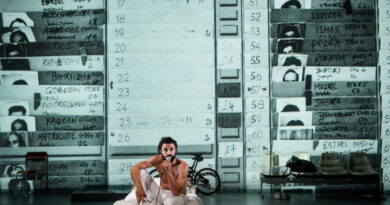
Even before the performance begins, the attic imposes its presence on the gathering audience, and it is almost like a fifth character, so essential is it to the unfolding events. Evocatively designed by Jon Bausor, it is a cavernous space that is lit by two large skylights and, as the play proceeds, by a variety of lamps (the lighting is designed by Anna Watson). It is stuffed with articles of furniture and other items that are described in loving detail by Victor and arouse strong memories for him, his wife Esther, and later his brother Walter. Centrally placed is an armchair that – along with a stool and side table – sits on a circular rug and appears to symbolize the absent father, as a harp upstage symbolizes the more distantly deceased mother. (Max Pappenheim’s string-heavy score seems to conjure up her love of music and, more generally, a lost age.)

Photo credit: Mark Senior.
As Victor (played by Elliot Cowan) waits for the antique dealer, he has a long, uncomfortable conversation with Esther (Faye Castelow). She hopes that, at the age of 50, he will retire from the police force, finish his education and take up a more satisfying line of work. She also believes that money – whether from the sale of the attic’s contents or from elsewhere – will make them happier. Her dissatisfaction is fuelled by her belief that Victor sacrificed himself, by staying to look after his father and enabling Walter to attend medical school and so become a successful and wealthy doctor. And it is exacerbated by a long rift between Victor and Walter that has been emphasized recently by Walter failing to answer Victor’s calls. Esther, whose disappointments have turned her to drink, sums up Walter by calling him “a selfish bastard”.
Soon after the arrival of the antique dealer Gregory Solomon (Henry Goodman), Esther leaves to collect Victor’s suit from the dry cleaners so that he can change out of his uniform before they go to a movie. Clothing is an important indicator of identity and status both to her and the other characters, and their costumes are as thoughtfully designed by Bausor as the set.
Mr Solomon’s appearance lightens the mood. He is a funny, fast-talking Jewish New Yorker who has experienced much in his 89 years and loves to share his wisdom on almost any subject. Though Victor made it clear on the telephone that he wants to sell everything as a single lot, Solomon begins evaluating each item, leading Victor to retort, “you’re not taking the gravy and leaving me with the bones”. Solomon says that Victor “must have looked” him up “in a very old phone book”, as he has really retired and cannot take on such a large load of heavy, unfashionable objects, whatever their quality. Their intrinsic and associative value are painfully raked over as Victor attempts to get Solomon to name a price. Then just as he names it, and Victor agrees, Walter (played by John Hopkins) arrives, and Act One comes to an end.
Act Two centres on the first meeting between Victor and Walter in several years, and how their differing perspectives on the past and on their father affect their approach to the present sale. When Esther returns, she finds herself siding with the more worldly Walter, who proposes a shady deal in which Solomon would receive a fee to appraise the furniture at a much higher value than that originally agreed, so that they could donate it to charity and claim a massive tax deduction. He even offers to give the entire profit to Victor and Esther as a sign of peace. Unsurprisingly, Solomon prefers that they accept the original deal. The final decision and its outcome lie with Victor.
While all four of the performances are outstanding, it is Elliot Cowan who carries the production. Victor is a demanding role, and not only because he is on stage throughout the action of an admittedly long play. He also has to communicate the understandable but unpretentious frustrations and resentments of an ordinary guy, and he does so with great sympathy. Faye Castelow well conveys the complexity of Esther’s emotions, while John Hopkins captures Walter’s moral ambivalence, charm, and apparent concern soon slipping to reveal a degree of ruthlessness.
Henry Goodman was born to play Solomon, and he gives an extremely winning performance, lighting up the stage and almost threatening to steal the show. The vaudevillian routine in which he eats a boiled egg is, in itself, worth the price of a ticket. But there is also great depth to his interpretation, and he and director Jonathan Munby cleverly underscore the parallels between Solomon and the departed Mr Franz. When he sits in the armchair and begins to laugh hysterically to a novelty record, the power of the past is undeniably reconfirmed.