“Broken Glass” at the Young Vic
David Wootton on the South Bank
★★★★★
9 March 2026
The Young Vic has made something of a speciality of presenting powerful revisions of American classics. Benedict Andrews’ production of Tennessee Williams’ A Streetcar Named Desire in 2014 and Ivo van Hove’s production of Arthur Miller’s A View from the Bridge in 2015 remain seared into the memory. More recently, in 2022, Daniel Fish and Jordan Fein presented a revelatory retelling of Rodgers and Hammerstein’s musical Oklahoma!

Photo credit: Tristram Kenton.
Now Fein returns to the Young Vic to direct Miller’s Broken Glass, and he shows that this apparently difficult late play is both a masterpiece and extremely relevant to current concerns. While Miller habitually tackled the intersection of the personal and the political in his dramas, in Broken Glass he created a work that confronts “what it means to be Jewish, apparently trying to deal with his own Jewishness”, as Martin Gottfried explained in his 2003 biography of the playwright. In so doing, Miller achieved a profound exploration of identity, prejudice, and persecution from which all could learn.
Written in 1994, but set in 1938, Broken Glass takes as its starting point a pair of questions. Why should Sylvia Gellburg, an otherwise healthy Jewish New Yorker, aged about 40, have lost the use of her legs? And how, if at all, should this paralysis have been affected by her preoccupation with newspaper reports of the Nazis’ persecution of Jews (especially Kristallnacht – the Night of Broken Glass)?
Sylvia’s husband Phillip persuades his near Brooklyn neighbour Dr Harry Hyman to take her case and, though Hyman is not a psychiatrist, he decides that the cause is psychosomatic rather than physical, a diagnosis confirmed by his colleague Dr Sherman. As a result, Hyman begins to consider Sylvia’s condition in the context of her life, and especially her relationship with Phillip. And soon Phillip – in his character and behaviour – becomes as much the focus of attention as Sylvia.
In contrast to Dr Hyman, who has married a “shiksa” and seems to have successfully, even gracefully, assimilated, Phillip is at once proud and ashamed of his Jewishness. He harps on his exceptionalism as the only Gellburg in the telephone directory, the only Jew to be employed by Brooklyn Guarantee, and potentially the father of the first Jewish general in the American army. By so doing, he acknowledges his identity while separating himself from it. And, critical of recent Jewish refugees from Germany and, implicitly, the victims of Nazism, he personifies the oppressor as much as the oppressed. His attempts to shore up this unstable sense of self have long disrupted his intimacy with Sylvia, and have now affected her mobility. But they also have a big impact on his own wellbeing.

Photo credit: Tristram Kenton.
Dr Hyman is no bystander in this unfolding tragedy. While advancing his understanding of the situation through conversations with – variously – Phillip, Sylvia, and Sylvia’s sister Harriet, he becomes far too emotionally involved. His attraction for, and to, women is voiced by all the female characters, including his wife Margaret, and he comes dangerously close to beginning an affair with Sylvia. And, while his approach ultimately proves comforting and even energizing to Sylvia, his attractive personality exposes, and perhaps even exacerbates, the inadequacies of Phillip.
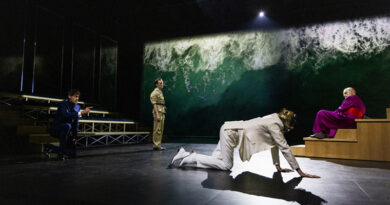
Phillip’s downward trajectory feels all the more acute when experienced in Fein’s staging of the play. The action takes place in a narrow space defined by a row of benches identical to those that seat the members of the audience. Actors often remain on stage between their scenes, and sometimes sit on these benches, apparently absorbed by what is happening around them. This instils in the spectator a sense of complicity as well as claustrophobia, and this sense is strengthened by the knowledge that there is no interval. The lighting design of Adam Silverman, abruptly switching from glaring to gloom, and the sound design of Tom Gibbons, introducing an insidious industrial grind, further emphasize the unease.
Combining the naturalistic and the expressionistic, Rosanna Vize’s set facilitates a fluidity of movement and the overlapping of scenes. The back wall suggests a public building, incorporating, as it does, a long, horizontal internal window surmounted by four clocks displaying the time in New York, London, Tokyo, and Berlin, while a water cooler stands by the door. The stage itself is dominated by two significant components, an unmade double bed and towers of newspapers. Wall and stage are united by a covering of vivid red carpet.
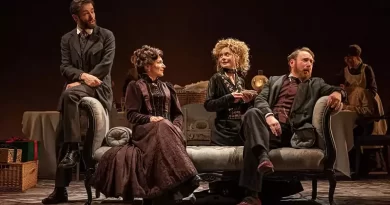
In a milieu so concerned about identity, appearance matters, and the costumes of Sussie Juhlin-Wahlén well communicate fine distinctions. Phillip’s black suit, chosen for its gravitas, contrasts with both the relaxed elegance of Hyman’s attire and the expensive cut of Case’s tailoring, and the women are similarly individualized.
These expressive elements all help to provide the perfect conditions for each of the actors to inhabit his or her role, and to maintain a delicate balance in their interactions with the others. Eli Gelb is near miraculous in his embodiment of Phillip, with his pale face punctuated by deep-set eyes and his heavy, awkward body. He conveys convincingly an often-aggressive tone of voice and a penchant for demonstrative gestures, while allowing confusion, vulnerability, and pain to break through – to devastating effect. And unlike Antony Sher, who played the part in the last major London revival of the play in 2010–11, he seems just the right age, with a residue of boyishness that suggests a Kafkaesque innocent abroad.
As Dr Hyman, Alex Waldmann provides the perfect foil for Eli Gelb, with a lithe physique and nonchalant motion that just occasionally betrays a degree of the character’s nervousness. He is well supported by the always reliable Nancy Carroll as Mrs Hyman, which, despite her loquaciousness and memorably loud laugh, is an underwritten role. Juliet Cowan and Nigel Whitmey are equally strong in the parts of Harriet and Phillip’s boss Stanton Case, respectively.
Fein’s production and Gelb’s performance undoubtedly foreground Phillip’s story, and his belated realization that, in Hyman’s words, he has worn himself out for nothing. Nevertheless, at the heart of the play lies (often literally) the enigmatic character of Sylvia, who is here radiantly portrayed by Pearl Chanda. Stating near the close that “I have been tiptoeing around my life for 20 years”, she epitomizes a quietude that sets Phillip’s angst in relief.