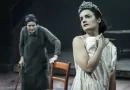
“Our Town” at Rose Theatre, Kingston
Neil Dowden in Southwest London
★★★★☆
8 March 2026
Having risen phoenix-like – or dragon-like? – from the ashes of the National Theatre of Wales, it may have seemed strange that Michael Sheen’s Welsh National Theatre should choose a quintessentially American play as their first fully-fledged show. But Francesca Goodridge’s engaging production of Thornton Wilder’s 1938 Our Town, while remaining true to the original text, has a distinctively Welsh flavour with a vibrant sense of community. Having started in Swansea before moving on to Llandudno and Theatr Clwyd in Mold, the show now culminates in a month-long run at the co-producing Rose Theatre, Kingston.

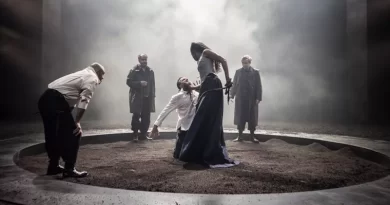
Michael Sheen.
Photo credit: Helen Murray.
Our Town may employ metatheatrical devices but it is different from Brecht’s alienation effect, with the breaking of the fourth wall here serving to involve the audience more in the everyday lives of the ordinary folk of the fictitious Grover’s Corners, New Hampshire between 1901 and 1913. Using the conceit of a play-within-a-play, Sheen’s Stage Manager ambles casually on stage humming to himself before signalling for the house lights to be dimmed – and we’re off.
Directly addressing the audience, he sets the scene as an omniscient narrator figure, while also playing some of the townspeople. He introduces a professor to tell us about the town’s history but hurries him along when his long-windedness becomes boring. The local newspaper editor gives some more up-to-date information about the demographics of the town, as he’s questioned by “members of the audience”. It’s clear that not a lot happens in the sleepy Grover’s Corners, yet we come to care very much about what goes on there.
While there isn’t a strong narrative drive, the heart of the play beats around the Webb and Gibbs families, especially with the touchingly innocent courtship of the young Emily Webb and George Gibbs, which starts over an ice-cream soda and reaches a joyous high with their wedding celebration at the end of Act II. The mood of the third act set in a cemetery turns sombre after tragedy has struck, though there are still surreally comic moments as the dead share their sadness with each other while being resigned to their mortality.
This production beautifully captures Our Town’s folksy charm and bittersweet essence. The play may well verge on the sentimental in idealizing the simple pleasures of small town life, but Wilder’s message of the importance of cherishing our daily blessings in an all-too-transient life comes across movingly here. And although there is no reference to the First World War in this version, the “halcyon” period in which the action takes place speaks volumes.

Yasemin Özdemir and Peter Devlin.
Photo credit: Helen Murray.
With creative associate Russell T. Davies, Goodridge has given the play a Welsh twist, inserting a few Welsh place names and songs into the usual Americana, while the accents and vocal rhythms of the Welsh cast accentuate a local identity. In some ways it is reminiscent of Under Milk Wood’s Llareggub – or rather Dylan Thomas’s lyrical drama must surely have been influenced by Our Town in form as well as in content.
Goodridge (who recently took over as artistic director of Cardiff’s Sherman Theatre) does justice to the quirky humour as well as the poignancy of the play in a dynamic production full of innovation. Much credit must go to movement director Jess Williams who superbly marshals the cast to mime, move together, and criss-cross each other’s paths in ways that create the impression of a tight-knit community where everyone knows each other.
Although it’s traditionally performed on a bare stage, here designer Hayley Grindle inventively makes the most of props rather than a set to evoke the layout of a small town, with planks of wood carried by the cast standing in for parts of buildings, and long grasses in mobile planters for gardens, while stepladders are used for upper storeys and for the deceased to look down on the living. Ryan Joseph Stafford’s lighting design does much to suggest the passing of time, with dawn breaking, a balmy moon, and most of all at the end handheld torches for twinkling stars representing souls of the dead. Dyfan Jones’s score drives the action along, while his sound effects including church bells and distant steam locomotive add to the ambience.
The excellent 18-strong ensemble make convincing townspeople. Sheen is in his element as the benevolent, all-seeing Stage Manager (in a similar role to his First Voice in Under Milk Wood at the National Theatre in 2021, though very differently played), who orchestrates what we see on stage as well as philosophizing on life and death. He also humorously plays the twinkly-eyed soda shop owner and the genial minister who marries the young couple. Yasemin Özdemir as Emily and Peter Devlin (in his professional stage debut) as George do well to convey the tenderly hesitant attraction of first love.
Rhodri Meilir has fun with the embarrassment of Mr Webb (editor of Grover’s Corners Sentinel) in his avoidance of explaining the facts of life to his soon-to-be son-in-law. Nia Roberts impresses as the bustling homemaker Mrs Webb who likes to gossip with Sian Reese-Williams’s Paris-dreaming Mrs Gibbs, while Matthew Trevannion is the soft-hearted Dr Gibbs. And Rhys Warrington plays the ill-fated church organist and choirmaster with a drink problem (who in a choreographed scene is revealed to be secretly gay – as was Wilder).
Welsh National Theatre’s second show in November (co-produced with the Wales Millennium Centre) will be Owain and Henry, a new blank verse drama by Gary Owen, starring Sheen as the 15th-century Welsh military leader who clashed with King Henry IV over English rule in Wales. After the transatlantic success of Our Town, that promises to be a full-blooded Cambrian experience.