“Glengarry Glen Ross” at the Old Vic
Jane Edwardes on the South Bank
★★★★☆
19 June 2026
Why would anyone want to do an all-female production of Glengarry Glen Ross? And why would David Mamet, known for his trenchant opinions, agree to such an idea? Isn’t his play steeped in toxic masculinity? Of course, women can be as nasty and as competitive as men, but aren’t they nasty in different ways? Gender reversal often creates a distancing effect, which is rarely desirable. So, is this project just an indulgence for female actors who are frustrated by the lack of parts and eager to attack something meatier than their usual fare?
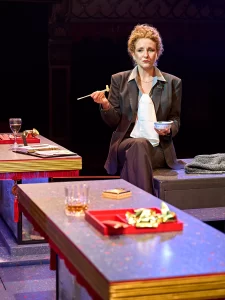
Dorothea Myer-Bennett as Williamson.
Photo credit: Manuel Harlan.
If I went with low expectations, Patrick Marber’s production turns out to be both unsettling and fascinating. Mamet’s play was first staged in the National Theatre’s Cottesloe in 1983 during the time of Reagan and Thatcher and depicts a group of foul-mouthed, sweaty Chicago salesmen struggling to stay afloat in a dog-eat-dog world. Every day they are sent out to cajole people into buying real estate that nobody really wants. If they come top of the board, they win a Cadillac; if they fail, they’re out on the street. The winners, like Rosa Salazar’s Roma, are given the best leads, and the losers the duds, consequently the latter’s chances of avoiding expulsion are diminishingly small. These men are both the perpetrators and the victims of capitalism in the raw. It is an even more ruthless world than that inhabited by Arthur Miller’s Willy Loman in Death of a Salesman.
Marber has not changed the text. No “he” has been replaced with a “she” or a James with a Joan. The actors, a mix of Americans and British, sometimes appear in unisex trouser suits, and sometimes in skirts, high heels, and lipstick.
Most startling is Indira Varma as Levene, the salesman who once dominated the board but in middle age has lost the knack of closing the deal. In the first scene, Levene attempts to persuade Dorothea Myer-Bennett’s Williamson, the office manager, to give him better leads. Her spiky hair and flamboyant gestures make Varma almost unrecognizable as Levene bullies, cajoles, threatens, and attacks Williamson. Varma is completely on top of Mamet’s fractured rhythms and splenetic language, and it is as if it is what she says that drives her into more masculine postures and, in particular, into occupying as much of the space as she needs, while sounding like she has stepped out of a Scorsese film. Then later, she appears in a skirt and, disconcertingly, even flashes a leg. An astonishing performance technically, it finally becomes unexpectedly moving as Levene faces certain jail. It is a sign of his total collapse that for once he can’t talk himself out of trouble. Varma proves that if the actor is good enough, it doesn’t matter what sex they are.
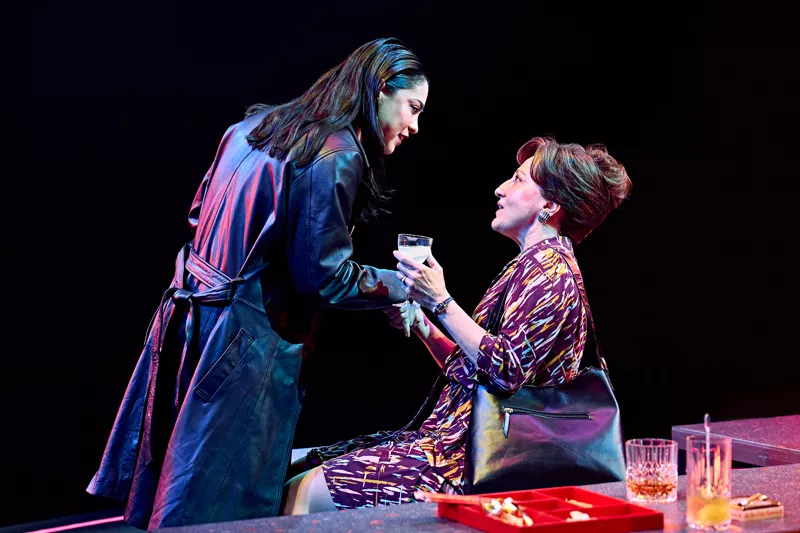
Photo credit: Manuel Harlan.
Rosa Salazar and Mercedes Bahleda.
Levene was once Roma’s mentor, but the mentor is now in control. In a long scene, Roma attempts to seduce Mercedes Bahleda’s Lingk into buying some worthless land. Lingk is called James but looks entirely female, especially when Roma takes his hand and caresses it. Salazar is more sympathetic than seems called for and one is more aware of a woman attempting to behave like an aggressive male winner. She becomes more shouty than scary when she attacks Williamson for wrecking her deal.
In contrast, Nancy Crane is particularly effective as Aaronow, the loser who has a more developed sense of right and wrong than anyone else on stage. In one of the funniest scenes, Niky Wardley’s bouffant blonde Moss attempts to persuade Aaronow that it is in his interest to burgle the office at night, to steal the leads and sell them on, while he, Moss, makes sure he has the perfect alibi. In the office, the morning after the burglary, Aaronow exudes guilt as Florence Odumosu’s detective questions them one by one.
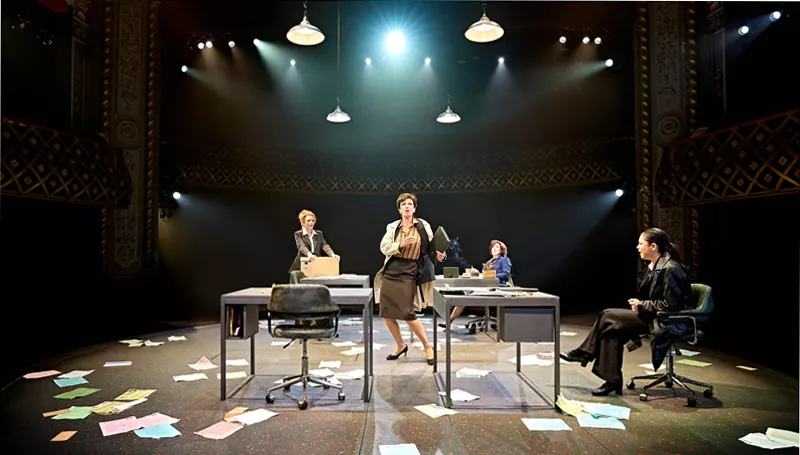
Like most recent productions at the Old Vic, Marber’s production is staged in the round. There are advantages in that more of us are close to the action. A gladiatorial atmosphere is created as the actors circle one another, constantly on the move, as if they fear a literal knife in the back. On the other hand, Mamet’s dialogue is delivered so fast that it can be hard to follow if the person speaking is turned away. Rob Howell’s design overcomes the limitations of being in the round as his set rises out of the floor to create the Chinese restaurant of the first scene, and the office of the second. Papers drop from the flies to create the chaos of the burglary.
There’s much to relish here. The women in the play pay a high price for trying to make it in a man’s world. Oddly, with an all-female cast, one becomes more aware that actors have something in common with the salesmen, in that they too must sell themselves, to put on an act to win the roles they then go on to play. Maybe this is not the best of productions with which to experience the play for the first time, but for those who are familiar with it, it’s a chance to see the play in a startling and impressive new light.