“Please Please Me” at Kiln Theatre
Jeremy Malies in North London
27 April 2026
★★☆☆☆
Michael Caine, who was actually there, once said that the 60s only happened to about 100 people. In his play about Beatles manager Brian Epstein, Tom Wright (born in Coventry in 1990) has a character say, “It’s the 60s – everything is exploding!” There seems to be a disconnect.

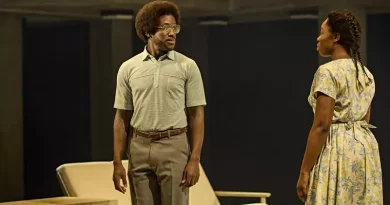
Noah Ritter and Calam Lynch.
Photo credit: Mark Senior.
It was the dialogue that came between me and this new piece of writing. “No good blowjob goes unpunished!” was one of several lines that made me groan. If Brian Epstein, known to be epigrammatic in his wit, is reduced to having such a line attributed to him then I contend that he is being poorly served. No dramaturge appears in the credits. Could Amit Sharma, artistic director of the Kiln and director of this piece, not trim clunky and crass lines of this sort?
Epstein is played with resourcefulness, spontaneity, and verve by Calam Lynch. But I think it’s revealing that Lynch amuses us the most with physical comedy in episodes such as the Fab Four and their manager coming under the spell of Maharishi Mahesh Yogi. I could have done with John Lennon (Noah Ritter in his professional stage debut) perhaps saying a few cogent things about his short-lived spiritual regeneration or how it was reflected in instrumental aspects of his compositions.
Ritter looks the part and is helped by costume designer Tom Piper (assisted by Deborah Andrews) who has the happy knack of catching precisely the cut of a suit or the character of fashion accessories. The play gives ample treatment to a much discussed holiday that Epstein and Lennon took to Torremolinos on their own in 1963 which (it’s uncontested) featured an element of physical intimacy.

Calam Lynch as Brian Epstein.
Photo credit: Mark Senior.
The interval came after this scene and the lady next to me (who appeared to have been attentive throughout) confessed that she thought that in this sequence Ritter was playing a nameless rent boy. This is a man whose structure, melody and logic in terms of composition have been compared to Bach.
I worried that Epstein was being seen by Wright exclusively through the lens of his sexuality. Did the fact (in a play!) that Epstein attended RADA not warrant one mention? And I waited in vain for Epstein to actually say something about the aesthetics of music and what he cared about. All we hear is one entreaty to focus on the key rather than overall dramatic effect and we learn of the Beatles’ first performance in his presence when he focused solely on their sweaty quiff hair.
There is much doubling and trebling up, and this is one of the merits of the production. Sharma, whose direction is unfussy, unmannered and fluid, will presumably have helped the actors find detail and gradations in their many roles. Arthur Wilson excels initially as Brian Epstein’s father, Harry, with some good gags as he confuses the pop stars being mentioned by his son’s rough trade pickups in the shop with his favourite classical composers. Wilson then drops down a generation to play Brian’s lawyer Geoffrey.

Calam Lynch as Brian Epstein.
Photo credit: Mark Senior.
But the multi-roling is incredible, including from the phenomenon that is Eleanor Worthington-Cox whose primary character is Cilla Black (who was another client of Epstein). Having hit the A above middle C in Jerusalem (unaccompanied) in Jez Butterworth’s play of that name, Worthington-Cox finds that Black’s towering, intense ballad “You’re My World” is a breeze. It’s the only song performed on stage all evening. Yes, it’s obvious that rights for Beatles songs would be stratospheric. But this is one of the obvious reasons from the outset as to why the whole project would prove flawed and hamstrung. Worthington-Cox also plays Lennon’s put-upon wife Cynthia and his ferocious worldly-wise Aunt Mimi who maps out her nephew’s career path more clearly than most.
Composer and sound designer David Shrubsole has to content himself with generic Beatles-inspired riffs, occasional counter melody and the odd jangly percussive trill. And Lennon is the only Beatle we see even in several scenes set at the Cavern Club.
While certain period details feel shoehorned, gratuitous, and of no help to the flow of the story, Wright does well to have Epstein and some male companions discuss (and toast) the decriminalization of homosexuality between consenting adults in July 1967. Epstein would be dead of alcohol and barbiturate misuse in the following month. It is of course to the credit of the Beatles as gentiles that Epstein’s Jewishness was of about as much interest to them as his hair colour. However, antisemitism was rife in the Britain of the 60s, and a better dramatist might have been able to hint subtly at parallels now.
The set, also by Piper, begins with a palette of browns in Epstein Snr’s furniture shop where his son begins to sell records. I understand the need for wooden bookcase equivalents for the vinyl albums but wardrobes unaccountably litter the set for the rest of the play. The browns change to textured beige and whites as Epstein is shown surrendering to drugs and casual sexual hook-ups in the Waldorf Astoria at a time when he (disastrously) surrenders merchandising rights.
Equally ill-judged is Lennon’s assertion, made during a newspaper interview in London (and famously recycled on the Ed Sullivan Show), that the Beatles were more popular than Jesus Christ. Song royalties are out of the question but I’m amazed that Sharma did not make more use of contemporary television footage or even radio broadcasts.
Once or twice Wright catches what we know to have been the Epstein tone and charisma in lines such as, “At least Joe Orton had a lover to kill him!” Occasionally the discussion of sexual addiction has insight and brings us to empathy with Epstein. But when he says that all he needs is love and that you could say that he is mad about the boys, I felt that the songbooks of his charges and others were being raided to no great effect.
Yes, of course it’s a biographical piece, but Epstein warrants a more astute evaluation in which the generalized reflections are not hackneyed and do not veer towards instant wisdom. Telstar by Nick Moran and James Hicks – the bio-play about record producer Joe Meek – deals with the music of the time better, while Nicholas de Jongh’s Plague Over England is stronger on the sexual themes. A flash forward almost works; Epstein is a ghost while Lennon (I think) is still alive but dreaming all the time about being shot.
The title of the play is a Beatles album from 1963. This was a long evening at two hours 30 minutes including an interval. I left humming “All Things Must Pass”.