“Much Ado About Nothing” at Globe Theatre
Jeremy Malies on the South Bank
★★★☆☆
22 June 2026
Much Ado About Nothing is unusual in Shakespeare’s output for being 70 per cent prose. So there are few verse speeches during which an actor who might be competing against the elements will be buoyed by the metre. There were no extraneous noises in gorgeous weather on press night at the outdoor Globe Theatre save for a military-sounding plane that flashed over the venue and blended with the martial backdrop.

Pippa Nixon as Beatrice.
Photo credit: Marc Brenner.
I could have done with director Chelsea Walker ramping up the fact that the younger male characters have just returned from war. It’s my belief that Shakespeare is showing some of them as brutalized by combat experiences. And while this production is often innovative, I feel that Walker was on better form at the adjacent indoor Sam Wanamaker Playhouse with the far more problematic All’s Well That Ends Well which actually features battle scenes.
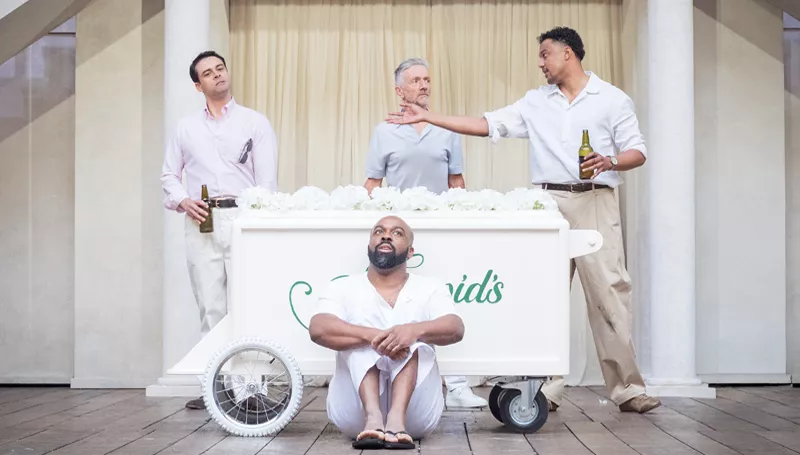
There are many moments of unnecessary slapstick here at the expense of natural physical humour that might have evolved from the action and dialogue, perhaps with actors improvising more. And with the knowledge that Richard Katz’s prolonged turn as the not always comic constable Dogberry would be coming up later, I wondered if Ken Nwosu (Benedick) really needed to be immersed in the water beneath a flower seller’s cart during one of the eavesdropping scenes. The flowers are at least a logical precursor to the impending marriage of Hero (Assa Kanouté) to Claudio played by Joshua John.
My enthusiasm for this never really recovered after Pippa Nixon made a woeful start as Beatrice. Like Rosalind in As You Like It, she must come across as indisputably the most intelligent character on stage. Nixon does eventually hit her stride but not before over-telegraphing meaning, giving bizarre stress to pronouns, and adopting formal, caricatured poses. Only when she and Benedick begin their merry war does Nwosu help her to ignite the verbal skirmishes. Indeed, he gets her running on a higher octane fuel altogether as she begins to score with her bawdy puns and their interchanges become a courting ritual. And Nixon does at least negotiate the high-tariff, notably difficult line, “Kill Claudio.” It can often sound incongruous.
Pippa Nixon and Matilda Bailes.
Photo credit: Marc Brenner.
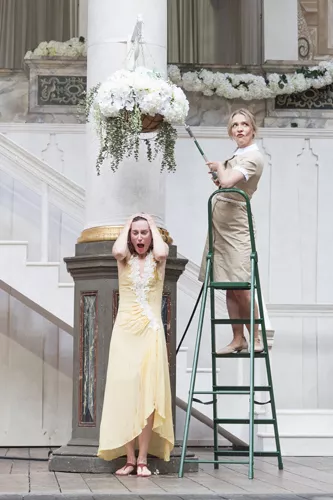
The physical elements are mixed. I groaned when Beatrice (totally unnecessarily) was also soaked (by a watering can) while hiding under a hanging basket in her own eavesdropping scene. Conrade, a pal to the villainous Borachio (played by Marlowe Chan-Reeves) and part of the scheme to blacken the reputation of Hero, has been cut. I’m all for pruning and there is a clean minimalist tone to all this, but the lack of a companion sees Borachio (high on coke) confess things to his better self while urinating! Yuk!
Elsewhere, physical elements work well. There is a gasp of the right kind during the abortive nuptials when Claudio pushes his fiancée’s face into their tiered wedding cake. Now that was inventive.
And there is some highly physical acting, much of it from the stand-out performer for me, this being Joseph Potter as the psychotic Don John who hopes to wreak havoc right across Messina. His interaction with the groundlings is unforced; it was a joy to see his quick wits allowing him to improvise reactions to behaviour by individuals near the stage. Oddly, Potter is the most gifted comedian in the company but has a role that is largely saturnine. I should like to see him play Iago perhaps with Nwosu as Othello, but both men are a tad too young for the roles. Potter is never an archetypal villain or mere plot device.
So what kind of Messina and Sicily do set designer Sami Fendall and costume supervisor Jackie Orton give us? The soldiers, the older generation of men, and the female companions could well be having downtime at a resort hotel though as written the setting is Leonato’s estate. The permanent pillars of the Globe are augmented by Doric plaster pillars and twin staircases that see (movement director Aline David) many pointless to and fro chases. Four musicians sit atop the staircases.
Orton has Leonato (Jonathan McGuinness) sprint on in shades, swimming briefs, and a Versace dressing gown. Several of the women wear dresses made of interlinked hexagonal metallic plates. Some of the patterns are vaguely Art Deco which was enough to confuse me. And Orton does Claudio no favours by putting him in a BDSM harness though as part of early Generation X, I might have been blind to some of the themes.
Full animal headsets for the masked ball also suggested furry fandom anthropomorphic animal characters that are sometimes associated with transgender or outside gender binary. A few unexpected early kisses added to this mix. There is an interesting gender flip with the Friar being played (the role tweaked) as a woman (Sister) by Geraldine Alexander. Indeed, some of the Friar’s lines are even given to Hero which empowers her a little.
Katz as Dogberry is more straightforward, a lineal antecedent of Mrs Malaprop who is tormented by language. It is a contrast to the way that Beatrice and Benedick excel with it.
The production is very different to the one directed by Sean Holmes here two years ago which showed us a Renaissance Italy much as Shakespeare would have imagined it. There is a wonderful minimalist score by Angus MacRae for three cellos and a guitar. Sinister scraping bowed sounds accompany Don John. It’s one of the many plus points of a mixed offering. I have been following Walker for eight years now, having much admired her excellent A Streetcar Named Desire at Nuffield Southampton Theatres. She is on solid but less than inspired form here.