“Sweeney Todd”, Hartford co-production
Robert Schneider in Connecticut
★★★★★
22 June 2026
Sweeney Todd: the Demon Barber of Fleet Street marks the first ever co-production between Hartford Stage and TheaterWorks Hartford, the only professional companies in this mid-sized city, the capital of Connecticut. Hartford Stage anted-up its 489-seat space on Church Street while TheaterWorks contributed its artistic director, Rob Ruggiero, to direct.
In a pre-show taped announcement, Ruggiero joins Hartford Stage artistic director Melia Bensussen in welcoming their combined audiences. The souvenir store in the lobby now features branded sweatshirts and coffee mugs from both theatres; the photo wall adjacent has been re-papered in a repeating pattern of the theatres’ logos. I couldn’t help wondering if all these trappings don’t presage a permanent merger.
There is precedent: in 1682, after attendance fell during the Popish Plot, the Duke’s Company and the King’s Company fused into the United Company. The King’s Company, it’s true, had been badly managed, but the underlying truth was obvious: London could no longer support two theatres.
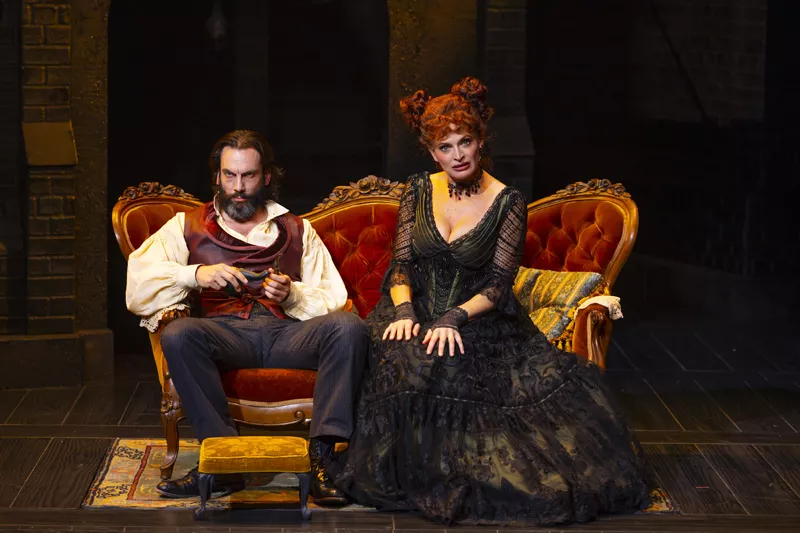
Photo credit: T. Charles Erickson.
The Hartford theatres first started talking about pooling resources during COVID when the future looked dark indeed. Last year, TheaterWorks worked up a co-production of Sanaz Toossi’s English with the Long Wharf in New Haven. This time, however, they are co-producing with a company in their own city; their modest house on Pearl Street will go dark as all their resources and their audience troop three blocks north to Church Street.
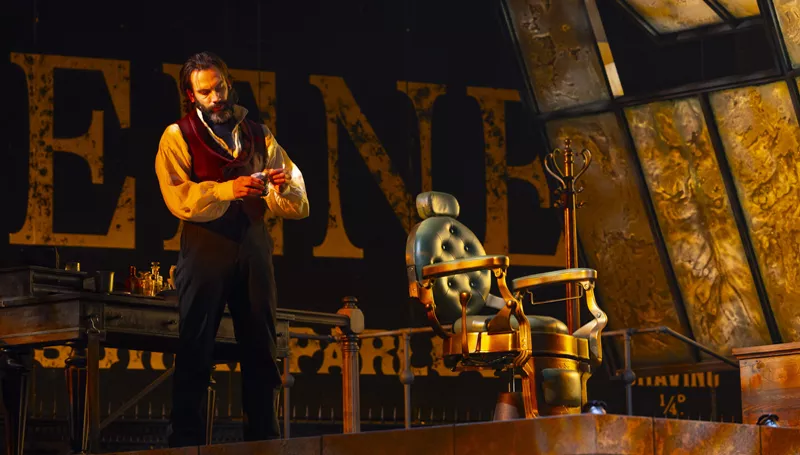
If a merger comes, it may well be a happy one. The production was excellent and the house was full. Visually, this Sweeney Todd was dark and brooding. Luke Cantarella’s set seems lacquered with soot from industrial chimneys and washed with acid rains that corrode but don’t refresh. Fabian Fidel Aguilar’s costumes are spot-on for the characters who wear them but also point out extremes of wealth and poverty in 1840s London.
While it’s well known that the original source for Sweeney was a Victorian “penny dreadful” called “A String of Pearls,” it was Christopher Bond’s 1970 stage version that first supplied the murderous barber with a motive. In all previous tellings of the story—and there were many—it was quite natural that Sweeney would occasionally slit his customers’ throats, something that anyone who has ever been shaved with a straight razor has already thought about.
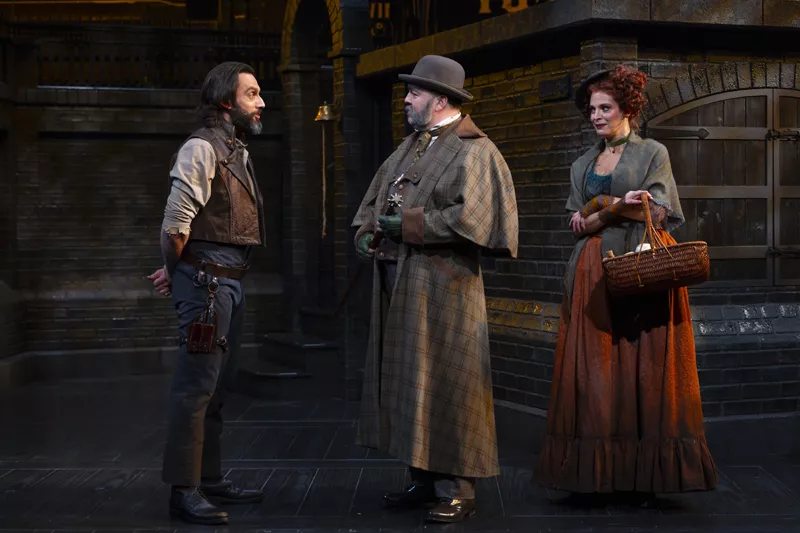
Photo credit: T. Charles Erickson.
Bond gave Sweeney a backstory: a barber and his bride attract the attention of a lustful and corrupt judge who sends the barber to Australia on a trumped-up charge in order to rape the wife. When the barber escapes from the penal colony and returns to London, a city he sees as a cesspit of evil, he is obsessed with revenge. His plans take form when he meets Mrs. Lovett, who runs the pie shop downstairs from his old lodging. Mrs. Lovett’s pies suffer from a penury of meat; London suffers from a surfeit of corrupt men. In their charming, darkly-comedic duet, “A Little Priest”, Sweeney and Mrs. Lovett join forces: the cadavers from the barber shop upstairs can slide straight to the pie shop kitchen in the basement. Sooner or later, the horrible judge and his minion beadle are bound to take their turns in Sweeney’s chair.
In 1979, Stephen Sondheim and Hugh Wheeler took Bond’s adaptation and turned it into the present musical—some prefer to call an opera; it’s been catnip for opera companies since the Houston Grand Opera company first performed it in 1984.
Bringing Sweeney Todd to a decidedly non-operatic stage in Hartford required some big choices. There is no orchestra pit, so music director Wiley DeWeese and his nine musicians had to work in the wings. The stage is shallow and the house is fan-shaped. Set designer Luke Cantarella would like us to believe that the trap in front of the barber chair on the upper level, stage right, connects to a shoot next to the oven stage left. Sweeney tests it by dropping a bundle of books into the upper trap and, sure enough, a similar bundle drops into Mrs. Lovett’s hands after a passage that is more horizontal than vertical. Unfortunately, there is no way to make this bit of theatrical hocus pocus work with the bodies of real actors.
Not that the actors would not be willing to try; they are game for anything. In the title role, Matt Faucher combines menacing intensity with a strong baritone voice. As Mrs. Lovett, Jackie Burns is arch, whimsical or sweet as the occasion demands. Tristan David Caldwell and Cole Thompson further lighten the mood as Pirelli, the faux-Italian barber, and his sometimes-artful, sometimes-lost assistant. Caldwell also has the unenviable task of playing a string of Sweeney’s victims. He performs each with a different topcoat and just a glimmer of here-we-go-again dread that is quite endearing. Edward Watts and Brian Ray Norris are perfect as the Judge and the Beadle. Lauren Maria Medina sings a trifle sharp as Johanna.
Sweeney Todd appears to have entered the canon. It’s exceptionally popular even among Sondheim’s works, few of which have shown wrinkles. (Company, perhaps? It’s the work that’s most anchored to the period of its creation.) Sweeney Todd’s music and characters are splendid. The piece tells a horrific story gleefully. It resonates particularly well with anybody who has ever worked retail: the barber’s customers always come in bunches just when he’s least able to give them the individual attention they deserve.
Isn’t it always that way?