Shaw Festival at the Irish Cultural Centre
David Wootton in West London
17 July 2026
Until Bob Dylan received the Nobel Prize for Literature in 2016, the Irish playwright George Bernard Shaw was the only writer to have won both a Nobel Prize and an Oscar, indications respectively of the distinction and popularity of his extensive literary output. Indeed, for much of his long life between 1856 and 1950, Shaw was, in the words of his biographer Sir Michael Holroyd, “the most famous writer of his day”, and both a household name and face.
If Shaw’s profile is no longer as prominent, and his plays less central to the repertoire, there thankfully remains a lively interest in his life and work. This was confirmed by the Shaw Festival, a convivial gathering of experts and enthusiasts that took place at the Irish Cultural Centre in Hammersmith over the weekend of the 10–12 July.
In an enterprising collaboration with the Shaw Society, the ICC presented a stimulating programme of lectures, films, speeches, and discussions – and a full production of Shaw’s 1894 play Candida. If there was no overarching theme to the festival, two aspects seemed to dominate. The first was Shaw himself – his personality, ideas, achievement, and legacy – while the second was his approach to women.
The festival began on the Friday evening with speeches from Maureen Clark-Darby (the Shaw Society’s Chair), Murray Rosenthal (its Vice-Chair), and, most memorably, the distinguished actress Dame Siân Phillips (a Vice-President). The latter offered a “performer’s perspective”, stating that, for most of her career, Shaw “was a living presence in the theatre” and that there was usually “one production” of a play by him “on in London”. She starred in several of Shaw’s plays herself, including Saint Joan (in the title role) at the Belgrade Theatre, Coventry, in 1958, Man and Superman (as Anne Whitefield) in London in 1965–66, and Major Barbara (as Lady Britomart) at the National Theatre in 1982–83. She was also “lucky enough to have met people who had worked with Shaw”.
Alluding to the way in which lady members of the Shaw Society have believed, from its foundation in 1941, that “Shaw’s words mattered”, Phillips stated that “he is someone to be heard, spoken and performed”. She knows from experience that if actors devote “commitment, patience, and time” to his texts and make the effort to understand their “structure and rhythm”, then both the sense and musicality of his language will come alive, with “exhilarating” results.
Shaw himself was brought to life in Friday’s main event, the screening of two films made in 1988 with the involvement of Neil Titley, the writer, director, and actor who is best known for his solo shows about Irish writers. In the first film, Titley directed an interview with Michael Holroyd, Shaw’s official biographer (and Honorary President of the Shaw Society), just after he had published the first instalment of his magisterial four-volume biography. In the second, Shaw’s Corner, he adapted his stage play, based on a thorough study of Shaw’s writings, for Dermot Walsh, who plays Shaw.
In his wide-ranging half-hour interview, Holroyd makes an excellent case for Shaw while articulating his “complicated character”. Admitting that writing about Shaw encourages the use of paradoxical turns of phrase, he describes the author as “a respectable revolutionary” and “intellectually mature” but “emotionally lame”. Much of Shaw’s success, he says, was due to the way in which he “ventilated controversial subjects with humour and good humour”, including socialism, feminism, and vegetarianism. As a result, he was “very influential on three or four generations” and “changed the mind of Britain”. However, partly because of his longevity and productivity, “no one can agree what Shaw’s major achievement is”. Such obvious candidates as Man and Superman (1903), Pygmalion (1912), and St Joan (1923) compete not only with other plays but with works in a wide variety of genres, and both fiction and non-fiction.
Though hampered by an unconvincing beard (more reminiscent of Henry VIII than GBS), Walsh gives a spirited performance as the older Shaw in Shaw’s Corner. He is shown travelling by train through the countryside to his house at Ayot St Lawrence in Hertfordshire, and then engaged in various situations, mostly around the village and at home. While he shares a range of Shaw’s ideas with energy, he is shown gradually to age, and finally sitting in a wheelchair. He is often accompanied by a stirring soundtrack, excerpted from the music of Richard Wagner, a composer that Shaw championed.
Following the screenings, Titley responded to questions, first from Rosenthal, and then from the audience. Titley proved interesting in explaining the genesis of the two films, and authoritative in comparing Shaw to Oscar Wilde, his having played Wilde for many years in the one-man show Work Is the Curse of the Drinking Classes. For him, Wilde is “a great talent” but Shaw “the great genius”. However, he was less certain when dealing with more controversial issues, and especially the question of whether Shaw modified his support of eugenics after the Second World War. (Sad to say, he didn’t.) Rather than answering the question directly, he focussed on Shaw’s equally provocative views on the dictators Adolf Hitler, Benito Mussolini, and Joseph Stalin. The mood lightened a little when Titley said that, though Shaw admired Stalin, Stalin described Shaw as “an awful man”.
As something of a prelude to subsequent festival events, Titley and Rosenthal touched on Shaw’s feminism, prompted by the suggestion from a member of the audience that Titley write a play about Shaw’s wife Charlotte. After mentioning a solo show on Charlotte, written by Helen Tierney and Alexis Leighton, and her appearance in Lawrence After Arabia by Howard Brenton, Titley broadened the subject. Rosenthal then talked of the influence of the Norwegian playwright Henrik Ibsen on Shaw’s representation of women, with A Doll’s House and Hedda Gabler, among others, inspiring Mrs Warren’s Profession (1893), Arms and the Man, and Candida (both 1894).
On both Saturday and Sunday, a performance of Candida was paired with a lecture, first Dr Audrey McNamara’s “Candida: An Oedipal Crisis”, and then Rosenthal’s “Shaw and Feminism”. In his overview, Rosenthal expanded on the influence of Ibsen on Shaw, and explained how, in writing his study of Ibsen’s plays The Quintessence of Ibsenism (1891), Shaw divided humanity into three main groups. The rarest of these is the lone realist, comprising one per cent of the population, who, in Rosenthal’s words, tears down “social orders so that human well-being comes before rigid dogmas. This was the essence of Ibsen’s plays” – and Ibsen’s lone realists are often women.
Rosenthal went on to detail “three models for demonstrating feminism in women’s roles in Shaw’s plays”. The first is “a woman who pursued a man rather than the other way round”, best exemplified by Ann Whiteside, who, in Man and Superman, takes on some characteristics of Don Juan. The second is “a woman who became independently successful in life”, first exemplified by the brothel owner Kitty Warren in Mrs Warren’s Profession. And the third is “a woman striving for a complete relationship”, ostensibly exemplified by Candida, though Rosenthal felt that “the need for a full relationship was more strongly shown” in the character of Lady Magnesia FitzTollemach in Passion, Poison and Petrifaction (1905), which he described as “Shaw’s most popular one-act play”. He then concluded that the development of this third type by Somerset Maugham in The Constant Wife exemplifies Shaw’s influence on others.
If Rosenthal expressed dissatisfaction with Candida, both in his lecture and in discussion, McNamara emphasized the strengths of the play through an original interpretation. While acknowledging the influence of Ibsen, and especially A Doll’s House, on the play, she focussed on the way that it relates to, and upturns, structural and thematic principles of Ancient Greek drama.
Candida conforms to the dramatic unities of time, place, and action, and the development of that action, as derived from the theories of Aristotle. Its three acts are set in the drawing room of the prominent evangelical clergyman the Reverend James Mavor Morell and his wife Candida, and its plot centres, over the course of 24 hours, on a crisis in their relationship with each other, and with the young poet Eugene Marchbanks. When Marchbanks declares his love for Candida, Morell realizes that he might lose everything, but Candida recognizes her own agency, and states that she will choose the “weaker of the two”, which she decides is her husband.
McNamara perceived an “Oedipal scenario” at the heart of Candida, as Marchbanks is under 20 years of age and Candida over 30, so that she appears as the mother to be loved and Morell as the father to be overcome. However, Candida averts the potential tragedy – of “social suicide” as well as marital breakup – in having the courage to think, speak, and act.
While McNamara acknowledged that the play is short and economical, she elucidated its many complexities, including a series of further triangular relationships between its six characters, expressive of the themes of wealth and property as well as love and marriage. She also traced the effect of the triangular relationships in Shaw’s own life, beginning with that between his parents and George Vandeleur Lee, and how, as a result, the tightly structured Candida proved cathartic for its author.
It may be difficult now to comprehend the phenomenal popularity of Candida in the early years of the 20th century, described at the time as “Candidamania”. Indeed, it seems not only subtler but slighter than the plays of Ibsen that so informed it. And, yet, as demonstrated by her substantial speech in Act Three, Candida is, in the context of late Victorian England, a strong, successful woman who does not need to leave her home (as Nora does in A Doll’s House) or commit suicide (as Hedda Gabler does).
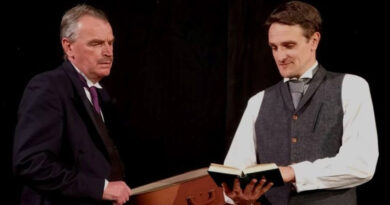
Having listened with interest to these lectures, it was delightful to have the opportunity to see Candida in a vigorous production by the Rumpus Theatre Company. While the ICC’s main stage might be unable to accommodate some of Shaw’s more elaborate plays, the concise format of Candida, demanding just a single set, made it a perfect choice for the setting. The production was masterminded by John Goodrum, who was not only director and designer, but also starred as the Reverend Morell. If he was older than the typical Morell, he still brought charisma to the role, making it understandable why he should be outwardly successful and attractive. However, the age and stature of Pavan Maru, playing Marchbanks, were more detrimental to an understanding of his character, as he needs to seem like a teenager and be physically subordinate to Morell. Fortunately, Sarah Wynne Kordas as Candida mediated sufficiently well between them to maintain the sense of the whole, and they were well supported, especially by Karen Henson, who injected just the right amount of Shavian wit into her performance as Morell’s secretary Proserpine Garnett.
The festival closed on the Sunday evening with a screening of Shakes Versus Shav, a 2023 film version of Shaw’s last completed dramatic work, a 10-minute play written for puppets in 1949. The original play was commissioned by Shaw’s friend, the master puppeteer Waldo Lanchester, who was based in Malvern, the spa town that had played host to several productions of Shaw’s plays during the 1920s and 1930s.
In producing Shakes Versus Shav, Shaw reflected on his identity, stature, and legacy by pitting himself against William Shakespeare. However, the format of a knockabout puppet play gives it a light-hearted quality, and suggests that Shaw was self-deprecating as well as self-knowing.
As directed by Damian Farrell and Gerry Hoban, the play transfers beautifully to film, and the marionettes that represent the playwrights are made to seem alive. This is the result of lighting, close-ups, and other techniques, and the skills of both the puppeteers and the actors who provide the voices – Sir Derek Jacobi as Shakespeare and Colm Meaney as Shaw. The film’s opening sequence shows Shaw in archive footage before cutting to Jacobi and Meaney preparing to perform.
Following the screening, audience members were able to discuss the film with the directors, before heading to the bar to see the marionettes, which were copied from the originals especially for the film. The discussion revealed that Shaw preferred puppets to actors, and, given that caricaturists sometimes presented him as a puppet master, this is not entirely a surprise.
The film provides an entertaining way of introducing new audiences to Shaw, and one English teacher who was present asked the directors if, and when, she might be able to show it to her pupils. More generally, the festival succeeded in galvanizing a passion for the playwright, who, despite his complexity and imperfection, is a figure of international significance with a large body of thought-provoking, accessible, and funny work. All those who attended the festival will surely hope that it becomes an annual event. In the meantime, many may join the Shaw Society, and enjoy its activities, including monthly playreadings. And those who missed it altogether can still catch performances of Candida at Shaw’s Corner, in Hertfordshire, on Friday 24 and Saturday 25 of July, and so celebrate Shaw’s 170th birthday weekend.