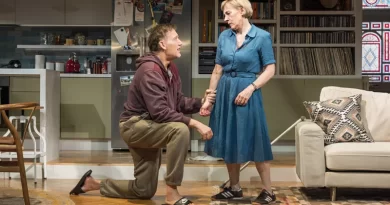
“Cyrano de Bergerac” at Noël Coward Theatre
Neil Dowden in the West End
★★★★★
29 June 2026
After entertaining audiences in Stratford-upon-Avon last autumn with its sharp wit, the RSC production of Edmond de Rostand’s Cyrano de Bergerac now swaggers into the West End. The pen may be ultimately mightier than the sword, but in this unashamedly theatrical revival the swordplay is as impressive as the wordplay. Rostand’s 1897 tragicomic verse romance is loosely inspired by the exploits of the seventeenth-century titular French writer-soldier, played here by Adrian Lester with panache – as well as a moderately huge prosthetic nose.

Levi Brown as Christian.
Photo credit: Marc Brenner.
In a new version by grime poet Debris Stevenson and director Simon Evans, the show embraces the larger-than-life, mythologizing quality of the original. Cyrano’s heroic fighting skills in taking on a hundred enemies single-handedly and later resisting the Spanish forces at the Siege of Arras are contrasted with his lack of courage in declaring his love for Roxane (feeling she will reject him because of his ugly protuberance). Writing lyrical love letters to her on behalf of the handsome but inarticulate Christian is a way of vicariously conveying his own passion. But we are all urging Cyrano to belatedly realize that it is the poetic expression of a romantic soul rather than just physical attraction that Roxane is looking for.
The production was designed for the open-stage Swan Theatre, but Evans has adapted it well for the proscenium arch Noël Coward Theatre by having the performers use different parts of the auditorium and engaging the audience directly. We see this especially in the opening act set in a theatre, with an actor shouting from the circle that he can’t find the way to the stage, with others entering down the aisles, while Roxane and her hapless admirer the Comte de Guiche sit in opposite boxes waiting for the show to begin. Ragueneau asks the audience to stand, then immediately sit down again. No one knows where Cyrano is, but he makes a dramatic entrance on a balcony above the stage to belittle and eject the absurdly vain actor Montfleury. Then – having proved his verbal dexterity – he shows his fencing ability as he duels with the count’s henchman who has insulted his hooter. It’s all brilliantly chaotic.

Adrian Lester as Cyrano.
Photo credit: Marc Brenner.
The mood in the following scene in Ragueneau’s pastry shop for poets is bittersweet as Cyrano swallows his avowal of love to Roxane when he finds out she has arranged the tête-à-tête there to ask him to protect Christian who is in his regiment. The wooing scene outside Roxane’s house is superbly done in its alternation between romance and farce, while the battle scene is surprisingly stirring and the sad but uplifting epilogue at the convent deeply touching. This is a big-hearted show that does not shy away from emotions.
This version of Rostand’s play takes a very different approach to the last major staging in the West End, Martin Crimp’s free adaptation in 2019 (revived in 2022), starring a normal-nosed James McAvoy with internalized self-loathing in the modern setting of a rap battle. That was of course a much more radical spin on Cyrano de Bergerac, but Stevenson and Evans’s take is also very inventive if more traditional in its tone. Notably, the highly rhythmic poet Stevenson (author of the musical Poet in da Corner which premiered at the Royal Court in 2018) has boldly created an elaborate acrostic for Cyrano to deliver to the speaker of the unimaginative insult of his nose (“It’s fucking huge”), while simultaneously teaching him a lesson with his sword. It is received deliriously by the audience..
The use of music (composed by Alex Baranowksi) here is also ingenious, with a sextet of actor-musicians apparently won by Cyrano in a wager following him around everywhere (even into battle) as almost a chorus-like commentary on emotional shifts, with individual instrumentalists free to improvise as they see fit.
Grace Smart’s multi-tiered set design evokes a neoclassical façade, with costumes of the period including military dress. Joshie Harriette’s sensuous lighting varies from rosy tones of courtship to the subdued blue of the siege, and Donato Wharton’s sound design encompasses the explosions of war and church bell tolling. Movement director Sarita Piotrowski ensures dynamic ensemble scenes, while the fight and intimacy direction of Bethan Clark ranges from violent confrontations to tender confessions.
In what must be one of the finest performances of his career, Lester’s charismatic Cyrano enthrals us throughout, as the bombastic yet sensitive cavalier whose jeu d’esprit conceals a vulnerable heart. He nails the character’s pointed witticisms, while also demonstrating a remarkable athleticism for someone approaching 58.
Susannah Fielding is a high-spirited and unusually earthy Roxane, evidently a wordsmith in her own right, who is more feisty than demure. Levi Brown’s Brummie-accented Christian sometimes overdoes his simple-mindedness but convinces us of his strong, genuine feelings for Roxane. Scott Handy shows how the cowardly and pompous De Guiche discovers a more noble behaviour suited to his rank, Christian Patterson’s Ragueneau is full of bonhomie (and pastry), and Chris Nayak cuts a pathetically absurd figure as Montfleury who is forced to give up the spotlight to Cyrano.