“End” at the Dorfman, National Theatre
Neil Dowden on the South Bank
★★★★☆
24 November 2025
David Eldridge’s End is the final part of his loose trilogy set in 2015/2016 examining the challenges of being in love for three different couples. Like the previous two standalone plays – which also premiered at the Dorfman, though this time the director is Rachel O’Riordan rather than Polly Findlay – it’s another two-hander featuring a man and woman (played by Clive Owen and Saskia Reeves) talking with frank intimacy to each other in a domestic setting in real time. While Beginning (2017) depicts the falteringly romantic start of a 40ish couple’s relationship and Middle (2022) shows the marriage of an older middle-aged pair just about surviving, End focuses on how the long-term partnership of a couple approaching 60 is about to be ended not by choice but by death.

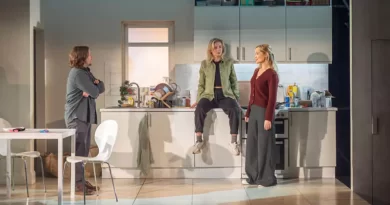
Clive Owen and Saskia Reeves. Set design by Gary McCann.
Photo credit: Marc Brenner.
We know right from the off that Alfie is dying of (an unnamed) cancer. There is a pregnant silence while he stands with the aid of a crutch and stares out of the window into the sunlight, before turning to Julie to tell her that he has decided to stop having any more treatment for what is presumably a terminal condition. She wants him to continue to try to extend his life – maybe even paying huge amounts of money for unproven alternative therapy abroad – and we later find out it’s for a particular reason. But he has had enough and wants to go out with some dignity, not a slow lingering death. It’s not the only important subject that they disagree about, but though their perspectives are different there is no doubting the strong bond between them.
Though their home has long been in north London, Alfie wants to be laid to rest not in Highgate but in a cemetery in Brentwood, Essex alongside his parents – going back to his roots as his life comes full circle. Julie had imagined walking through the park to visit his grave. Although Alfie, an acid house DJ for many years, plays snatches from songs he is shortlisting for his funeral (“I don’t want any of that John Lennon ‘Imagine’ bollocks!”), he then says he doesn’t want a funeral. And – even more upsettingly for Julie – he tells her he wants to say one final farewell to her and their 20-something daughter Annabelle before dying alone in a hospice, as he is haunted by the memory of the multiple goodbyes he shared with his own father as his life slowly ebbed away.
Whilst the musician Alfie – who has made a career out of playing records in clubs to hedonistic dancers often high on ecstasy – values living in the moment, the teacher-turned-writer Julie prefers to bring some shape to transient experiences and give them meaning. Though a successful crime novelist she now tells Alfie she wants to write a memoir of their life together – which he takes exception to. Their love for each other shines through but their differing reactions to the stress of the situation is in danger of pulling them apart.
The 95-minute running time of the play is a sort of review of their close-knit relationship over the decades. There are some revelations especially about a long-past but scar-making infidelity and its aftermath, as well as about Julie not getting on with Alfie’s mother, and how their daughter is not free-spirited like them but has had counselling for anxiety and is now worried about what her boyfriend is getting up to on a mate’s stag weekend in Amsterdam.

Saskia Reeves and Clive Owen.
Photo credit: Marc Brenner.
There are also more elegiac moments such as Alfie recalling seeing with Annabelle his beloved West Ham winning their last match at the Boleyn Ground after more than a century there – another end – before moving to London Stadium. And the music he plays, to which Julie dances sensually, brings back intensely sweet memories of their younger passion leading to truncated sexual congress on the sofa that is both awkward and moving – probably the last time they will have sex together.
End features a surprising amount of comedy amidst the pathos, which as well as the couple’s blunt arguments helps it from becoming at all sentimental. The play may slightly overstrain Alfie’s dance music background while Julie’s reflections on the nature of writing sometimes seem to stem more from Eldridge than her. But we are fully persuaded that this is a couple who have known each other extremely well over many years and who still care passionately for each other – and make each other laugh – despite their frustrations and disagreements.
O’Riordan’s sensitive, subtle production is the final show programmed by the National’s former artistic director Rufus Norris (before he passed on the reins to Indhu Rubasingham), a mixed reign ending on a high. It is played out on Gary McCann’s convincingly detailed set of a smart kitchen/living room (with a glimpse of upper storey) that includes an acid house smiley face clock and shelves of vinyl and books, as well as a framed Paolo Di Canio number 10 football shirt on the wall.
Owen and Reeves – who have had strong careers on screen, including appearing together in Stephen Poliakoff’s taboo-busting 1991 film Close My Eyes – both return to the stage after six years to give committed performances and the chemistry is strong between them here. Owen makes us believe in Alfie’s current physical and emotional pain, interspersed with flashes of playful humour, while his eyes light up when remembering epic all-nighters on the decks. Reeves shows us how Julie tries to restrain her fear and distress of losing her life partner by her pragmatic consideration for Alfie, though this cracks at one moment when she shatters a teapot on the floor and screams into a cushion.
While his adaptation of John Le Carré’s Cold War novel The Spy Who Came in from the Cold opens at @sohoplace in the West End next week after transferring from Chichester, here Eldridge – just as Alfie wants so much for his own life – makes sure his relationship trilogy comes to a “good end”.