“The Waves” at Jermyn Street Theatre
David Wootton in the West End
★★★★☆
27 April 2026
On the one occasion that Virginia Woolf turned to writing a play, in 1935, she produced the light satirical comedy Freshwater, which is so different from the modernist “stream of consciousness” novels for which she is most celebrated. And, yet, in adapting her 1931 novel The Waves, which is considered the culmination of her experimental lyricism, Flora Wilson Brown demonstrates how Woolf was potentially as groundbreaking in the field of poetic drama as she was in prose fiction. Indeed, in writing in her diary in 1928, Woolf herself identified The Waves not as a novel but as a “playpoem”. Its patterned structure weaves together the intense, allusive soliloquies of six characters, and explores the connections that bind them as they develop their friendships and, more generally, their lives.
This is not the first time that The Waves has been dramatized. As almost a symphony for voices, it has worked particularly well on radio. The poet Louis MacNeice provided an abridgement for BBC Radio 3 way back in 1976, while the filmmaker Terence Davies directed a version for Radio 4 in 2007. Significant adaptations for the stage have been directed by Linda Mussmann in New York in 1977 and Katie Mitchell at London’s National Theatre in 2006, while the Dutch director Annette Apon filmed it for the cinema in 1982. The musicality of its prose has even inspired such dance pieces as Wayne MacGregor’s Tuesday, the third and final section of his Woolf Works (2015) and Christos Papadopoulos’s Elvedon (2016).
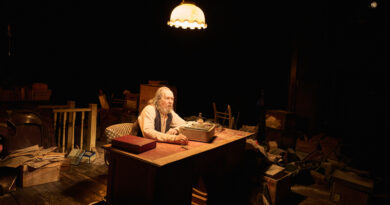
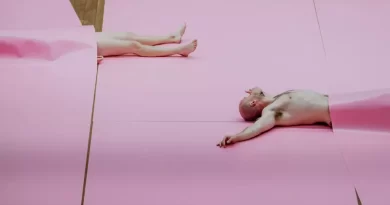
Nevertheless, Wilson and her director Júlia Levai manage to “make it new” (in Ezra Pound’s pithy modernist slogan) and indeed contemporary. The small, shallow stage of Jermyn Street Theatre is presented (by the set designer Tomás Palmer) as a silver box, with a raised platform surrounded by walls that are divided into gloss above and matt below. It is a shimmering variant on the classic “empty space”, in which the appearance of each prop or item of furniture takes on a symbolic significance. Similarly, the costumes (designed by Anett Black) have an almost diagrammatic clarity, most notably at the outset, when the six actors appear in white T-shirts, each emblazoned with their character’s name. These are then shed once they have established their individual identities, and are replaced by other clothes to mark their arrival at boarding school. Further changes of garment indicate similar rites of passage. The music and sound (provided by Matthew Tuckey) and the lighting (designed by Lucía Sánchez Roldán) equally emphasize, in subtle and sophisticated ways, the shifts that take place across the years.
Though Wilson remains true to the trajectory of Woolf’s narrative, she reshapes the text, breaking down the long soliloquies and dividing them between the characters to make them more conversational. And, while she quotes and paraphrases sufficiently from the original to retain its distinctive timeless spirit, she is not afraid to update the vocabulary from time to time, and even introduce the occasional four-letter word. This is a version of The Waves for today that affirms that Woolf can speak to all ages.
The six young actors certainly relish the challenging task of showing their characters grow – physically and mentally – from childhood to late middle age. At first, they make the most of the opportunities to elicit humour from being children, whether together at play or alone in their thoughts. Then, gradually, they evolve believably into psychologically complex adults, often aided by clear visuals. One singular element of this strong production is the way that it itself will exhibit signs of experience and aging during its run, for instance by the actors carving relevant and suggestive words into the walls at points in each performance.
Played by Ria Zmitrowicz with a touching vulnerability, Rhoda is singled out from the beginning by standing separately from the others in a spotlight. And, while they tend to face the back wall when not in scene, she moves to the side. One of the most autobiographical of Woolf’s characters, she often appears as anxious and withdrawn, traits that are signalled by her lagging behind in action and in costume change.
Rhoda is drawn to Louis, who, as Australian rather than English, sees himself as different and something of an outsider. Unlike his male friends, he does not go up to university, but becomes a businessman, and, while financially successful, remains unfulfilled. As performed by Archie Backhouse, he seems attractive but ill-at-ease.
Susan is an outsider in a different way, for she remains truest to the country roots of the friendship group. Feeling out of place in the city, she finds satisfaction in becoming a farmer’s wife and a mother. In Breffni Holahan’s interpretation she appears earthy and instinctive. Standing in marked contrast to Susan is Syakira Moeladi’s engaging Jinny. A dedicated socialite, she values her appearance and enjoys a good time in the company of others.
Equally outgoing, Bernard is a raconteur rather than a writer. He loves to explore the facets of his personality and to share the products of his vivid imagination, though is aware of the inadequacies of language. Tom Varey plays him as a pleasant pragmatist contrasting with the aesthetic ambitiousness of Pedro Leandro’s Neville, who gains fame as a poet.
Neville is in love with Percival, an important seventh character, who is discussed and admired by the others, but who – at least in the novel – never gets to speak. In the play, he is represented by Zmitrowicz as a kind of counterpart to Rhoda, an outsider embodying an absence. She is so identified with him that when Rhoda speaks to Percival at a party, it is Zmitrowicz who voices Percival, while Varey, playing Bernard, voices Rhoda. The success of this device is just one instance of the fine ensemble acting that helps make this latest innovative incarnation of The Waves so memorable and moving.