“Furlough’s Paradise” at Yale Repertory Theatre
Robert Schneider in Connecticut
★★★★★
1 June 2026
After a funeral, family members, once close but now estranged, get together to reminisce, argue and settle old scores. Long-buried resentments reemerge. Skeletons exit their closets. Finally, some new understanding is reached. In many ways, a.k. payne’s Furlough’s Paradise is a conventional American family drama. It’s saved from banality by the beauty of its dialogue and an intermittently expressionist production at Yale Repertory Theatre directed by abigail jean-baptiste. (Both playwright and director distrust gendered pronouns and like British dramatist debbie tucker green they eschew upper-case letters.)

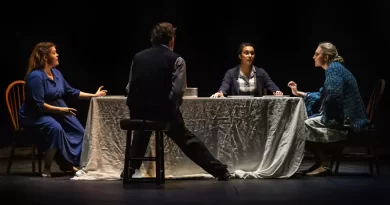
Photo credit: Joan Marcus.
Mina and Sade (pronounced “shah-day”) are cousins. Mina’s father and Sade’s mother were twins but developed sharply different attitudes toward life. Sade’s mother worked for 25 years in a dollar store and had little time for her daughter. Mina’s father, more laid-back, spent long hours on his front porch blasting Coltrane and Louis Armstrong around the neighbourhood. Both were single parents.
For reasons that neither cousin fully understands, Mina went to an Ivy League college and eventually got a job at Google. Sade eventually went to jail; we never learn what her crime was. When the play opens, she is on a three-day furlough to attend her mother’s funeral. Gallantly, they code-switch for each other. Now that she’s back in the neighbourhood (which, psychologically, she never actually left) Mina talks Blacker for her cousin than she ever would for her colleagues in San Francisco. But her life in California, for all its relative comfort, also feels like a prison:
i can’t deal with another
white face
scared of me
i think i will combust
the next time a white face
looks at me with fear
and then it happens again
and i do not combust
and i am very surprised
i am always very surprised
that i am not
air
exhaust
heat
matter
gone

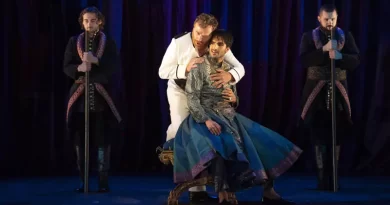
Photo credit: Joan Marcus.
To lighten the mood, Mina offers to take them both kayaking, but Sade doesn’t want to do anything special on her furlough. She wants to stay inside, watch re-runs of The Fresh Prince of Bel-Air, eat her favourite sugary breakfast cereal and talk to her cousin. She recounts the “paradise” she has planned with her jail mates:
so we gonna buy some land when we get out
first one gets out in may
gonna buy a house
then the next gonna buy the one next door
and so on and so forth
till we got a block
till we got a town
gonna bring all our people
and all our things
gonna pool our money
gonna make a school
gonna make it the first black girl nation
gonna say the u.s.
took our rights
and call up the UN
or black girls in every country
who got independence in africa
to make us the united states
of free formerly incarcerated
black girls
Mina feels compelled to point out that it’s not that easy to buy a house when you have a felony conviction. Sade negotiates with hard facts. Mina tells her that she has made bad choices, that she should not pretend the cards have been stacked against her from the beginning. In response, Sade reveals the existence of a child:
you had just left for college
and everybody was like mina
gonna be something
but who knows bout sade
sade is lost
gone
you got no idea
what that feels like
to be the lost cousin
to have everybody looking at me
like i had the same chance
and i just
fucked it up
i just
threw it all away
so i just had her
by
myself
i was eighteen
The child, also called “Paradise,” was picked up by the state after Sade’s arrest. Sade doesn’t know where she is now.
While it’s easy to miss the women’s cultural references, we can’t miss their troubled intimacy. I suspect anyone in the Trump administration would dismiss Furlough’s Paradise as hopelessly woke: two resentful individuals blaming their woes on their minority status in America. (Both women appear to have female lovers, so all the boxes are checked.) When Mina remembers her father, however, she riffs on a pain that is beyond circumstance:
i haven’t been able
to shake
the sound of his voice….
aunt shonda
holed up in her house
ain’t
she ain’t come to the funeral
my mama
ain’t
she ain’t come to the funeral
there were military men
and american flags
and fuckin bugles blaring
and all that goddamn soil
We come to understand that the cousins emerged from imperfect families into a larger world which they navigate fitfully and fearfully. Retreating to childhood, they make a blanket fort on stage. They huddle in nostalgia, desperate to mean something to the other. It’s hard to imagine what would make them whole, but race is not the foremost of their problems—at best, it’s running neck-and-neck with neglect.
As Mina, Tiffany MacLarty is cautious, walking on eggshells and alert to nuance. As Sade, Lauren F. Walker is wilder, more insistent, less contained. While their actual interaction is confined to a small apartment, the design is wide-open stylistically. The two actors first appear in odd costumes: Mina’s is like the Michelin tyre man with sausage-like appendages and Sade’s is like a robot wearing a lamp shape over her head. They dance and totter onto the stage. An elevated area to the rear becomes a kind of proscenium to their manic puppet show. (Costumes by Renea S. Brown, scenic design by Anthony Robles) When they sleep, they are visited by nightmares distilled from a world of mostly blue abstractions. (Projections by Wiktor Freifeld, music and sound design by Constant Dzah.)
When Sade’s three days are up, a knock on the door announces the marshals who have come to take her back to prison. The cousins say an agonizing goodbye. In a preface, a.k. payne says Furlough’s Paradise is “an abolition play or perhaps simply a play about cousins.”
I would say it’s both.