“Between the River and the Sea” at the Royal Court Theatre Upstairs
Neil Dowden in West London
★★★★☆
25 April 2026
The slogan “From the river to the sea” is of course highly controversial. Referring to the region between the River Jordan and the Mediterranean Sea, it can be regarded as a call for the restoration of Palestinian rights or as an anti-Semitic denial of the right of Israel to exist, depending on which side of the divide you are on. But Yousef Sweid and Isabella Sedlak’s play Between the River and the Sea (with its slightly different wording) is the opposite of inflammatory or divisive in its conciliatory and inclusive account of overlapping identities. First staged at the Maxim Gorki Theater in Berlin last year, performed by Sweid and directed by Sedlak, its humane and humorous approach to the subject is both moving and uplifting.
This 60-minute monodrama is very much Sweid’s own story of living in between or across the mental and physical borders that separate different groups. An Arab Israeli with a Palestinian father and a Christian mother, he has twice married (and divorced) Jewish women, with whom he shares a son and a daughter, and lives in cosmopolitan Berlin. He starts the show with disarming comedy by displaying some of the banners used by people protesting against previous plays and films he has been involved in, projects which have seen him called a “traitor” by all sides. Then he tries to downplay any contentiousness in this show by claiming: “I am not going to talk about October 7th or the war in Gaza. I am going to talk about – my divorce.”
This is slightly disingenuous. It’s true that Sweid does not address those atrocities directly (until near the end) and does indeed go on to describe his domestic situation, with his estranged second wife wanting to return to Israel with their young daughter. But of course the conflict in the Middle East colours most of what he narrates. He has chosen to live in Berlin, and wants to stay there with his kids, because its secular, multicultural liberalism is so different from his own upbringing – though he also affectionately satirizes the city’s hipster culture as well as German “coldness”. He recalls the shock as a four-year-old kindergartner in Haifa when a Jewish boy calls him “a stinky Arab” and for the first time he was made to feel different from those around him – a stranger in his own land. Life is never the same again.
Although Sweid’s parents later moved him from his Jewish school to an Arab Christian school he hated it there, so went back to the better-endowed first school, and there is a touching description of both schools coming together for a festival of peace. There are some warmly funny anecdotes about his early sexual experiences as an adolescent holding hands with a church-going girl (his “religious phase”) and making it with a Jewish girl who has fantasies about an Arab guy licking her toes. But we also hear how he stops seeing his basketball-playing Jewish friends who are doing military service after one describes forcing a “fucking Palestinian” to open his violin case by pointing a gun at him at a checkpoint. After studying theatre in Tel Aviv, Sweid meets his first wife who is directing a show about the Israeli–Palestinian conflict, and they later move to Berlin.
Near the start there is a short history lesson about how this conflict started, using projections of maps and images, covering the British withdrawal of the Mandate for Palestine and the creation of Israel in 1948, followed swiftly by the Palestinians’ Nakba (catastrophe) as they lost their homeland. But it’s not done heavy-handedly (“let’s do it fast”). And when the massacre at the Be’eri kibbutz in 2021 and its appalling aftermath in Gaza finally rear their ugly heads, they are viewed sideways in his loss of friendships for refusing to take sides.
There is a risk that Sweid could be seen as wanting just to escape from the harsh realities of his background and not get involved in political campaigns. But the positive, peace-loving nature of his stance is shown in his rejection of his German divorce lawyer’s advice to go for “full custody” of his daughter by attacking his wife: “I’m interested in finding an agreement with my ex, not to start a war.” And then the parallels between his personal situation and the geopolitical one become clear. This particular Arab–Jewish marriage didn’t work out but their mixed children offer hope for the future. “We need to become hybrids.” And there is a coda that ends the play on an optimistic note, with Sweid’s 15-year-old son’s “utopian fantasy” for school that imagines – John Lennon style – a Middle East without borders.
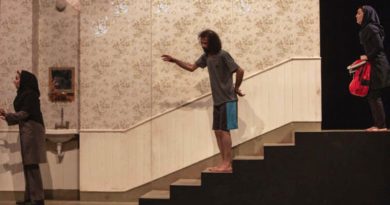
Between the River and the Sea may be an autobiographical monologue but it’s a fully realized piece of theatre with Sedlak’s assured direction making the most of Sweid’s engaging stage presence. There is no set as such, just a chair and a microphone, but lighting and sound changes effectively signal shifts in mood, so that the show never feels static.
Sweid is the only speaker but not the only character. He often uses the microphone when he is re-creating conversations with unseen family or friends, in person or on the phone. In particular, he affects a deeper voice of authority for his overbearing father (now living in Canada after dodgy financial dealings in Israel) who tells him: “You are not a Palestinian Israeli. You are a Palestinian with an Israeli passport.” Sweid’s charming, relaxed manner – even at one point flirting with a female member of the audience when talking about his love life – beguiles us into sympathizing with his tricky balancing act of expressing multiple perspectives. But there is a serious intent behind all of it: recognizing that we have much more in common with each other than we have differences.