Dream Factory festival, Ostrava
Mark Brown in Czechia
May 2026
The problem of cultural metropolitanism – whereby the artistic life of major urban centres is seen to be promoted at the expense of other cities or regions in a given country – extends far beyond the obvious places, such as London and New York. I remember attending a Scottish cultural summit in Edinburgh some years ago in which the panel included Keith Bruce, then the arts editor of The Herald newspaper.

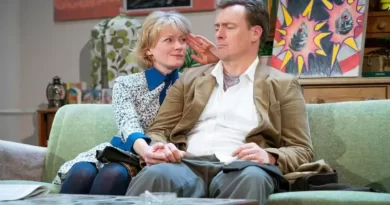
My Struggle.
Photo credit: KIVA.
A delegate from an arts organisation in the Highlands stood up and lobbied Mr Bruce very publicly. Would he – a leading representative of the Glasgow-Edinburgh metropolitan elite, it was implied – acknowledge that it wasn’t artists in the Highlands and Islands who were “remote” (after all, such artists were well aware of what was going on culturally in Scotland’s much-vaunted “central belt”)? Surely, the questioner continued, it was the metropolitans who were remote, cut off, as they were, from what was happening in the rest of the country?
I was reminded of this event during my recent visit to the Dream Factory festival in Ostrava, Czechia (as the government of that country now asks us to call the Czech Republic). Ostrava – Czechia’s third largest city – is only a three-and-a-quarter-hour journey (on one of the country’s excellent, publicly owned trains) from the capital city, Prague. However, sitting – in the Moravia-Silesia region – on the east of the country, Ostrava is considerably closer to the Polish city of Katowice than it is to either Prague or (Czechia’s second city) Brno.
Moreover, with its history in coal mining and a variety of other heavy industries, Ostrava was long considered the engine room of the Czech lands. However, despite – or perhaps because of – its industrial status, Ostrava has not enjoyed the same cultural position as other Czech cities. Theatre audiences in the city – both during Ostrava’s industrial heyday and in its post-industrial era – have long felt relatively ignored by the Czech theatre.
Since 2009, the Dream Factory festival has endeavoured to address this historical neglect. The festival seeks to programme the best work from across Czechia, as well as staging productions from Slovakia and pieces created in Ostrava itself.
Every edition of the festival has a theme. As with most such themes, the 2026 programme’s heading of “Transformation” was deliberately vague and open to interpretation. However, inevitably nebulous though the concept was, it did, at least, have the virtue of allowing for a diverse set of theatre and performance works.

My Struggle.
Photo credit: KIVA.
I attended the festival as a guest of the HI PerformanCZ visitors programme for international theatre professionals. The programme – which is hosted regularly by the Czech Arts and Theatre Institute – is a superb initiative that not only brings the world to Czech theatre, but also promotes all manner of useful interactions between Czech theatre people and a variety of theatre practitioners, directors, programmers and, indeed, theatrologists and critics from around Europe and beyond.
In my four days in Ostrava, the most memorable performance was My Struggle: A Man in Love by the Prague company Theatre on the Balustrade (TOTB). An interesting little aside about TOTB is that, as a young man, Václav Havel worked on the technical staff of the theatre. To this day the lovely playhouse – which sits in the Old Town of Prague, a short walk from the River Vltava – commemorates the tiny room overlooking the stage in which Havel used to work.
The play is adapted from the autobiographical novel of the same name by Norwegian writer Karl Ove Knausgaard. The novel is part of a six-book series written under the ironic, collective title My Struggle (the Norwegian title, Min Kampf, mirroring unambiguously, and controversially, Adolf Hitler’s infamous combination of memoir and Nazi treatise).
Directed by Jan Mikulášek, this cool and beautifully stylised production follows the move to Stockholm of Karl (the barely fictionalised Knausgaard character, played with knowing self-regard by Miloslav König) and his wife Linda (the equally impressive, and appropriately sympathetic, Simona Lewandowska). The emotional untidiness of the relationship – which is generated, to a considerable degree, by Karl’s dissatisfied ego – contrasts perfectly with designer Marek Cpin’s sets, which are all clean, Scandinavian lines and smart functionality.
There is – both in Knausgaard’s novel and Mikulášek’s production – a stark juxtaposition between the Norwegian couple’s apartment and that of their distressed Russian neighbour. While Karl and Linda attempt at all times to moderate and control tension, their young, chaotic female neighbour bursts – aurally, visually and ideologically – through their efforts at Nordic calm.

An Enemy of the People.
Photo credit: Martin Špelda.
Clever, excellently acted, ironically humorous and never less than engaging, this technically accomplished production was the highlight of my time in Ostrava. A production that could – and, in many ways, should – have rivalled Mikulášek’s piece was the staging of Henrik Ibsen’s classic An Enemy of the People by the Petr Bezruč Theatre of Ostrava.
The production, sensibly, draws Ibsen’s story of local business, political and media interests involved in a town’s contaminated spa into the present day. It goes without saying that the play’s implications for the climate emergency – and a host of other ethical and political matters – in the twenty-first century are far greater than the Norwegian writer could have imagined when his drama premiered in 1883.
The Ostrava production succeeds very well in joining Ibsen’s moral excavations to recognisable figures and forces from our times. Indeed – as I said to director Jan Holec and dramaturge Peter Galdík during the post-show conversation between them and the international guests – in many departments their staging impressed me more than the production of the play by Thomas Ostermeier that I saw in France some years ago.

An Enemy of the People.
Photo credit: Martin Špelda.
However – in relation to the shallow grasp of east Asian culture displayed by characters in their production – Holec and Galdík introduced dream sequences involving extremely bold east Asian caricatures (including a pair of sumo wrestlers). These sequences may have been intended as a satire of the attitudes of the western characters (indeed, Holec and Galdík said as much during the post-show). Nevertheless, this aspect of the production raised uncomfortable questions – not of cultural appropriation – but of cultural representation.
My feeling of unease was – I discovered during the post-show – shared by others. The dream sequences were, to my mind, a distraction and an unnecessary risk. In the end, such is their discomfiting prominence, they overshadow much else in a generally strong production.

Shooting Hedda Gabler.
Photo credit: Pavel Nesvadba.
Other productions at the festival included Shooting Hedda Gabler, Nina Segal’s satire about a leading American actress attempting to take refuge from Hollywood by starring in a Norwegian film adaptation of Ibsen’s great play. In this production by the Drama Club of Prague (if not in Segal’s script) the contemplations of the various character types on the film set – and of the catastrophic relations between them – are disappointingly schematic and predictable.
A definite high point of the trip was a visit to the home of the new circus company BoCirk ensemble. It was fascinating to see how this former school building in an Ostrava suburb has been converted into a successful centre for new circus and acrobatic performers across a range of ages. We were treated to a superb performance of a segment of a show by two of the company’s accomplished professional performers. It was also great – not only to hear about BoCirk’s work locally, nationally and internationally – but to see so many young people in the building in order to learn and to hone skills.
Further to that, there was an enjoyable experience of Ostrava’s forward-looking museum Futureum – which is built within a former coal mine – where we saw a performance of the interesting, if uneven, dance piece Carpe(t) Diem, by local company Move Ostrava. Yes, the show did combine choreography and acrobatics, somewhat improbably, with pieces of carpet.
All of which – in its intriguing diversity – is a testament to the commitment of the people who have programmed Dream Factory in Ostrava for its 18 editions. It testifies, too, (as does Ostrava’s interesting city art gallery) to the shortsightedness of dismissive metropolitan prejudices.