“Crazy for You”, Goodspeed Musicals, East Haddam
Robert Schneider in Connecticut
★★★★★
15 July 2026
In a programme note, director Michael Fling lauds this show as “light, fun, frothy entertainment—AKA escapism”. Like the dozen Gershwin films, musicals and orchestral works that were raided to make up this very successful jukebox musical, Crazy for You is certainly fun and frothy, but I wouldn’t call it “escapism”. I believe that musicals from the 1930s repose on weightier stuff than that. If you must call it “escapism,” it’s not mere escapism. These works allow us access to a world that is spiritually superior to our own—if, perhaps, intellectually a bit dimmer.

Photo credit: Diane Sobolewski.
What is the subtext of a 1930s musical? Why does it thrill us to see the complications of a silly romantic plot effortlessly resolved in waves of dancing and song? A Gershwin musical persuades us that human beings can relate to each other on a higher plane. When the actors respond to each other’s taps, when they pick up a beat or join a chorus, they are more compelling, more romantic and more in harmony with each other than we have ever seen elsewhere. This instills in us a profound hope that humans can not only get along; they can do beautiful things in synchrony.
The only thing I know to compare to a Gershwin musical is a well-turned double play in baseball.
What is more, this type of “let’s put on a show” musical asks us to believe that the characters are making it up on the spot. Production numbers develop from a flow of pure good feeling; neophytes can join intricate dance numbers with no other coaching than a nod from one of the principals. Rehearsal is hardly necessary because they got rhythm—and who needs anything more?
If props are called for, if the number requires a stepladder, five pairs of stilts or six, ten-foot lengths of rope, these items can always be found in the wings, a bit of rummaging and they are part of the show. Such happy coincidences abound, but it’s the togetherness that impresses. It’s almost miraculous.
Is it credible? Not at all but watching ostensible amateurs put together a song-and-dance at the drop of a hat is comforting. It’s a conceit we need. We live in a world, after all, where professionals squander weeks of preparation and then paint the reflecting pool blue.
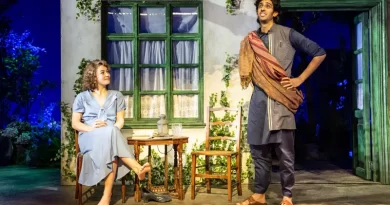
The current production is catnip for Goodspeed Musicals’ markedly mature audience members and their grandchildren. (The middle generation was mostly absent from the matinée I attended.) In addition to 19 glorious songs from George and Ira, it features winning performances from the principals, a small but brilliant chorus and fabulous costumes by Joseph Shrope.
The venue is a tall, narrow Victorian structure that dates from 1876. The theatre proper is on the third floor. There is some wing space stage left, much less stage right: where do they hang all those costumes when they are not wearing them?
The same question arises for Ann Beyersdorfer’s clever sets. With no fly or trap space, where does the scenery come from? The orchestra pit is similarly cramped, but music director Adam Souza and nine musicians create sounds that are rich and tuneful.
The cast is excellent. Will Burton and Brittany Zeinstra shine as Bobby Child and Polly Baker, the romantic leads who detest each other until they don’t. Jeremy Davis and Edward Juvier are perfect as Polly’s father and Bela Zangler, a Hungarian theatre director in the Flo Ziegfeld mould. Michele Ragusa and Hailey Thomas insert an acid note as Bobby’s disapproving mother and neglected fiancée. When the action shifts west to the mythical hamlet of Deadrock, Nevada, Brian Shimasaki Liebson, Griffin Wilkins, Samuel Colina are three cow pokes who just happen to sing close harmony.
Special mention must be made of Kelli Barclay’s choreography which adapts Susan Stroman’s Tony-winning movements to a much smaller stage. The dancing is thrilling in itself, but it also fulfils a narrative function, advancing the story in dozens of small ways.
In the second act, Burton and Edward Juvier are dressed and coiffed alike. (Bobby was impersonating the director in order to ingratiate himself with Polly when the real Zangler showed up.) Drunk, the two characters perform an extended “mirror exercise.” Each man would rather have the other turn out to be his reflection than a separate entity he will have to deal with. It should not have worked dramatically, but somehow it did.
When I Got Rhythm explodes to end the first act, it’s more than a production number: it’s a declaration that certain catalogues of human behaviour—tap dancing and baseball at the top of the list—are made beautiful by the simple fact of performance.
Ken Ludwig’s book is admirably lean. A wisecrack or two between the songs is just enough to hold them together, like a dab of superglue from one of those tiny tubes. I can’t see how it could be improved.
Final thoughts:
1) Together with the murder of Christopher Marlowe, George Gershwin’s untimely death at 38 is one of the great tragedies of theatre history.
2) Although I feel it in my soul, I’m at a loss to explain why this lyric from Ira Gershwin…
Things arе looking up—
It’s a great little world we live in.
Oh, I’m happy as a pup
Since love looked up at me.
…thrills me when the desperate punning of Oscar Hammerstein and Alan Jay Lerner often leaves me cold. If anyone has the answer, write care of this magazine.