“Bird Grove” at Hampstead Theatre
Maryam Philpott in North London
★★★☆☆
24 February 2026
What makes a famous or celebrated person who they are meant to be is endlessly fascinating, and there is no shortage of biographical books, films, and plays dedicated to pinpointing the origin of their genius – as if such a singular moment could possibly exist. In Alexi Kaye Campbell’s rather weighty new play, premiering at the Hampstead Theatre, it is the turn of Mary Ann Evans – aka George Eliot to be – and the writer selects a year at Bird Grove House in Coventry which would prove formative. But repackaging characters as bundles of proto-feminist ideas, delivered in laboured exchanges barely brings us closer to the genius of this future author.

Owen Teale, Sarah Woodward and Elizabeth Dulau.
Photo credit: Johan Persson.
Refusing a proposal of marriage from a preposterous man, Mary Ann incurs the displeasure of her brother Isaac but also becomes set on a collision course with her father Robert when she soon refuses to go to church. While her family are keen to see her respectably married, Mary Ann desires only to read, and perhaps to write, but the household at Bird Grove fear the influence of radical new friends.
There is a really strong concept at the heart of this play examining the pressure on young women to provide a return on the investment of their parents – in fine houses as well as clothes and education – by marrying well against the shifting social and political attitudes that the education of middle-class women has afforded. And to dramatize that through the complex relationship between a father and his adult daughter is an even greater proposition. Yet the play that Kaye Campbell presents drowns these themes in words that tell rather than show, and as a result characters recite ideas at one another without feeling like fully rounded human beings instead of vessels for the playwright’s vast research.

Elizabeth Dulau as Mary Ann Evans.
Photo credit: Johan Persson.
One of the big, missed opportunities is to see Mary Ann in action day-to-day and both parts of the play begin by hearing other people, largely men, talking about her and the personality we never really see. The audience will be aware of the singular individual and writer she would become but in that moment she did not, so there is more to explore in her domestic determination to be different and how that shaped her relationship with her father and brother. Removing most of Act One, for example, would bring the audience instantly into that conflict without needing the wordy exposition of a rejected proposal that is tonally lifted from Elizabeth Bennet and Mr Collins in Pride and Prejudice while adding little to the overall effect of the show.
Kaye Campbell could also help the audience to better understand Robert who is all supportive affection for his daughter in Act One, entirely on her side about the unsuitable suitor and reveals stories of facilitating her access to the libraries of neighbours for her as child, yet is transformed by Act Two and seemingly surprised by her actions with significant consequences for Bird Grove’s conclusion that never resolves his personality. The gaps make it hard to see the purpose of the play or the significance of this house that no one appears to have much affection for until suddenly they do.
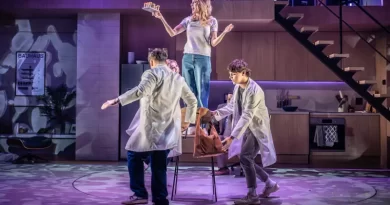
This Hampstead Theatre production is handsomely staged by director Anna Ledwich and designer Sarah Beaton; the venue has made these contemporary-looking period pieces a speciality. The performances from Elizabeth Dulau as Mary Ann and Owen Teale as Robert have a strength that hints at greater emotional depths than the play is prepared to offer, and while Mary Ann’s evolution into George Eliot may have started in this house in these circumstances, a tighter drama might help the audience to also see that future a little more clearly.