“The Great Wave” at Theatre Royal, Glasgow
Mark Brown on Clydeside
★★★★☆
17 February 2026
The Great Wave Off Kanagawa – the iconic image created in 1831 by the Japanese master Katsushika Hokusai – is one of the most famous art works in the world. The picture comprises a huge, beautiful and frightening wave, three stricken fishing boats and, in the background, the unmistakable peak of Mount Fuji.

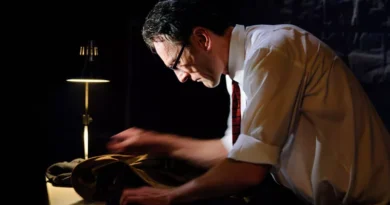
Daisuke Ohyama and Julieth Lozano Rolong.
Photo credit: Mihaela Bodlovic.
Dominated by a gorgeous, startling blue, this strikingly stylized picture seems to be ubiquitous in modern culture, appearing everywhere from clothing to crockery, posters to political placards. Extraordinary though it is, The Great Wave is only one of more than 30,000 Hokusai art works still in existence.
Alongside his brilliant daughter Katsushika Ōi – who was an accomplished and distinctive artist in her own right – Hokusai established an astonishingly successful studio. The drama of nature and human experience that is reflected within the artist’s work was, at times, surpassed by events in his own life.
In 1819, when Hokusai was 50 years old, he was struck by lightning: an event that, miraculously, did not prevent him from going on to have a long and continuously productive artistic life. In 1839, when Hokusai was 79, the home and studio he shared with his daughter was ravaged by fire. Many art works by both Hokusai and Ōi were lost.
All of the above – Hokusai’s life, his work and, not least, his productive collaboration with his daughter – form the basis for the new opera The Great Wave. Co-produced by Scottish Opera and Tokyo-based musical company KAJIMOTO, the piece is the work of Japanese composer Dai Fujikura and Scottish librettist Harry Ross.
Performed in five acts, the opera has a pleasingly liberal attitude to time. It begins at the end, with Ōi as chief mourner at Hokusai’s funeral.

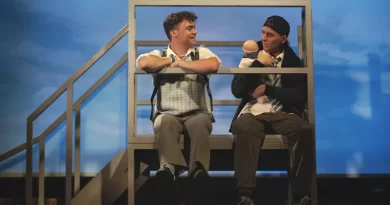
Daisuke Ohyama and Julieth Lozano Rolong.
Photo credit: Mihaela Bodlovic.
From there, the piece shifts in and out of time. It depicts real events, such as a trade with a Dutch merchant (illegal under the highly protectionist law of 19th-century Japan) that secured for Hokusai some much sought after “Prussian blue” pigment.
The opera also steps out of time, as in the scene in which Hokusai – in a coma following the lightning strike – dreams himself into the scenario that will become The Great Wave Off Kanagawa. The scene evokes the terror of the oarsmen in the boats and the inspirational impression that the storm leaves on the artist.
Fujikura’s score emerges from the modern tradition of Western classical music, while incorporating the sonorous sound of the Japanese bamboo flute the shakuhachi, played by a master of the instrument Shozan Hasegawa. As one would expect, the music shifts tonally in relation to the subject matter at any given time.
The composition has a restrained modesty that contrasts with the sometimes exaggerated grandeur of classical opera. However, that modesty in no way prevents Fujikura from measuring up to the elemental drama of Hokusai’s work.
This is certainly true in the opera’s evocation of The Great Wave itself. The music is also appropriately elemental in the adeptly choreographed scene in which umbrella-carrying people are blown around the stage (as in Hokusai’s 1831 picture portraying wind-tossed denizens of Ejiri in Suruga Province).
Ross’s libretto – which is impressively precise and humane – accompanies the music beautifully. The entire cast of singers – from the superb leads through to the excellent chorus – give themselves to the diverse concepts, ideas and emotions of the opera (not least its bold use of monochrome set and costume design, which gives way, gradually, to the dominant blue of the titular art work).
Fine baritone Daisuke Ohyama sings Hokusai with an understated dignity that befits the humility of the great artist. His memorable performance is matched by soprano Julieth Lozano Rolong’s affecting playing of Ōi, which conveys both her affectionate reverence for her celebrated father and the resolve of a true artist.
This original and accomplished new opera plays the Festival Theatre, Edinburgh on 19 and 21 February. It is given a marvellously balanced production by director Satoshi Miyagi. One can only hope that it is revived soon, following its all-too-brief appearances in Scotland’s two largest cities.