“The Shitheads” at Royal Court Theatre Upstairs
“The Shitheads” at Royal Court Theatre Upstairs
David Wootton in West London
★★★★☆
16 February 2026
The truism that playwrights always speak of their own time even when their plays are set in the past is tested to the extreme by the award-winning poet Jack Nicholls in his astonishing stage debut. The Shitheads is set in prehistoric Britain, “tens of thousands of years ago”, but its characters are given such modern names as Clare and Adrian. And, at least in its committed first production, by David Byrne and Aneesha Srinivashan, Adrian dances to pop songs beneath a spinning glitter ball.

Jacoba Williams as Clare.
Photo credit: Camilla Greenwell.
Such elements of play and production make it clear that human nature has changed very little across the centuries, and that mankind is still struggling to overcome its most primitive fears and prejudices. The “shitheads” of the title refers to a dehumanizing term of abuse used by people to define otherness and so construct their own sense of superiority, described as “magic”, which may help to ensure their survival. However, as various groups employ the term to describe others, there is a strong suggestion that we are all “shitheads” now. Furthermore, the opening line of the play – “I think this is based on a true story” – expressed by Lisa, the youngest speaking character, emphasizes the contemporary relevance of this antediluvian tale.
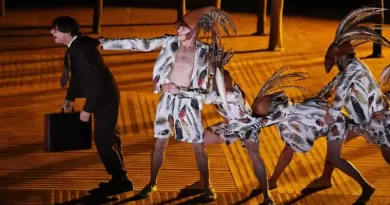
From the outset, the audience is confronted by a savage existence, as an Irish elk, wounded by spears, lumbers on to the stage and swings its massive antlers over the heads of those sitting in the front row. Though it is a puppet powered by three actors, it is so proximate and immediate in the intimate space of the Royal Court Upstairs that it provides a visceral experience that sets the tone for much of what follows.
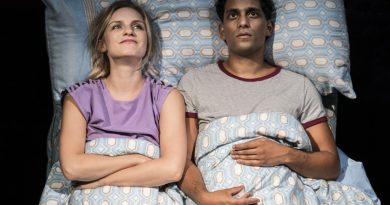
The elk has been hunted by Clare (Jacoba Williams) and Greg (Jonny Khan), who have met only that morning and are still getting to know each other. Their initial exchanges emphasize their differences, both as individuals and representatives of groups. Clare is a member of a settled family of cave dwellers and seems to be confident and worldly-wise. The more naïve Greg is a nomad and is about to leave with his partner and child because of a change in the climate (“Ice and floods and black grass and animals turning”). Nevertheless, there is also an apparent degree of chemistry between them, and, having first told Greg that he is “actually a ‘shithead’”, she says “I knew you were magic”, once she has coaxed him into telling her a story.

Annabel Smith and Peter Clements.
Photo credit: Camilla Greenwell.
It is soon revealed that Clare is wooing Greg into a false sense of security, for she then kills him with repeated blows of her hand-axe and, having shattered his skull, eats its contents. Though gruesome, the act is not simply cannibalistic, because she believes that, by consuming his brains, she will absorb his thoughts and dreams and so gain in knowledge. The lack of an immediate result disappoints her, but she will come to realize that “shitheads” aren’t so different from her. They too can feel, communicate, and socialise, while she, like them, is destined to die.
Clare is the elder daughter of Adrian (Peter Clements), who is cave-bound and lives with permanent injuries. Like Amfortas in Richard Wagner’s opera Parsifal, his pain poisons the atmosphere, though, unlike Amfortas, he has no hope of healing or redemption. Attempting to maintain his patriarchal position, he is resentful of Clare, and of her intelligence and independence, and over-protective of her younger sister, Lisa (Annabel Smith).
Clare brings home both part of the elk carcase and Greg’s head. She then announces that she has invited a wounded woman and her child to stay with them, though she does not explain that they are actually Greg’s family. So, however altruistic her intentions might be, she initiates a complicated situation in which she and her family cohabit with the relatives of the man that she has killed. And she discovers too late that the woman, Danielle (Ami Tredrea), knows what Clare has done and has tracked her down.
Nicholls writes with such assurance that he crafts a convincing and compelling primitive world that is also very modern. He has an uncanny ear that allows him to establish a tone that is simultaneously frightening and darkly funny. And, though he might have tightened the denouement, he is well able to construct a strong narrative. His viewpoint may be pessimistic, but its power is undeniable.
The playwright is well supported in every aspect of the production. The designer, Anna Reid, finds a perfect visual parallel for Nicholls’s synthesis of ancient and modern in costumes that combine furs and beads with torn combat trousers and scuffed walking boots. In collaboration with the lighting designer, Alex Fernandes, she also creates a credibly claustrophobic cave, riven with fissures and hung with human bones. It echoes to the sound of rhythmic drumming and haunting piping, scored by Asaf Zohar. That the interior and exterior landscapes are believably inhabited not only by adults but by animals and children is due to the imagination and skills of Finn Caldwell, Dulcie Best, and Nick Barnes Puppets, and the Puppetry Captain, Scarlet Wilderink.
While all the acting is impressive, Jacoba Williams should be singled out for the way in which she inhabits the complex and demanding role of Clare. For she carries the play, and fully conveys Clare’s burgeoning but fragile sense of empathy.